Compare Tools

Mocha vs Zite: which one survives a small business web app?

June 16, 2026

Verdict

Neither is safe for a business portal: Zite locks you into rigid templates and Mocha is shutting down on August 1, 2026. If you are non-technical, look past both.

Mocha logo

Mocha

Chat-to-app builder, shutting down August 1, 2026 - migrate now

Zite logo

Zite

Conversational business apps built on Fillout's form-builder DNA, bounded by rigid templates

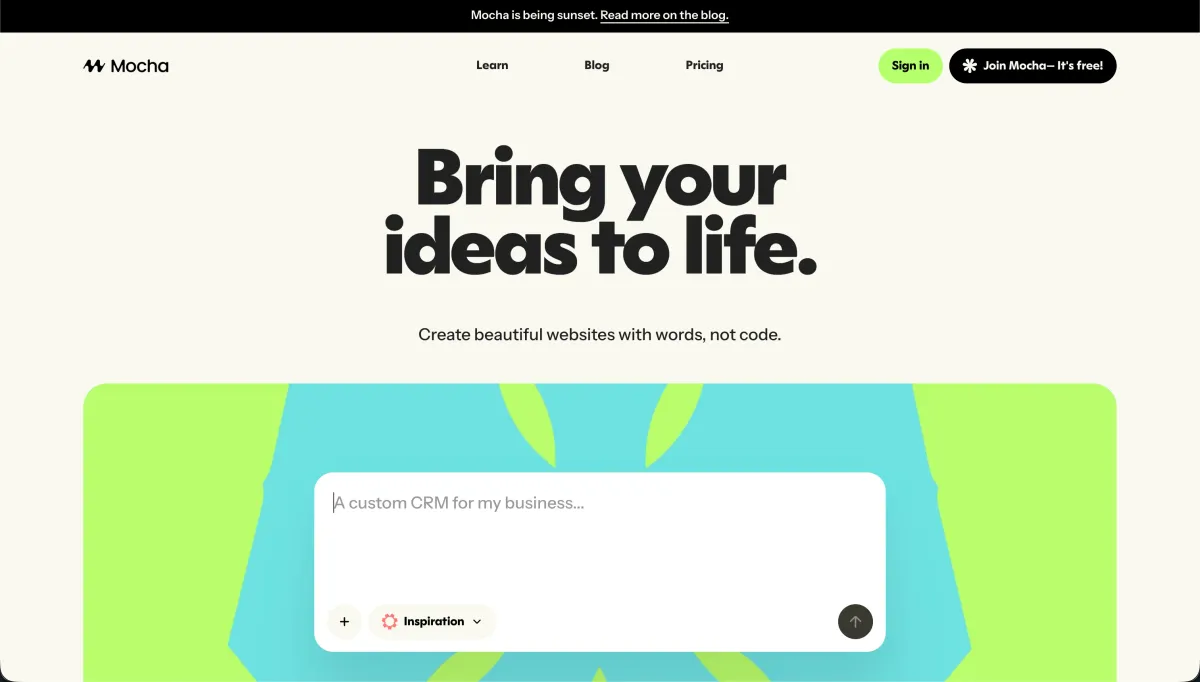
Mocha vs Zite, on screen

getmocha.com
Mocha homepage
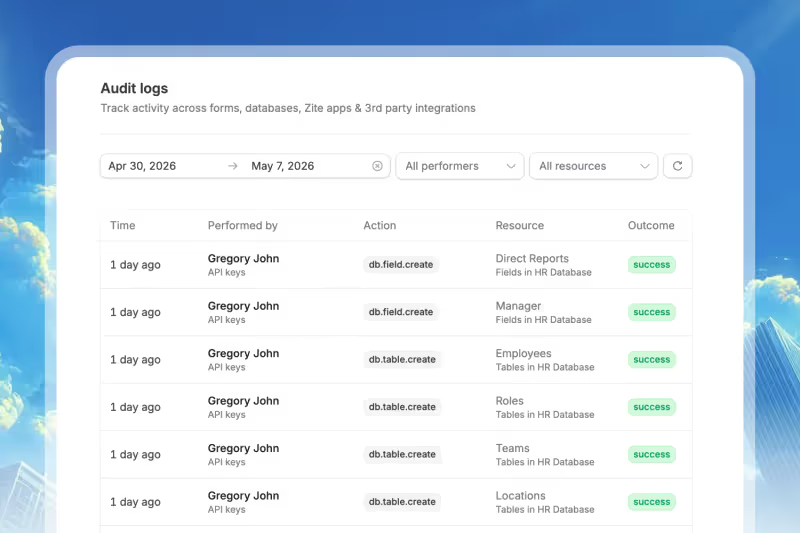
zite.com
Zite homepage

The fairest way to compare Mocha and Zite is on a typical business-shaped task: a small business CRM where logged-in team members or clients view and edit their own isolated records. This is a task of pure infrastructure: secure authentication, user groups, and robust database logic. The primary challenge is not making a polished landing page, but ensuring that delicate backend rules never leak one user's client details to another.

Mocha approach relies on an AI-first chat builder compiling a codebase from prompts, accompanied by a built-in SQLite backend. Zite operates under a different architecture, using conversational prompt-to-app generation that maps to a spreadsheet-like SQL backend constrained by fixed structural layout blocks. This difference in design philosophy shapes the entire maintenance and deployment lifecycle of the app.


The audience

Who each one is for

Mocha

  • Solopreneurs and creators who want to generate simple web utilities and database-backed SaaS MVPs.
  • Makers who want to prompt an application and immediately download raw source code.
  • Prototypers who need an instant, disposable environment for basic directory concepts.
  • Builders who are actively looking to migrate to open-source alternatives before August 2026.

Zite

  • Business operators who want to build internal database tools and client portals quickly.
  • Teams who want to support unlimited logged-in users without seat-based subscription pricing.
  • Solopreneurs comfortable defining operational workflows through structured AI instructions.
  • Organizations that value robust, pre-built validation logic inspired by mature form engines.

Mocha was designed to serve makers who wanted to generate codebases to export, whereas Zite targets business operators searching for an all-in-one spreadsheet-style interface.

The scope

What you'd build with it

Mocha

  • Basic directories and standalone calculators that do not require complex, multi-role permission logic.
  • Disposable SaaS mockups meant for pitch-decks rather than production-grade operations.
  • Lightweight web utilities connected to an integrated, lightweight SQLite database.
  • Production operational apps with secure data routing: definitely avoid, as the platform is sunsetting.

Zite

  • Internal company dashboards, project trackers, and business portals mapped to standard layouts.
  • External data collection forms featuring multi-language translation and custom input validations.
  • Multi-step approval pipelines triggered by client form submissions or record updates.
  • Highly custom consumer interfaces that require complex, bespoke CSS and layout freeform building.

Who owns the context window

Mocha builds applications as custom, compiled React codebases wrapped around a SQLite backend. Because it operates at the code level, any advanced access control, role filtering, or secure page routing must be fully generated as code inside Mocha. When your database schema grows, the conversational AI must maintain reference to the entire application's file layout, meaning complex relational updates routinely risk hitting context window limits and introducing breaking compilation bugs.

Zite structures the application architecture by keeping the code abstracted. The frontend layout is composed of standardized, rigid templates that are populated dynamically from its spreadsheet-like SQL database. Rather than asking an AI to write custom authentication or database queries, you prompt the AI inside Zite to map data relationships and trigger pre-configured workflows. While this limits creative layout freedom, it safeguards against the compilation errors and context-drift regressions common to pure raw code-generation systems.

Strengths

Where each one is strong

Edge: Zite

Zite dominates this category because of its stable SQL backend, mature form heritage, and the fact that it is a live, ongoing platform.

Mocha

  • Turnkey pre-configured environment featuring automated SQLite setup and Google Sign-in working out of the box.
  • Full codebase export allowing builders to download React and backend source files.
  • Automated compile bug resolution engine designed to handle runtime initialization crashes.
  • One-click direct publishing to live, fast subdomain environments.

Zite

  • Form builder DNA inherited from Fillout, yielding robust field validations, multi-language support, and clean signatures.
  • All-in-one database environment featuring bulk spreadsheet editing, history undo/redo, and direct REST API endpoints.
  • Plan Mode guardrails that show a markdown summary of proposed modifications before executing prompts.
  • Generous unlimited user plans, making it highly cost-effective for large-scale client registries.

Failure modes

Where each one breaks

Edge: Zite

Zite features rigid layout systems, but Mocha is facing an active shutdown, making it entirely untenable for real-world operations.

Mocha

  • Sunsung announcement: The platform will shut down completely on August 1, 2026, forcing all current users to migrate.
  • Wasted credits on regression loops where the agent repeatedly re-runs failing compilation scripts.
  • Basic user management that relies on prompts rather than visual role interface controls.
  • Customization limitations that require manual developer editing to adjust styling past basic outputs.

Zite

  • Severe workflow consumption traps which count basic page loads and reads as workflow executions.
  • Rigid UI boundaries that restrict visual adjustments strictly to generated template blocks.
  • Complex workspace bloat where prompts generate dozens of scattered, hard-to-track workflows.
  • Database features that currently lack advanced calculations, complex roll-ups, and custom SQL views.

Iteration cost

The fix loop, priced

Even

Both systems require careful monitoring of credit pools, though Zite's credit scaling structure is more robust.

Mocha

  • Bronze tier starts at $20/month billed monthly, offering a baseline of 1,500 credits.
  • Debugging compilation cycles consistently consume hundreds of credits trying to resolve repetitive errors.
  • Worse-case scenarios can cause complete quota exhaustion during a single complex database setup.
  • Unused credits on paid plans do not support infinite rolling accumulation blocks.

Zite

  • Pro tier matches $19/month billed monthly, but only provides a starter pack of 100 credits.
  • Both chat and plan modes deduct from the same pool, making preparation loops expensive.
  • Worst-case workflows run out quickly because active users loading pages quickly exhaust limits.
  • Pro plan scales all the way up to 19,200 credits for $3,769/month.

Re-prompting an AI to get visual spacing or database triggers correct comes with predictable financial trade-offs, making the fix loop tax an essential consideration.

Exit paths

The code you end up with

Edge: Mocha

Mocha was designed with code export in mind, whereas Zite locks your app structure inside its cloud environment.

Mocha

  • Complete React frontend and backend source code export, eliminating developer lock-in.
  • Clean folder structures separating SQLite configurations from individual view segments.
  • A standard node server setup that can be run locally or moved to a self-hosted cloud provider.
  • Manual script edits are required to decouple compiled modules once exported.

Zite

  • No direct raw code export or GitHub sync path is supported.
  • The application can only run on Zite's integrated hosting infrastructure.
  • Data must be moved via API or CSV exports if you choose to migrate.
  • Proprietary visual layout configurations that cannot be rebuilt outside of Zite.

When neither wins

If you are trying to build and maintain a client portal or internal app with logins and per-user data, both of these tools introduce severe operational risks. Mocha is shutting down in August 2026, meaning any business-critical logic you build there must be migrated immediately. Zite avoids the code-dependency trap but binds you to rigid templates, counts simple database reads as workflow executions, and locks you into their hosting with no export path. For a non-technical builder, maintaining database validation and authentication rules through conversational prompts is a payday loan of technical debt.

For this specific job, Softr treats user logins, granular user groups, and row-level record security as native platform infrastructure. You configure who sees what visually without writing or generating code, bypassing the prompt-and-fix iteration loop. Softr connects directly to Softr Databases, Google Sheets, or Airtable, keeping your data accessible. It is the wrong choice if you need a bespoke consumer mobile application or raw codebase ownership, but it is the reliable choice for running secure business operations.

Verdict

Zite is the clear choice between these two platforms, solely because Mocha is actively shutting down on August 1, 2026. Building on a sunsetting codebase represents an immediate operational risk for any business. Zite's Fillout form lineage provides robust validation, spreadsheet-style data management, and useful plan-mode summaries, making it functional and fast for standard, template-shaped software.

Mocha is only relevant if you want to quickly scaffold a basic React/SQLite demo, export the full codebase immediately, and continue development in an external IDE like Cursor. If you plan to rely on in-browser hosting and ongoing visual updates, do not start a new project on Mocha.

However, if your goal is to build a reliable client portal, CRM, or internal business directory without writing code, neither tool is the optimal choice. Transitioning to a platform like Softr ensures that your user authentication, granular access controls, and database schemas are built on proven, secure non-code configurations rather than AI guesses or rigid layout boundaries.

Q & A

Frequently Asked Questions

Why is Mocha shutting down?

The team behind Mocha announced they are sunsetting the product on August 1, 2026, due to high user acquisition costs, expensive AI token economics, and capital-intensive support requirements.

Can I export my code from Mocha and Zite?

Mocha allows you to download your complete React and backend database source code. Zite has no raw code export or GitHub sync, meaning you are locked into their platform.

What are the pricing traps to watch out for on Zite?

Zite counts every single database read and page reload as a workflow execution, which can exhaust limits quickly. Additionally, custom login screens and scheduled workflows are gated behind the Business plan.

What is the best alternative for building a secure client portal?

Softr is the recommended alternative because it moves user authentication, user groups, and database security away from fragile generated code and into stable visual settings.