Compare Tools

Bolt vs Mocha: which one survives a real business-critical application?

June 16, 2026

Verdict

Bolt wins if you are a developer looking for standard React repository scaffolding; Mocha is better suited for a non-developer wanting guided visual builds, though its upcoming shutdown on August 1, 2026, forces a hard migration.

Bolt logo

Bolt

In-browser AI dev environment that scaffolds and runs full-stack apps.

Mocha logo

Mocha

Chat-to-app builder, shutting down August 1, 2026 - migrate now

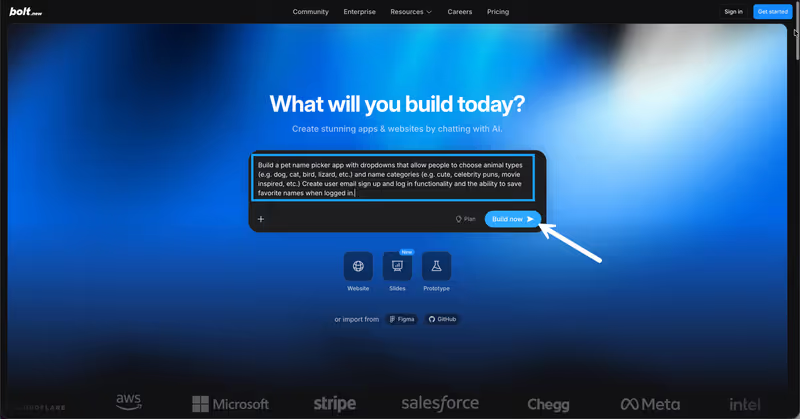
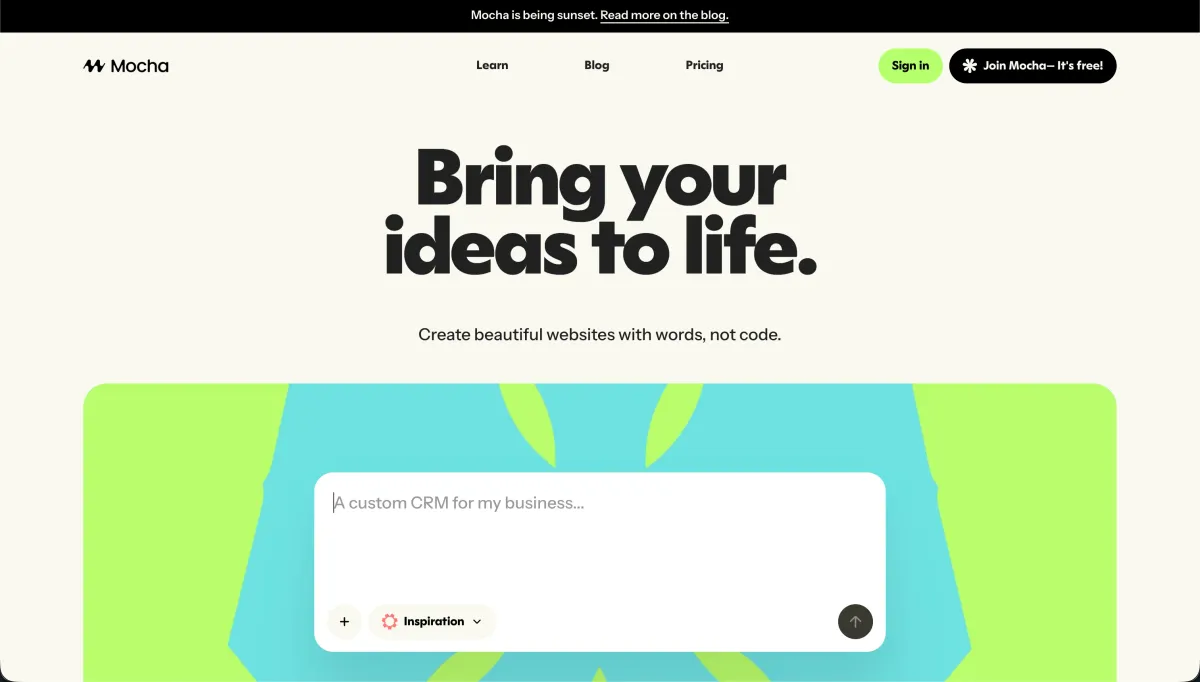
Bolt vs Mocha, on screen

bolt.new
Bolt homepage
getmocha.com
Mocha homepage

The fairest way to compare Bolt and Mocha is to judge them on a single concrete job: scaffolding and deploying a business-shaped application with structured tables and user logins. One of these tools treats this as software engineering scaffolding where you eventually run commands inside a terminal. The other views it as an automated, guided walk through UI blocks, databases, and instant hosting designed to shield the user from raw configuration.

This application is a real test of code stability. Business tools rely heavily on robust data relationships, user access controls, and logical updates. Evaluating these builders solely on their landing page generation misses the point; the moment a user signs up or edits pre-existing database records, the underlying code architecture and the risk of automated regression loops become the only things that matter.


The audience

Who each one is for

Bolt

  • Developers who want rapid boilerplate styling but require absolute control of the terminal
  • Technical founders wanting custom node packages and direct npm dependency management
  • Builders shifting code immediately into an IDE like VS Code or Cursor
  • Teams needing a real Git-based version history from the first prompt

Mocha

  • Non-technical operators who prioritize conversational guidelines over command-line configuration
  • Makers looking for integrated SQLite setups running out of the box
  • Founders iterating on early directory pages and visual mockups without a setup guide
  • Teams looking to migrate immediately, as the tool is shutting down August 1, 2026

Bolt assumes you read what it writes and understand Node environments; Mocha targets the builder who wants to pretend the code doesn't exist under the hood.

The scope

What you'd build with it

Bolt

  • React and Vite web applications utilizing standard npm utilities cleanly
  • SaaS Minimum Viable Products relying on custom state management or styling libraries
  • Complex database schemas where you configure your own production database engine
  • Web apps only: Bolt cannot package builds for the Apple App Store natively

Mocha

  • Directory platforms and informational trackers mapped to simple SQLite databases
  • Internal utilities such as basic calculators or localized staff forms
  • Simple data curation interfaces built onto standard OAuth social login flows
  • Prototypes with a limited lifespan, given Mocha's planned sunset in late 2026

Who owns the context window

In Bolt, the browser runs StackBlitz WebContainers, providing a full Node.js environment client-side. The code generated is Yours from the start; the tool compiles React, parses Vite configurations, and launches localized servers right in your tab. Because it is a real file tree, you can run diagnostic tools and import any node module. However, when codebases grow, they threaten to hit memory thresholds or out-of-memory container crashes, leaving the burden of structuring folders and optimizing performance on the builder.

Mocha handles background architecture on their managed servers, abstracting the terminal into a conversational stream. When adding a column or modifying a relational linkage, Mocha automatically handles the SQL migrations, code generation, and deployment of backend endpoints without developer feedback. But this handrail is limiting: the user cannot easily reach down to fix a broken migration manually. The builder must rely on the AI's internal feedback loops to resolve compiler faults, causing extreme prompting loops when the model's model of the code drifts from the actual state.

Strengths

Where each one is strong

Edge: Bolt

Bolt provides a real, untouched repository environment, making it structurally superior for handling custom complexity.

Bolt

  • True browser-native Node.js execution via StackBlitz WebContainers, enabling live terminal commands
  • Clean, standard GitHub synchronization options that avoid any proprietary runtime layers
  • No backend lock-in, offering complete freedom to select your database and deployment pipelines
  • Generous starter tier allowing 10 million tokens for Pro users to experiment

Mocha

  • Integrated zero-config database utility pre-packed with lightweight SQLite models
  • Structured wizard setups executing database migrations and authentication steps conversational style
  • Automated compile testing that catches visual deployment errors before publishing a build
  • Simple app exporting option to save underlying React code for manual hosting plans

Failure modes

Where each one breaks

Edge: Mocha

Mocha handles the compilation abstractedly, saving the non-developer from memory limit crashes, though its lifetime is limited.

Bolt

  • OutOfMemory errors on massive files, causing browser containers to shut down unexpectedly
  • Token depletion during recursive diff-engine loops that overwrite correct files with duplicate modifications
  • Opaque 'Project too large' errors that lock the prompt box while millions of unused tokens remain
  • The complete absence of a database control GUI, requiring hand-prompted PostgreSQL scripts

Mocha

  • Critical server-sunset reality: the platform officially ceases operations on August 1, 2026
  • Credit-draining regression loops where the AI repeatedly attempts to fix simple compiler errors in circles
  • Inability to manually edit compiled files directly, forcing dependence on chat edits
  • Slow customer responses on community-managed Discord channels and support email systems

Iteration cost

The fix loop, priced

Even

Both systems require you to spend credits for their mistakes, making the iteration cycle costly.

Bolt

  • Pro plan begins at $25/month containing a baseline allocation of 10 million tokens
  • Editing loops frequently burn millions of tokens refactoring files over minor styling edits
  • Worst-case scenarios see users locking their accounts out of memory due to 'Project too large' thresholds
  • Tokens roll over for up to two months, provided the base subscription remains active

Mocha

  • Bronze subscription starts at $20/month offering a quota of 1,500 credits
  • Complex features consume hundreds of credits as the AI runs automatic compile-diagnostics continuously
  • Worst-case loops consume visual credits during loops only to leave pages in unrendered states
  • Additional credits can be bought inside the panel, but base limits reset monthly

Relying purely on conversational prompting means paying an iteration tax every time you change a label. For reliable development, evaluate the reality of the fix loop economy closely.

Exit paths

The code you end up with

Edge: Bolt

Bolt's exit path is cleaner, generating a standard React template free of proprietary orchestrators.

Bolt

  • A highly portable Vite project synced straight to your GitHub workspace
  • Clean folder layouts using modern state management scripts standard developers can read
  • No complex proprietary API wrapper layers built strictly into custom platform hosts
  • You own 100% of the repository, enabling deployment to platforms like Netlify or Vercel

Mocha

  • Standard React frontends paired with SQLite database connection scripts
  • Codebases that require manual refactoring to compile smoothly in standard IDEs
  • Database linkages that are difficult to detach cleanly from Mocha or Anything
  • Zero long-term support guarantees following the system shutdown in August 2026

When neither wins

If the business tool you are constructing is a database-backed portal, internal directory, or client hub, both of these tools introduce severe structural complexity. Bolt forces you to manage database instances and secure environments yourself. Mocha attempts to guide you but forces credit-expending prompt loops for basic interface tweaks, and the day two problem will still hit you once real user data arrives.

For operational software, Softr bypasses the hazard of generated architecture by using pre-built blocks on top of native databases and permissions. You don't prompt an AI to align forms, build authentication flows, or secure user visibility groups; you configure them visually. This saves you from structural errors and removes the fix loop entirely, though it is not matching the workspace needs of native consumer tools or custom React exports.

Verdict

Bolt wins this face-off for technical builders. By providing a client-side Node.js workspace, it offers a real repository that developers can audit, control, and export without worrying about proprietary environments. If you can handle standard code libraries, it is the best scaffolding tool of the pair.

Mocha behaves more like a guide for non-developers, packaging lightweight SQL databases and user permissions easily. However, this ease is eclipsed by their official shutdown announcement on August 1, 2026, meaning any tool built here must be migrated before late 2026.

For non-developers building business applications, look past both. Building an operational tool like a portal or CRM on top of raw custom-generated repositories is an invitation to technical debt. Choose Softr to preserve your sanity and construct secure platforms without code dependencies.

Q & A

Frequently Asked Questions

Is Bolt better than Mocha for business databases?

Bolt is vastly superior if you have the technical knowledge to configure database hosting like Supabase yourself. Mocha offers an easier conversational SQLite config but is shutting down entirely on August 1, 2026.

Can I export my code from Bolt and Mocha?

Both platforms allow code exporting. Bolt outputs standard React and Vite directories cleanly synced to GitHub, whereas exporting from Mocha is largely an exit route to help users vacate before the platform closes down in 2026.

Which tool has the more cost-effective iteration loop?

Neither is cost-effective for heavy iterations. Bolt burns extensive tokens during file-rewriting loops, while Mocha users report consuming hundreds of credits trying to debug automated deployment issues.

What should non-technical teams use for operational software?

They should use Softr. Rather than prompting AI agents to write custom React, Softr connects portal and internal-tool layouts straight to built-in databases visually with zero code or debugging loops.