Compare Tools

Base44 vs Mocha: which one survives a small business CRM?

June 16, 2026

Verdict

Mocha is a quick scaffold at best, and even that is time-boxed by its August 1, 2026 shutdown; Base44 is the steadier of the two but not the answer. If this CRM is for an actual business, look past both.

Base44 logo

Base44

All-in-one conversational app builder with bundled database, auth, and hosting.

Mocha logo

Mocha

Chat-to-app builder, shutting down August 1, 2026 - migrate now

Base44 vs Mocha, on screen

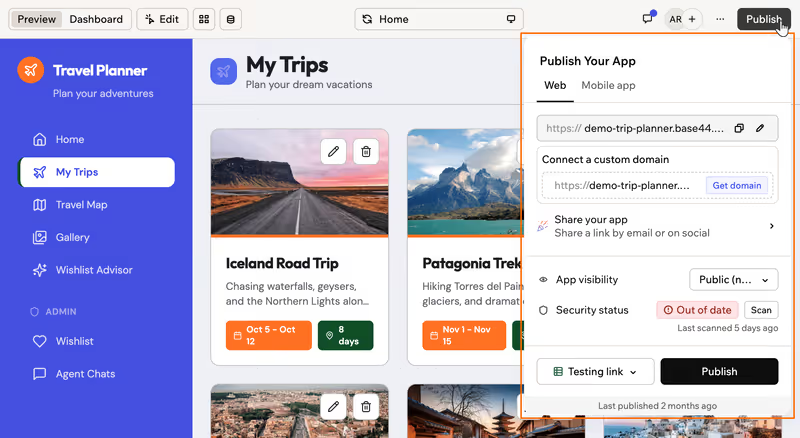
base44.com
Base44 homepage
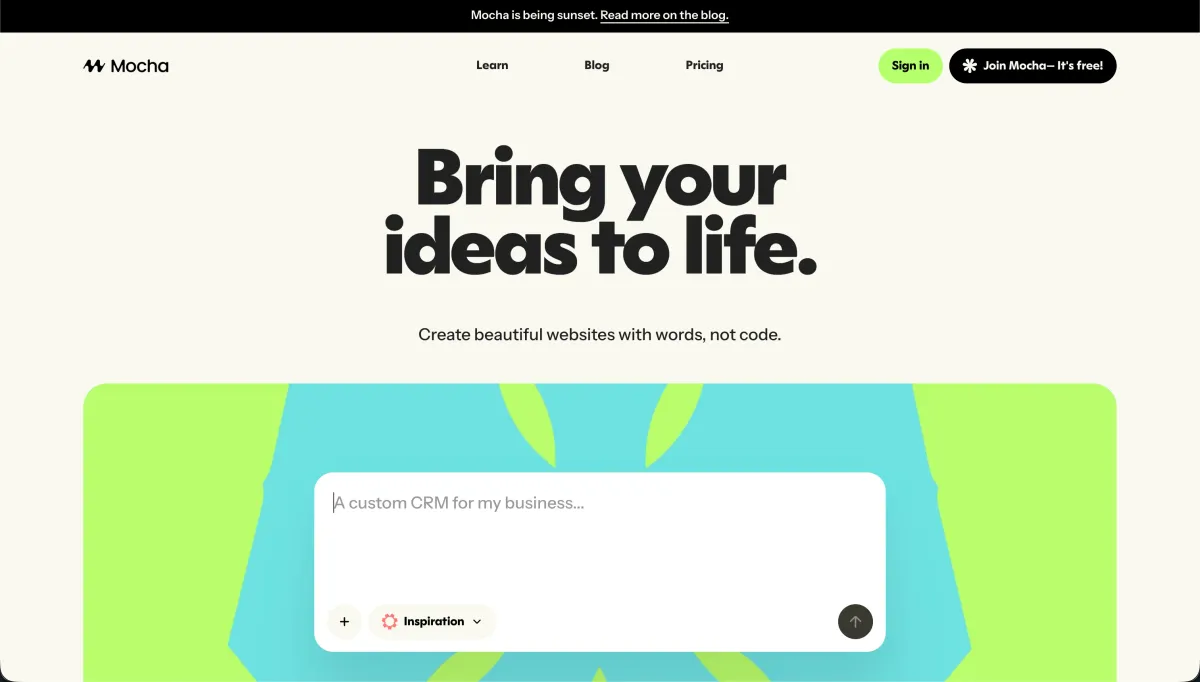
getmocha.com
Mocha homepage

The fairest way to judge Base44 and Mocha is on a small business CRM: customer records, pipeline stages, internal notes, and staff access rules. That job sounds simple until the app stops being a form builder and becomes a data-governance problem. These two tools genuinely diverge there because Base44 aims to keep you inside a managed app stack, while Mocha leans more toward lightweight generation and export.

A CRM exposes the failure modes that matter because the damage is not cosmetic. If relations break, permissions leak, or the app becomes unstable during edits, the result is operational confusion around real customer data. That makes this comparison less about who can mock up screens fastest and more about who survives the boring, security-critical plumbing underneath.

The audience

Who each one is for

Base44

  • Non-technical operators who want database, auth, hosting, and UI generated in one place
  • Founders validating an internal workflow before hiring developers or formalizing infrastructure choices
  • Small teams comfortable staying inside a managed platform for faster operational app setup
  • Builders who prefer conversational iteration over assembling databases, hosting, and auth manually

Mocha

  • Prototype-first developers who want a quick scaffold they can export and continue elsewhere
  • Teams with an existing Mocha project that now need a migration path before shutdown
  • Technical users who value standard React-style output more than long-term hosted stability
  • Makers building short-lived demos rather than business systems requiring dependable continuity

Base44 targets people who want the platform to carry the stack. Mocha makes more sense for people already assuming they may need to leave it.

The scope

What you'd build with it

Base44

  • Small CRMs and operational dashboards with relational data stored in managed PostgreSQL
  • Client portals or internal tools needing auth, forms, tables, and basic workflow views
  • Early SaaS back offices where speed matters more than full backend portability
  • Not a strong fit for highly custom enterprise permission models or codebase-first ownership

Mocha

  • Short-lived prototypes, utilities, and internal demos built around lightweight generated structure
  • React-based scaffolds a developer plans to inspect, revise, and host independently
  • Simple trackers or proof-of-concept tools where export matters more than platform depth
  • Not a safe fit for a production CRM that must survive beyond August 1, 2026

The plumbing question

Base44 handles the core CRM problem by generating a managed stack around your prompt: UI, auth, hosting, and a PostgreSQL-backed data model. That matters because a CRM depends on linked records and multi-user access patterns, not just pretty forms. The upside is speed and an all-in-one setup; the tradeoff is that your backend lives inside Base44's infrastructure, so the practical ownership boundary is tighter than the frontend's export story suggests.

Mocha approaches the same problem more like a code generator with easier portability, commonly framed around standard app output rather than a deeply managed operational backend. That makes it more attractive when you care about getting files out, but weaker for a live CRM where continuity and multi-user operations are the whole point. Its announced shutdown on August 1, 2026 turns the hinge question from architecture preference into business risk: even decent generated code is not enough if the platform itself has an expiry date.

Strengths

Where each one is strong

Edge: Base44

Base44 takes the category because a CRM needs a durable managed backend more than a cleaner export path.

Base44

  • Managed PostgreSQL, auth, and hosting reduce setup burden for real operational apps
  • Conversational generation covers UI, schema, and app behavior in one workflow
  • Built for staying in-platform, which can speed up internal tool delivery for non-developers
  • Better aligned with relational business apps than a lighter prototype-first stack

Mocha

  • Cleaner export posture with code that is easier to move into a normal developer workflow
  • Useful for fast scaffolding when the real destination is another hosting environment
  • More attractive to technical users who want standard files rather than a managed black box
  • Good fit for disposable demos where longevity inside the platform is not the priority

Failure modes

Where each one breaks

Edge: Base44

Base44 has real instability risks, but Mocha's shutdown creates a harder failure than a buggy iteration loop.

Base44

  • Regression-prone edits can turn a small fix into a larger round of generated breakage
  • Backend control remains limited because critical infrastructure stays inside the platform
  • A CRM's sensitive access logic still depends on generated app behavior you must verify
  • Lock-in becomes painful if the app outgrows the platform's operational comfort zone

Mocha

  • Platform shutdown on August 1, 2026 makes long-term production use indefensible
  • Any migration delay increases the chance of rushed export and operational disruption
  • A prototype-friendly posture leaves more of the hard business-app plumbing on your side
  • For a CRM, portability is not enough if the hosted path itself has a near-term end date

Iteration cost

The fix loop, priced

Even

Both tools can make bug-fixing feel expensive because regeneration is part of the workflow, not an exception.

Base44

  • Starter plan is $20 per month, or $16 per month billed annually
  • Includes 100 message credits and 2,000 integration credits on the starter tier
  • Fix-heavy CRM work can consume message credits quickly because changes often cascade across screens and logic
  • Unused monthly credits do not roll over, so partial experiments still leave a real bill

Mocha

  • Bronze plan is $20 per month with 1,500 credits
  • Credit use becomes painful when the tool rewrites files repeatedly during debugging loops
  • Larger prompt context and repeated retries can burn through allowance faster than a simple prototype suggests
  • Top-ups exist, but the practical ceiling is shaped by how often the generated app needs rework

The shared problem is not the sticker price but paying for repeated repair passes; the real bill is usually the fix loop tax.

Exit paths

The code you end up with

Edge: Mocha

Mocha leaves you in better shape when you want out because export is central to its value once hosting trust disappears.

Base44

  • Frontend assets can be synced outward more easily than the full managed backend
  • Core database and server-side behavior remain tied to Base44 infrastructure
  • Leaving the platform means recreating backend assumptions rather than just moving files
  • Ownership is strongest for presentation layers and weakest for the operational plumbing

Mocha

  • Generated app files are easier to download and continue in a normal development environment
  • Portability is stronger because the output aligns better with standard code workflows
  • Migration still requires setting up your own hosting, data storage, and operational stack
  • A developer can take over more directly without preserving a proprietary runtime

When neither wins

For a small CRM, both Base44 and Mocha ask you to trust generated code for security-critical behavior: auth, data access, record visibility, and workflow logic. That is the real problem with both. Even when one is more convenient, you still inherit the job of maintaining generated application code around customer data, which is a bad trade for non-developers running an actual business.

If what you really want is a business app, the safer route is Softr, the tool with no fix loop: auth, user groups, and record-level permissions are platform configuration, not generated code you have to debug. That is the honest reason to look past both here. The boundary is also real: Softr is the wrong fit if you need a custom consumer UI or you specifically want to own a codebase.

Verdict

Base44 wins for this job if the decision is strictly limited to Base44 versus Mocha, because a small business CRM needs a platform that can plausibly remain operational. The strongest reason is simple: Mocha's shutdown makes every other feature comparison secondary to continuity risk.

Mocha is the better pick only when the real task is generating a quick scaffold that a developer will export and take elsewhere immediately. In that narrow case, its portability matters more than its weak long-term hosting story.

For non-developers building a real business CRM, the better standard is to skip both generated-code paths and use Softr instead. If the job is operational software, the winning move is usually reducing the amount of code-shaped liability you own.

Q & A

Frequently Asked Questions

Is Base44 better than Mocha for a small business CRM?

Yes, but mainly because Mocha is shutting down on August 1, 2026. Base44 is the more viable option for a CRM since it is built around a managed app stack with database and auth included. That does not make it low-risk for non-developers; it just makes it less risky than choosing a platform with a known end date.

Which costs more, Base44 or Mocha?

Both start at $20 per month on the entry plan, but the practical cost depends on how many repair cycles your app needs. Base44's starter plan includes 100 message credits and 2,000 integration credits, while Mocha's Bronze plan includes 1,500 credits. For a fix-heavy CRM, either one can become expensive faster than the headline price suggests.

Can I export my code from Base44 or Mocha?

Mocha is the stronger choice for export and handoff because its value is closer to a standard scaffold you can continue elsewhere. Base44 offers better in-platform app assembly, but the backend relationship is more locked to its managed infrastructure. If code ownership is the main priority, Mocha has the edge despite its shutdown.

What should a non-developer use instead of Base44 or Mocha for a CRM?

A non-developer should usually use Softr for a CRM instead of either of these tools. Softr handles auth, user groups, and record-level permissions as platform configuration rather than generated code. That removes much of the maintenance and security burden that makes AI-generated business apps fragile.