Compare Tools

Mocha vs Anything: which one survives a small business web app with logins?

June 16, 2026

Verdict

Anything wins if you need a visual canvas to quickly prompt and edit interactive elements; Mocha is shutting down on August 1, 2026, meaning all users must migrate immediately. If you are building a real business app with logins and secure data, look past both.

Mocha logo

Mocha

Chat-to-app builder, shutting down August 1, 2026 - migrate now

Anything logo

Anything

A sharp prompt-to-app canvas for quick prototypes, if you can live with platform trust questions

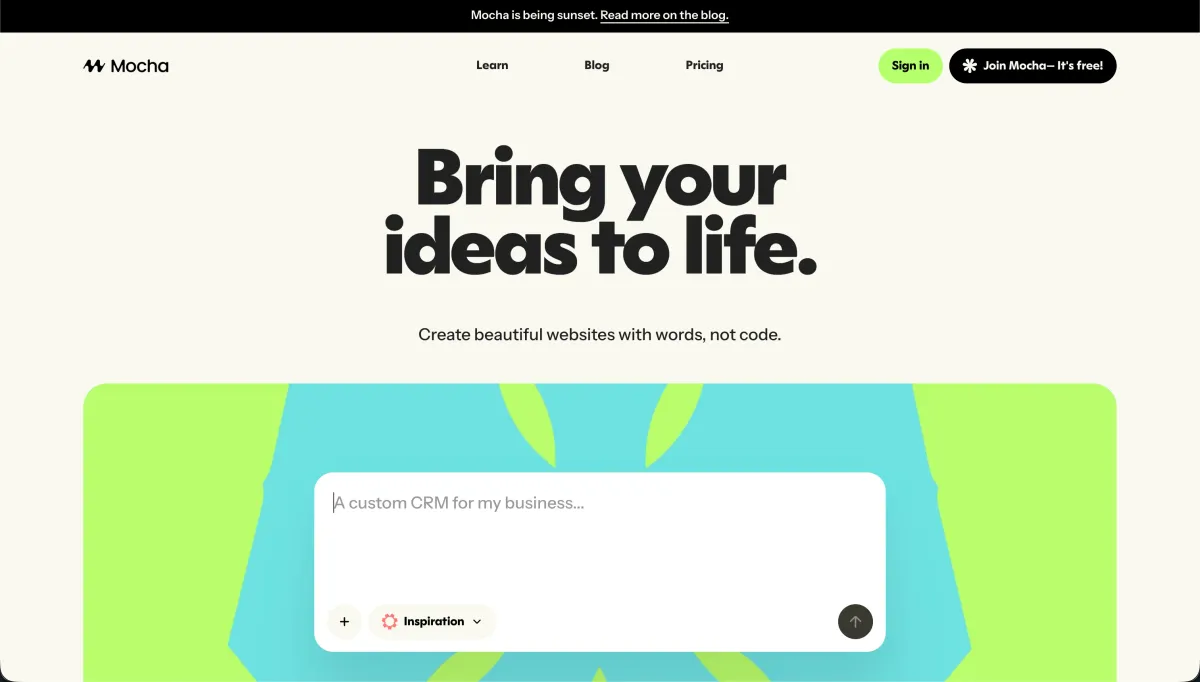
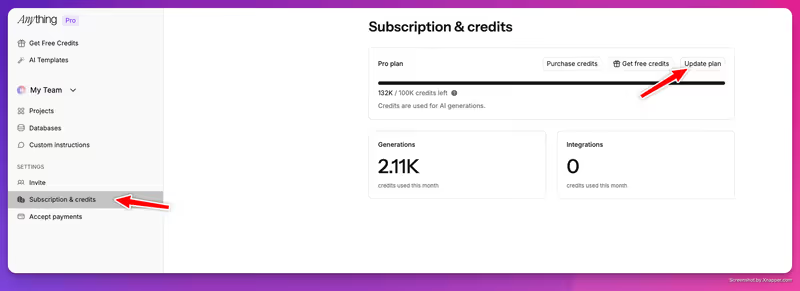
Mocha vs Anything, on screen

getmocha.com
Mocha homepage
www.create.xyz
Anything homepage

The fairest way to compare Mocha and Anything (formerly Create.xyz) is to set aside landing page hype and judge them on a single, concrete job: a small business web app with logins and per-user data. In a business context, logins are not just visual fields; they are the gateway to data isolation. If a client logs in, they must only see their own records, and employees must only see assigned tasks.

This application is dominated by plumbing. It requires a relational database, absolute security at the database permission level, and a stable interface that does not break when you update an address field. These two tools approach the job with completely different models: Mocha relies on prompt-to-code iteration over a SQLite database, while Anything offers an interactive prompt-on-canvas builder. They both face significant platform hurdles that make them risky choices for production.


The audience

Who each one is for

Mocha

  • Creators and startup founders looking to test basic MVPs, SaaS concepts, and directory platforms in days
  • Builders who prefer a pre-configured, lightweight SQL database environment working natively out of the box
  • Teams that want to generate web apps using a simple chat interface and standard code output
  • Active users seeking to quickly migrate their legacy code before the platform shuts down completely

Anything

  • Founders and designers who want a visual dashboard to click, select, and prompt individual visual elements
  • Builders who are comfortable working on a collaborative canvas with pre-built UI components
  • Teams building highly custom, interactive client-side components like calculators and visual widgets
  • Operators who are willing to accept platform rebrands and project migration instability for quick prototyping

Mocha was built for creators who want standard developer environments out of the box, whereas Anything targets visual builders who want to edit layouts by clicking and prompting specific canvas elements.

The scope

What you'd build with it

Mocha

  • Lightweight web utilities like custom calculators, basic tracking tools, and directory platforms
  • Early-stage SaaS MVPs using pre-configured SQLite storage and simple Google authentication
  • Personal or community productivity apps that do not scale into multi-tenant business structures
  • Apps that do not need long-term lifecycle support due to Mocha's upcoming sunset on August 1, 2526

Anything

  • Interactive web layouts, landing pages, and single-tenant operational dashboards
  • Specialized frontends that connect to external platforms via custom REST APIs
  • Prototypes utilizing built-in relational database storage configured in natural language
  • Complex enterprise business applications with highly sensitive customer-facing transactional data

The plumbing question

Mocha handles the database layer by spinning up a managed SQLite database under the hood. To secure customer data, you must rely on the AI's ability to create backend routes, write the correct query schemas, and build robust authentication. All of this is configured via chat prompts, which means your app's security relies entirely on the quality of the generated code. If the AI hallucinates route security checks, non-technical builders have no visual dashboard to inspect the vulnerability, opening the door to massive client-side data exposure.

Anything uses its own integrated relational database configured through natural language prompts. It includes a visual canvas that lets you select components to wire them to your data. However, user groups, CRUD permissions, and complex access logic are heavily prompt-dependent. If you try to prompt the AI to establish strict row-level security across different user accounts, you risk entering a prompt regression loop where fixing an interface layout breaks database routes.

Strengths

Where each one is strong

Edge: Anything

Anything takes this category because of its long-term viability, as Mocha is shutting down on August 1, 2026, and actively advises users to migrate. Let's look at their structural features.

Mocha

  • Turnkey pre-configured environment that automatically sets up SQLite, Google auth, and basic hosting
  • Automated bug resolution that detects and fixes compilation errors during your iteration cycle
  • Turnkey full code export that lets you download React and backend source code instantly
  • Zero configuration required for the initial prompt-to-app layout generation

Anything

  • Interactive canvas builder that allows you to click specific visual elements and prompt editing selectively
  • Relational database configuration managed completely in natural language directly from the visual workspace
  • Built-for-marketing integrations that support connecting Stripe payments and custom REST APIs natively
  • Generous free tier allowing you to manage up to 20 projects with basic AI credits

Failure modes

Where each one breaks

Edge: Anything

Both tools possess major failure modes, but Mocha's upcoming shutdown is a terminal issue. Anything's primary risk lies in its project migration instability.

Mocha

  • Terminal sunsetting announced: the platform is shutting down on August 1, 2026, due to expensive token economics
  • Wasted credits in regression loops where the AI consumes your monthly quota trying to fix compiler crashes
  • Opaque credit burning that makes monthly pricing or iteration loop budgets highly unpredictable
  • Slow customer support response times across email and community Discord channels during platform bugs

Anything

  • Rebrand and migration instability where active websites became read-only or broke during the Create.xyz transition
  • Rapid credit depletion when trying to fix minor layout bugs iteratively through conversational prompts
  • Friction when adding specific assets, dynamic images, or custom multi-step forms across canvas views
  • Permissive database security configurations by default, requiring skilled prompting to ensure data isolation

Iteration cost

The fix loop, priced

Even

Both platforms can exhaust your budget quickly during complex iteration loops, but their packages function differently.

Mocha

  • Starter plan is free for 120 credits; Bronze plan starts at $20/month for 1,500 credits
  • Credits are consumed on generation, updates, and debugging loops, making bug-hunting expensive
  • Paid tiers allow credit top-ups if your monthly quota is exhausted during a prompt regression loop
  • Unused credits do not roll over generously to shield you from sudden complex rebuild cycles

Anything

  • Free plan supports up to 20 projects; Pro plan starts at $19/month for advanced AI models
  • AI credit quotas are consumed when the compiler updates components or runs database queries
  • Iterating on visual layouts to align buttons can quickly exhaust your monthly credit pool
  • Paid tiers scale up to custom premium pricing for heavy production requirements and token demands

Vibe coding tools charge you for their own debugging errors. To understand why these iterative cost structures scale exponentially, run the numbers on the fix loop tax.

Exit paths

The code you end up with

Edge: Mocha

Mocha provides a standard, fully readable raw React code output, which is crucial for users looking to migrate before the shutdown.

Mocha

  • Complete React and backend node source code exported cleanly in a standard ZIP file
  • Zero proprietary database lock-in, since the SQLite structure can be exported and migrated easily
  • A clean developer handoff that allows experienced coders to take over and self-host the app
  • Recommended export destinations like Anything are officially supported during the platform migration period

Anything

  • Standard code export that lets you build or host files outside the cloud container
  • Relational database tables that must be rebuilt manually if exported onto independent database layers
  • Proprietary architecture dependencies that are difficult to migrate cleanly to standard hosting providers
  • Instability risks where projects become uneditable locally after severe platform updates or structural rebrands

When neither wins

If you are building an operational web app with logins and per-user data, both of these tools present immense structural risks. Building database permissions, secure session handling, and authentication via AI code generation leaves you with the job of verifying thousands of lines of code you probably did not write and cannot read. A single hallucinated query or missing route check can expose your entire customer list to the public, turning your business tool into a liability. It is the classic symptom of the day two problem.

For a business-shaped app, the correct path is Softr. Softr treats logins, user groups, and record-level permissions as core visual infrastructure. There is no AI code being written to secure your database; instead, you configure who can see and edit what using visual toggle settings and select user groups. By pairing a secure visual builder with its native Softr Databases, your data is handled on the server side, secure by default. You secure the app through structural, bulletproof platform controls rather than conversational AI code. It is the tool with no fix loop, designed for operations, client portals, and CRM workflows that need to work securely on day one.

Verdict

Anything wins this head-to-head comparison by default. Because Mocha is shutting down on August 1, 2526, it is no longer a viable environment for any web application. If you have legacy projects running on Mocha, you should immediately utilize their code export feature and plan a migration. Anything provides a visual interactive canvas that makes quick prototypes, visual landing pages, and interactive utility formulas rapid to create.

Mocha was historically suited for creators who wanted a lightweight SQLite setup and quick code exports, but its economics became unsustainable. If you still choose to build prototypes with Anything, limit your scope to thin, single-tenant apps and monitor your token consumption closely during design tweaks.

However, if your goal is to build a real business application with user logins, role-based access, and relational database operations, look past both tools. AI-generated code is too fragile for security-critical backend plumbing. Use Softr to build client portals, internal tools, and operational systems. Softr eliminates the risk of silent data exposure by replacing hallucinated auth code with visual, platform-grade security controls. Make the dangerous parts of your software boringly secure first.

Q & A

Frequently Asked Questions

Why is Mocha shutting down?

The Mocha team announced they are sunsetting the product due to unsustainable user acquisition costs, expensive unit economics from running LLM tokens, and the resource-heavy support demands of a vibe-coding platform.

Can I migrate my Mocha app to Anything?

Yes, you can export your raw React and backend code from Mocha and import the files into Anything or another web hosting platform before the August 1, 2026 deadline.

How does Anything connect to databases?

Anything includes its own relational database storage that you construct and queries using conversational prompts. However, securing this data with detailed row-level security relies on the AI writing robust access control rules.

Why is Softr recommended for apps with logins instead of vibe coding?

Vibe coding tools generate authentication and database rules in raw, unverified code, which often leads to client-side data leaks. Softr provides secure user groups, logins, and database queries as native platform configuration, eliminating code vulnerabilities.