Compare Tools

Emergent vs VibeCode: which one survives a real small business app with logins?

June 16, 2026

Verdict

VibeCode wins if you are shipping a native mobile app with predictable AI costs; Emergent wins if you need faster web-app scaffolding and can tolerate messier iteration. For non-technical business builders, the better answer is past both tools.

Emergent logo

Emergent

Fastest way to prompt out a full-stack app, if you can keep the agent from burning credits

VibeCode logo

VibeCode

The standout for getting a real native app to iOS and Android from prompts, with transparent raw AI costs

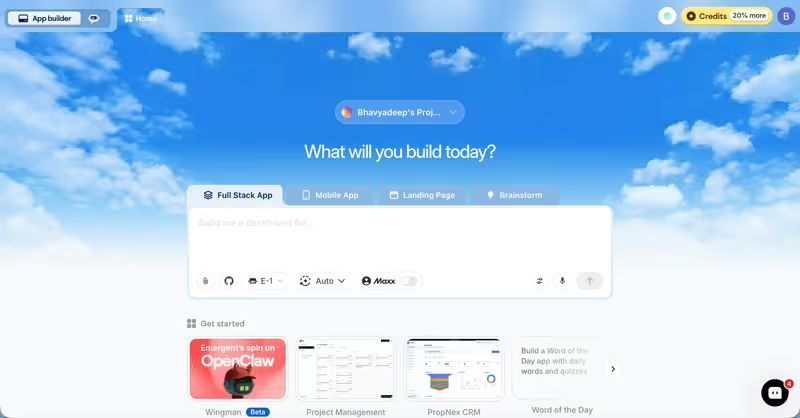
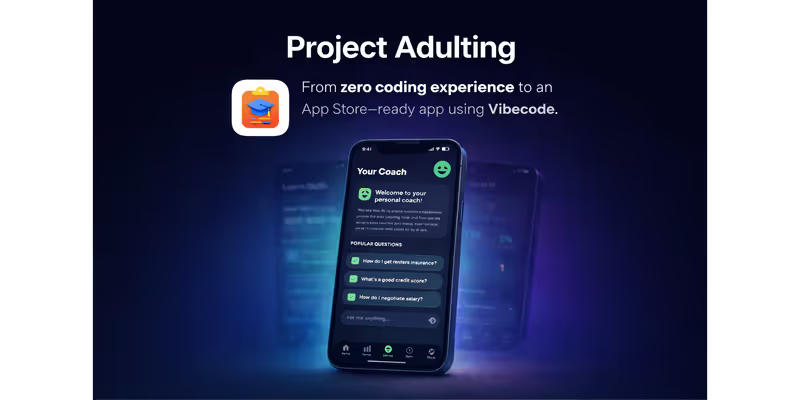
Emergent vs VibeCode, on screen

emergent.sh
Emergent homepage
www.vibecodeapp.com
VibeCode homepage

The concrete job here is not "can it generate screens" but "can it produce a small business app with logins and per-user data isolation without turning maintenance into the product." Emergent and VibeCode genuinely diverge on that job because Emergent is oriented toward broad full-stack web scaffolding, while VibeCode is oriented toward native mobile app generation with a more transparent usage model.

That difference matters because logins expose the failure modes that actually hurt. A generated to-do list is easy to demo; generated auth flows, database permissions, schema changes, and bug-fix loops are where teams discover whether they built software or just rented a convincing prototype.


The audience

Who each one is for

Emergent

  • Operations teams who need a full-stack web app prototype from one chat workspace
  • Non-technical founders testing internal workflows before hiring a dedicated engineering team
  • Product managers who want hosting, routing, and schema scaffolding bundled together
  • Builders prioritizing fast web previews over careful long-term code ownership

VibeCode

  • Mobile app creators targeting iOS and Android releases without hand-coding native apps
  • Design-led teams that care more about phone-first interfaces than desktop admin density
  • Builders wanting transparent AI usage costs instead of opaque platform credit markups
  • Developers who may later inspect exported mobile code through SSH access

Emergent aims at general web-app generation for mixed business use cases. VibeCode is narrower and more obviously mobile-first.

The scope

What you'd build with it

Emergent

  • Internal dashboards and lightweight business tools with forms, tables, and user accounts
  • Client portals and operational trackers that need hosted web previews quickly
  • Web MVPs needing database-backed CRUD flows inside a single generation environment
  • Not suited for: polished native mobile products where store-grade UX is the main requirement

VibeCode

  • Native mobile utilities, micro-SaaS apps, and simple consumer-facing phone experiences
  • Mobile-first portals that need camera access, app-store packaging, or device-native layouts
  • Early app concepts where transparent model spend matters during repeated prompting
  • Not suited for: dense desktop admin panels with complex tabular workflows

The plumbing question

Emergent handles this job by generating the full web stack around your prompt: frontend, backend routes, database structure, and hosted runtime. That is useful when the brief is broad, but it also means the tool is synthesizing the exact auth and data-access plumbing that determines whether one customer can see another customer's records. In practice, the hinge question is not whether Emergent can create a login screen; it is whether its agent can keep schemas, endpoints, and permission logic coherent through multiple revisions without introducing regressions or forcing expensive repair passes.

VibeCode approaches the same problem from the mobile side. It generates native-oriented app code and pairs that with its cloud layer, while its pricing model tracks underlying model usage more directly and higher tiers expose code through export and SSH access. That makes the system easier for technical users to audit than a more sealed generator, but it does not remove the core burden: for a business app with sensitive per-user data, someone still has to verify that generated auth, storage, and mutation logic are actually safe rather than merely plausible.

Strengths

Where each one is strong

Edge: Emergent

Emergent has the broader advantage for this specific job because it starts from web-app scaffolding rather than mobile packaging.

Emergent

  • Full-stack web scaffolding can assemble UI, routes, data structures, and hosting in one flow
  • Live hosted previews reduce setup friction for teams validating internal workflows quickly
  • Conversational editing makes schema and UI revisions accessible to non-developers
  • Bundled environment is convenient for simple CRUD-style business app prototypes

VibeCode

  • Native mobile output is the clearest fit for teams shipping to app stores
  • Transparent cost model tracks underlying AI usage instead of hiding spend inside vague credits
  • SSH access and code export on higher tiers improve inspectability and developer control
  • Phone-like previews are better for testing mobile layout assumptions early

Failure modes

Where each one breaks

Edge: VibeCode

VibeCode takes the edge because its problems are easier to reason about than Emergent's costly web-stack repair loops.

Emergent

  • Debugging loops can spiral as the agent rewrites working pieces while consuming more credits
  • Environment or container instability can block access right when backend fixes are needed
  • Regression risk increases as app complexity grows across routes, schemas, and generated logic
  • Business-critical fixes may require repeated prompts just to restore previously working behavior

VibeCode

  • Complex app logic strains context and can lead to incorrect generated data behavior
  • Lower tiers create stronger lock-in because export and deeper access are gated
  • Desktop-heavy business workflows are awkward when the product is optimized for mobile output
  • Generated mobile code still needs human review before production release

Iteration cost

The fix loop, priced

Edge: VibeCode

VibeCode hurts less in a fix-heavy build because the pricing model is easier to map to actual model consumption.

Emergent

  • Standard starts at $20/month billed annually and includes 100 credits
  • Reported burn can become unpredictable when repeated agent edits are needed to fix regressions
  • Worst case is paying credits again to repair code the platform itself just broke
  • Subscription credits do not roll over, while purchased top-up credits do not expire

VibeCode

  • Plus starts at $20/month and provides $20 of underlying model usage
  • Spend maps directly to raw LLM API rates rather than platform markup on tokens
  • Worst case is still repeated prompting on complex logic, but the meter is more legible
  • Pro at $50/month is the structural breakpoint for code export and SSH access

Both tools can still trap you in the fix loop tax once generated auth and data logic need repeated repairs.

Exit paths

The code you end up with

Edge: VibeCode

VibeCode leaves technical teams in better shape because higher tiers provide more direct access to the generated codebase.

Emergent

  • Generated web repos can be synced outward through GitHub integration on paid plans
  • The app is tightly coupled to Emergent's generated environment during active iteration
  • Porting custom backend behavior out may require cleanup beyond a simple export
  • You may own files on paper while still inheriting a lot of generated web-stack debt

VibeCode

  • Higher tiers provide downloadable code suitable for direct developer inspection
  • SSH access makes it easier to modify the generated project outside the default interface
  • Native-oriented output is better aligned with teams planning eventual manual maintenance
  • Base-tier users still face meaningful lock-in because deeper ownership is paywalled

When neither wins

For a real business app with logins, neither tool truly removes the dangerous part of the job: both make you maintain generated security-critical code. That means auth flows, session handling, database access rules, and per-user data isolation are still implemented as code someone has to inspect, retest, and keep from drifting as the app changes.

If your goal is a client portal, internal tool, or operational app, Softr is the tool with no fix loop: auth, user groups, and record-level permissions are platform configuration rather than generated code. That is the safer route for non-developers, with one honest boundary: it is the wrong fit if you need a custom consumer UI or you specifically want to own the codebase.

Verdict

Emergent wins if the job is a web-first small business app and your main priority is getting the first working version online quickly. Its strongest advantage is broad full-stack scaffolding in one place, which fits internal tools and portals better than a mobile-first generator does.

VibeCode is the right pick instead when the product is genuinely a native mobile app and you care about cleaner pricing visibility plus a more inspectable exit path on higher tiers. For teams aiming at iOS and Android distribution, that focus matters more than broad web-app ambition.

For non-technical business builders, though, the safer call is past both tools to Softr. If the app's value depends on secure logins, user groups, and record permissions more than on owning generated code, standardize on platform configuration instead of an endless repair loop.

Q & A

Frequently Asked Questions

Is Emergent better than VibeCode for a small business app with logins?

Usually yes, if the app is web-first. Emergent is the better fit for hosted business-style web scaffolding, while VibeCode is more naturally aligned to native mobile apps. That does not make Emergent safer; it just makes it closer to the shape of the job.

Which costs more, Emergent or VibeCode?

Emergent is harder to predict because it uses credits and repeated repair cycles can consume them quickly. VibeCode's entry plan starts at $20 per month as well, but it maps spend directly to underlying model usage. For fix-heavy work, VibeCode is easier to budget.

Can I export my code from Emergent and VibeCode?

Yes, but not equally. Emergent offers GitHub-based access on paid plans, while VibeCode gates stronger ownership features like export and SSH access behind Pro and above. If your exit strategy matters, VibeCode is cleaner.

Which tool has less lock-in, Emergent or VibeCode?

VibeCode has the better lock-in story for technical users because higher tiers expose the codebase more directly. Emergent can sync code out, but the generated app is more intertwined with its own web-app creation flow. In both cases, exported code still comes with generated-code maintenance debt.

What should a non-developer use instead for a secure business portal?

A non-developer should seriously consider Softr instead of either tool. Softr handles auth, user groups, and record-level permissions as platform configuration rather than generated code. That makes it a better no-code route for internal tools and client portals.