
Compare Tools

Emergent vs Mocha: which one survives a small business web app?

June 16, 2026

Verdict

Emergent wins if you need an active tool to ship a rough portal now; Mocha wins if your only job is exporting an old project, and non-developers should look past both to Softr.

Emergent logo

Emergent

Fastest way to prompt out a full-stack app, if you can keep the agent from burning credits

Mocha logo

Mocha

Chat-to-app builder, shutting down August 1, 2026 - migrate now

Emergent vs Mocha, on screen

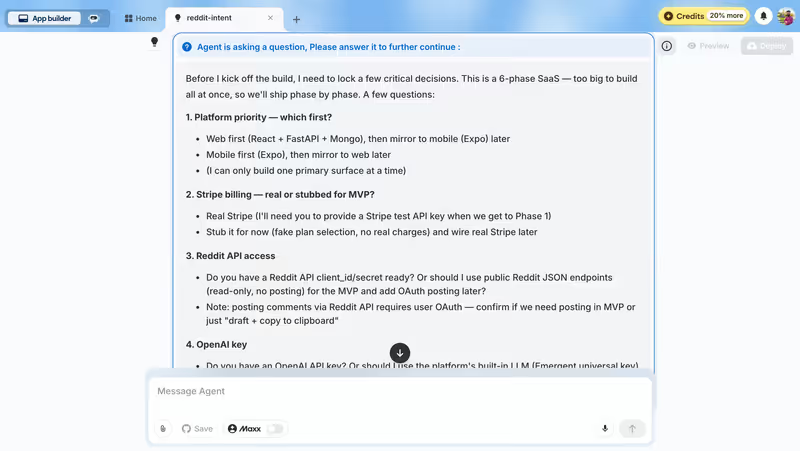
emergent.sh
Emergent homepage
getmocha.com
Mocha homepage

The job here is narrow and unforgiving: build a small business web app where logged-in customers can view and update only their own records. Emergent and Mocha diverge on that job because the visible UI is the easy part; the real test is whether the tool can survive auth, data boundaries, schema changes, and repeated fixes without turning the app into a maintenance project.

That is exactly where generated-app platforms tend to fail in ways that matter. A polished dashboard is irrelevant if password recovery is brittle, a user query leaks the wrong rows, or a later prompt quietly rewrites working logic. For a client portal, the important question is not who makes prettier screens fastest, but who leaves fewer security and migration problems behind.

The audience

Who each one is for

Emergent

  • Technical founders who want fast full-stack scaffolding before handing cleanup to developers
  • Operations teams prototyping internal workflows with enough budget to absorb retry costs
  • Builders comfortable reviewing generated backend logic, environment variables, and schema changes
  • Teams wanting hosting, previews, and app generation inside one managed workspace

Mocha

  • Existing Mocha users who need to export projects before the platform shuts down
  • Hobby builders making simple utilities or directories with minimal long-term expectations
  • Creators who value quick Google sign-in and lightweight starter code over depth
  • Teams treating it as a temporary prototype step before moving elsewhere quickly

Emergent is for people still willing to operate an agent workflow. Mocha is mostly for people planning their exit.

The scope

What you'd build with it

Emergent

  • Full-stack SaaS MVPs with generated frontend, backend routes, and hosted previews
  • CRUD-heavy internal tools where initial speed matters more than elegant long-term architecture
  • Draft client portals that developers will later audit, refactor, and stabilize
  • Not a wise choice for production mobile apps, where unfinished edges still matter

Mocha

  • Simple web apps backed by its managed SQLite setup and basic auth flows
  • Lightweight directories, calculators, or showcase tools with modest data complexity
  • Short-lived prototypes intended for export rather than durable platform dependence
  • Not suitable for business-critical long-term workflows because the platform is shutting down

The data-boundary question

Emergent approaches the hinge question through an agent-managed full-stack workflow: it generates backend code, schema changes, routing, and hosted environments together, then revises them through follow-up prompts. That can be powerful for a portal with evolving requirements, but it also means the same agent that created working auth or query logic may later rewrite it while fixing something unrelated. In a business app, the risk is not merely messy code; it is generated security-critical code that must keep enforcing per-user boundaries after every edit.

Mocha's handling is simpler and more portable: its apps sit on a managed SQLite layer and can be exported as ordinary code. That makes the exit path clearer, but it does not solve the core portal problem of durable access control under repeated changes. Complex row-level protections, larger-scale schema evolution, and long-term operational ownership all become your responsibility once the AI leaves rough code behind. With Mocha's shutdown already scheduled, any serious app built there is really a migration project with a prototype attached.

Strengths

Where each one is strong

Edge: Emergent

Emergent takes the edge because it is still an active, broader app-building platform rather than a product approaching shutdown.

Emergent

  • Fast full-stack scaffolding across UI, backend logic, and hosted preview environments
  • Supports web and basic mobile draft generation from the same conversational workflow
  • Built-in hosting and preview updates shorten the path from prompt to usable demo
  • Branching or forking workflows help when testing risky revisions to generated code

Mocha

  • Straightforward SQLite setup gives simple apps a low-friction persistence layer immediately
  • Clean ZIP export provides an unusually direct path out of the platform
  • Quick start for lightweight utilities, directories, and simple authenticated prototypes
  • Built-in compile-fix attempts can resolve minor breakages without manual setup first

Failure modes

Where each one breaks

Edge: Emergent

Emergent's failures are costly, but Mocha's worst failure is existential: the platform itself is going away.

Emergent

  • Regression loops can undo working code while trying to fix unrelated issues
  • Credits are still consumed when repeated edit attempts fail or stall
  • Hosted container environments can become unresponsive at exactly the wrong moment
  • Small UI changes can trigger disproportionately large and expensive code rewrites

Mocha

  • Platform shutdown on August 1, 2026 makes long-term hosting impossible
  • AI fix attempts can loop through credits without reliably resolving breakages
  • Customization can hit walls quickly, forcing manual code edits sooner than expected
  • Support and infrastructure delays are harder to justify on a sunset product

Iteration cost

The fix loop, priced

Even

Both models punish debug-heavy work because the meter runs while the AI is being wrong.

Emergent

  • Standard plan is listed at $20 per month billed annually for 100 credits
  • Each edit or retry can consume credits, including failed attempts to resolve bugs
  • Users report burning through paid credits on minor regressions and repeated rewrites
  • Top-up credits persist, but monthly included credits do not roll over

Mocha

  • Bronze starts at $20 per month for 1,500 credits and 5 published apps
  • Single runtime or compile problems can consume large chunks of credits during retries
  • Credit usage is hard to forecast when the model loops on the same issue
  • Top-ups exist, but subscription costs continue while you race the shutdown clock

Both tools make iteration look cheap until debugging starts. The real bill arrives when the agent confuses persistence with progress.

Exit paths

The code you end up with

Edge: Mocha

Mocha leaves a cleaner escape hatch, which matters even more now that escape is mandatory.

Emergent

  • GitHub sync gives you standard-looking project files rather than a sealed black box
  • Repeated agent rewrites can leave the repository harder to understand than it first appears
  • Operational setup remains entangled with Emergent-hosted workflows during active use
  • Large evolving repos can become harder for the agent to modify predictably over time

Mocha

  • ZIP export gives you raw project files for local ownership and external hosting
  • Fewer proprietary wrappers make migration simpler than many comparable AI builders
  • Once exported, you control build steps and deployment choices yourself
  • The platform is best treated as a temporary generator, not a permanent runtime

When neither wins

The core problem with both tools on a small business portal is not speed but responsibility. In both cases, you end up maintaining generated code that touches authentication, session handling, database queries, and user-specific access rules. That means every later prompt can become a security review problem, because you still need to verify that customer A cannot see customer B's records after the AI "helpfully" changes something nearby.

For that kind of business app, Softr is the tool with no fix loop: auth, user groups, and record-level permissions are platform configuration rather than generated code you must keep auditing. The honest boundary is that Softr is the wrong fit if you need a custom consumer UI or you specifically want to own and modify the codebase yourself.

Verdict

Emergent wins if the decision is strictly between these two tools and you need to start a new portal now. The strongest reason is simple: it is still an active platform that can generate a working full-stack skeleton, while Mocha is already on a countdown to shutdown.

Mocha is the right pick only when the real job is extraction rather than new development. Its cleaner export story makes it useful for getting code out, preserving a prototype, and moving the project into a stack you actually plan to keep.

For non-developers building business apps, the better call is to skip both and use Softr, where auth and permissions are configured instead of regenerated. If you do need code ownership, standardize early on a conventional stack rather than letting either tool define your long-term architecture.

Q & A

Frequently Asked Questions

Is Emergent better than Mocha for a client portal?

Yes, but mainly because Emergent is still an active product. For a client portal with logins and per-user records, both tools leave you responsible for reviewing generated security-critical code. Mocha's shutdown makes it a poor choice for any new long-term build.

Which costs more for repeated fixes, Emergent or Mocha?

In practice, both can get expensive once the AI starts looping on bugs. Emergent's smaller included credit pool makes repeated retries feel expensive quickly, while Mocha's larger credit numbers can still disappear fast during failed compile or runtime fixes. The important pattern is that neither tool prices debugging gracefully.

Can I export my app code from Emergent or Mocha?

Yes, but the experience differs. Emergent syncs projects through GitHub and gives you code ownership with more operational entanglement during use, while Mocha is stronger on straightforward ZIP export and migration. If exit planning matters most, Mocha has the cleaner portability story.

Is Mocha shutting down, and does that matter for new projects?

Yes, Mocha is scheduled to shut down on August 1, 2026. That matters a lot because any new app started there immediately inherits a migration deadline. It is better treated as a temporary prototype or export source than a platform to build on now.

What should a non-technical team use instead of Emergent or Mocha for a business app?

For a business portal or internal tool, Softr is the safer no-code route. It handles authentication, user groups, and record-level permissions as platform features instead of generated code. That removes much of the fix-loop and security-review burden non-technical teams otherwise inherit.