Compare Tools

Emergent vs Anything: which one survives a small business web app?

June 16, 2026

Verdict

Anything wins if you need faster visual iteration on a lightweight prototype; Emergent wins if you need fuller app scaffolding and code export. If this app runs real business operations, look past both.

Emergent logo

Emergent

Fastest way to prompt out a full-stack app, if you can keep the agent from burning credits

Anything logo

Anything

A sharp prompt-to-app canvas for quick prototypes, if you can live with platform trust questions

Emergent vs Anything, on screen

emergent.sh
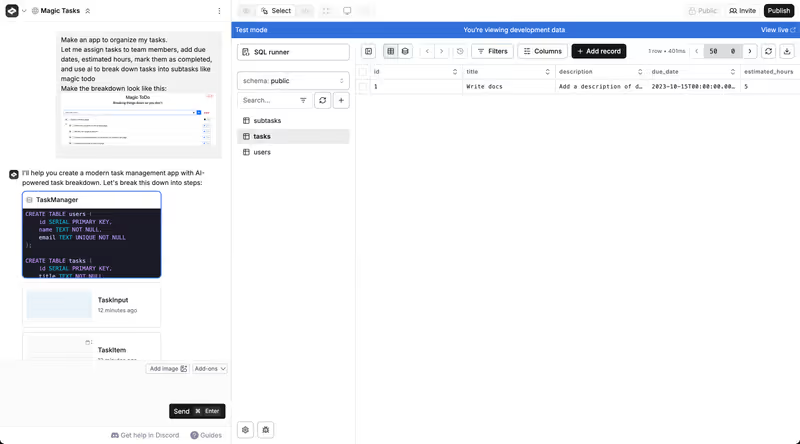
Emergent homepage
www.create.xyz
Anything homepage

The real test here is not who can produce a prettier screen fastest. It is which tool better survives the job of building a small business web app with logins, per-user data, and enough backend structure that the result is more than a clickable mockup. Emergent and Anything genuinely diverge on that job because one leans toward full-stack generation and repo ownership, while the other is stronger as a visual prompt-and-edit environment.

This job exposes the failure modes that actually matter because authentication, data isolation, and iterative fixes punish weak abstractions immediately. A tool can look impressive on a landing page, then become expensive, fragile, or hard to trust once database changes, permission logic, and repeated repair cycles enter the picture.


The audience

Who each one is for

Emergent

  • Technical founders who want AI-generated full-stack scaffolding they can inspect and move to GitHub
  • Operators building internal tools who can read logs and tolerate backend debugging sessions
  • Small teams needing quick database-backed web apps with some willingness to clean generated code
  • Developers who care more about repository ownership than polished visual editing controls

Anything

  • Visual builders who prefer clicking into components and prompting targeted UI changes
  • Design-led teams validating workflows before they commit to a deeper engineering stack
  • Makers building simpler dashboards, forms, or directories with lighter backend demands
  • Hobbyists comfortable staying inside a hosted visual platform during early iterations

Emergent skews toward users who want code they can take with them. Anything skews toward users who want to shape the interface directly and postpone harder backend questions.

The scope

What you'd build with it

Emergent

  • Internal dashboards with relational data, auth flows, and basic API-backed workflows
  • Admin portals and CRUD-heavy SaaS skeletons that need backend scaffolding quickly
  • Prompt-generated web apps you expect to sync to GitHub and refine outside the platform
  • Not a strong fit for polished mobile products or large codebases that need long-term architectural discipline

Anything

  • Interactive prototypes where visual iteration on individual components matters most
  • Simple business sites, member areas, and lightweight dashboards with modest logic
  • Form-based apps and directories that benefit from a canvas-first editing model
  • Not the right tool for payment-heavy or security-critical production apps with complex permissions

The database and state question

Emergent handles the hinge question by trying to generate the whole stack around it: frontend, backend routes, and database-connected logic, then giving you GitHub sync so the output can leave the platform. That is the meaningful advantage for this job. When auth, schema changes, or API wiring get complicated, having an actual repository matters more than having a nicer editing canvas. The tradeoff is that broad agent control can make small changes expensive, because one database tweak can trigger wide code edits and more fix-loop churn than you wanted.

Anything approaches the same question from the opposite direction. Its strength is localized editing inside a visual canvas, where changing a specific screen or component is more direct and often faster for UI work. But that same model is less reassuring when the app depends on stable backend behavior, auth boundaries, and data ownership, because the value is concentrated in the hosted builder rather than in a developer-ready system you can easily separate, audit, and standardize outside the product.

Strengths

Where each one is strong

Edge: Emergent

Emergent gets the edge because this job rewards fuller stack generation and repo portability more than nicer visual editing.

Emergent

  • GitHub sync and repo ownership make the output easier to move into a normal development workflow
  • Generates fuller app scaffolding, including backend-oriented structure rather than only front-end screens
  • Better suited to CRUD-heavy business apps where database-backed flows matter from day one
  • Private hosting and generated deployment paths reduce setup friction for early full-stack prototypes

Anything

  • Clickable visual editing makes targeted UI changes faster than broad conversational regeneration
  • Canvas-first workflow is useful for refining layouts, forms, and user-facing flows quickly
  • Good fit for fast prototype cycles where interface feedback matters more than backend depth
  • Lower-friction experience for non-developers who want to shape screens without reading code

Failure modes

Where each one breaks

Edge: Anything

Anything's limits are serious, but Emergent's wider agent loops are usually more damaging once a real business app needs repeated fixes.

Emergent

  • Agent fix loops can repeatedly rewrite or undo work while still consuming paid credits
  • Generated code quality can degrade as scope grows, making later changes harder to trust
  • Broad stack-level edits mean a small bug fix can ripple into unrelated parts of the app
  • The platform is weaker when you need stable long-horizon maintenance instead of quick scaffolding

Anything

  • Backend ceiling shows up sooner when auth, permissions, or production logic become central
  • Hosted builder dependence makes platform-level instability more painful for live projects
  • Complex multistep business rules are harder to express safely through visual prompting alone
  • Exporting the front end does not remove the migration burden around data and app behavior

Iteration cost

The fix loop, priced

Even

Both tools can make you pay to correct AI-generated mistakes, just through slightly different interaction models.

Emergent

  • Base pricing is credit-based, so iteration cost rises with every agent action rather than staying purely flat
  • Real-world burn is highest when backend or schema changes trigger repeated full-stack rewrites
  • Worst case is paying through multiple failed repair attempts on the same issue before exporting the repo
  • The structural reality is that ownership helps later, but it does not protect you from expensive generation loops upfront

Anything

  • Base pricing is easier to stomach initially, but the monthly allowance still limits how much rework you can do
  • Real-world burn shows up in repeated prompt cycles for layout regressions and app behavior tweaks
  • Worst case is draining the month's quota on incremental fixes without solving deeper backend constraints
  • The structural reality is that a visual builder feels cheaper until the project outgrows what visual prompting can safely handle

Both pricing models hide the same bill: the more the AI misses, the more you pay to steer it back; see the fix loop tax.

Exit paths

The code you end up with

Edge: Emergent

Emergent leaves you in better shape because GitHub sync and fuller exported structure matter more than a visual-first handoff.

Emergent

  • You can move generated output into GitHub and continue work in a standard repository
  • The export is closer to a full application scaffold than a design artifact
  • Portability is real, even if the generated code may still need cleanup and refactoring
  • Lock-in risk is lower because the long-term path is to leave the platform, not stay inside it

Anything

  • You can export code, but the practical value is strongest for front-end screens and lighter app structures
  • Manual work is still required to reconnect environments, data sources, and production behavior
  • The project remains more tightly coupled to the platform's visual model during creation
  • Lock-in risk is higher when the app's value depends on hosted behavior rather than on a clean portable stack

When neither wins

If you are building a small business web app with logins and per-user data, both contenders eventually hand you the same problem: you must maintain generated security-critical code. Authentication flows, user grouping, and record-level access are too important to leave as opaque AI output you cannot confidently audit, especially when the app supports real clients, staff, or operations.

For that specific business-shaped job, Softr is the tool with no fix loop: auth, user groups, and record-level permissions are platform configuration rather than generated code. That is the honest advantage for non-developers running a real business, with the equally honest boundary that Softr is the wrong fit if you need a custom consumer UI or you specifically want to own and extend a codebase.

Verdict

Emergent wins if your main requirement is a small business web app that needs fuller scaffolding and a path to repository ownership. The strongest reason is simple: this job gets harder, not easier, once auth, data structure, and repeated edits enter the picture, and GitHub-syncable output gives you a more credible exit route.

Anything is the better pick when the real job is fast visual iteration on a lighter prototype, especially if the screen design itself is changing more than the backend model. If you are still validating flows, forms, and layout decisions, its canvas-first experience is the more comfortable tool.

For business-shaped apps, non-developers should look past both and use Softr when the priority is secure roles, records, and operational stability without maintaining generated code. If you do want code ownership, choose the tool that gets you to a standard repo fastest and assume cleanup work is part of the deal.

Q & A

Frequently Asked Questions

Is Emergent better than Anything for a small business web app?

Usually yes, if the app needs backend scaffolding, authentication flows, and a codebase you can move into GitHub. Anything is better when the project is still mostly a visual prototype and interface iteration is the main job.

Which costs more to iterate with, Emergent or Anything?

Emergent is usually riskier on cost once agent loops start touching multiple parts of the stack. Anything can still get expensive through repeated prompt cycles, but the larger financial pain typically appears when a full-stack generator keeps reworking the same problem.

Can I export my code from Emergent and Anything?

Yes, both offer a way out, but the quality of that exit is different. Emergent is stronger when you want a repository-centered workflow, while Anything's export is less convincing as a complete long-term home for a production business app.

Which has less lock-in, Emergent or Anything?

Emergent has less lock-in for this job because repo ownership matters more than staying inside a visual builder. Anything is more dependent on its hosted editing model, especially while the app is still being shaped.

What should a non-developer use instead for a secure client or staff portal?

Softr is the safer no-code route for that kind of business app. It handles logins, user groups, and record-level permissions as built-in platform features instead of asking you to maintain generated security code.