Compare Tools

Devin vs Dyad: which survives taking a prototype to a real product?

June 16, 2026

Verdict

Devin wins if you want a managed agent loop inside the IDE; Dyad wins if you want local code ownership and cheaper iteration.

Devin logo

Devin

A capable local coding agent with fast autocomplete, but it struggles to match Cursor's overall pace

Dyad logo

Dyad

Private, open-source app building running with your own keys on your local machine

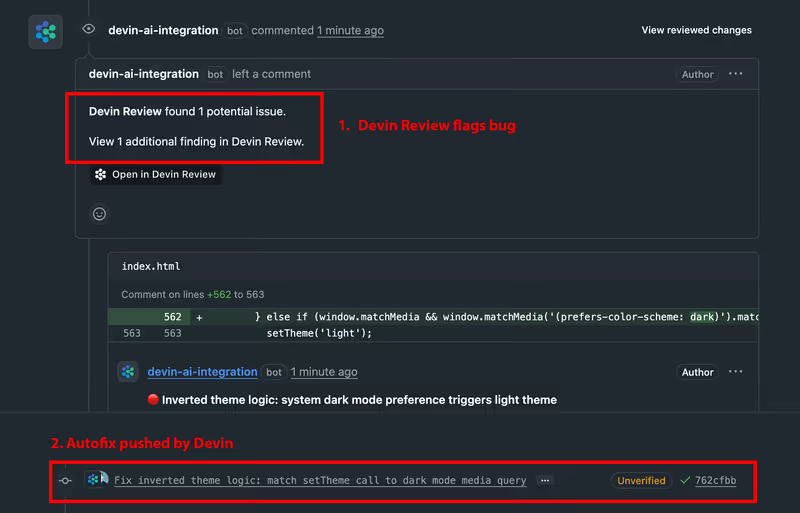
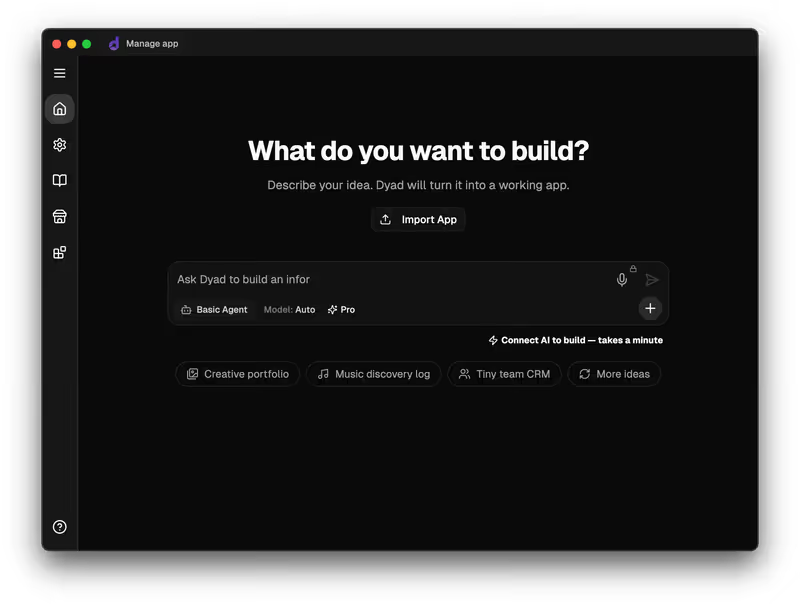
Devin vs Dyad, on screen

devin.ai
Devin homepage
dyad.sh
Dyad homepage

The real test here is not who can produce a flashy first draft, but which tool holds up when a prototype has to become a product other people depend on. That job forces a split between Devin and Dyad because they solve different problems: Devin leans into a managed, agent-driven coding workflow, while Dyad leans into local generation, direct file ownership, and a faster handoff to ordinary development.

This job exposes the failure modes that matter because production work is mostly fix loops, plumbing, and code stewardship. A tool can look impressive on day one and still become expensive, brittle, or operationally awkward once authentication, database changes, deployment, and repeated debugging enter the picture.

The audience

Who each one is for

Devin

  • Working engineers who want an agentic IDE that can edit and debug across files.
  • Developers who value fast autocomplete while still writing and reviewing code manually.
  • Teams comfortable with cloud-mediated workflows and subscription-style usage limits.
  • Builders who want the assistant to run terminal commands during iteration.

Dyad

  • Privacy-first developers who want generated code to stay on their own machine.
  • Technical founders planning to use their own model keys and control costs directly.
  • Small teams that want AI scaffolding but expect to own the repo quickly.
  • Developers happy to manage local setup, deployment, and environment issues themselves.

Devin is for people buying a managed AI coding workflow. Dyad is for people who mainly want generated code without adopting someone else's operating model.

The scope

What you'd build with it

Devin

  • Full-stack web apps where an agent can keep revising multiple files and rerun commands.
  • Repository-wide refactors that benefit from indexed context and automated edit loops.
  • Backend tools, scripts, and app features that need terminal execution during debugging.
  • Not the cleanest fit when you mainly want a simple local scaffold and immediate code ownership.

Dyad

  • React and Tailwind applications that you want generated into ordinary local project files.
  • Internal tools or startup apps where privacy and repo control matter from day one.
  • Projects that will move quickly from AI scaffolding into standard Git-based development.
  • Not ideal if you want a deeply managed agent to keep operating remotely inside the loop.

Who owns the working context

Devin's advantage on this job is its managed agent loop. It operates like an AI-first coding environment that can inspect files, reason across a codebase, and use terminal execution to test or repair changes, which helps when prototype code starts spreading into multiple directories and dependencies. That mechanism is useful precisely because productionizing a prototype means lots of cross-file edits, but it also ties the workflow to remote coordination, waiting on agent runs, and the cost of repeatedly spending credits while the system works through mistakes.

Dyad handles the same hinge question by keeping generation local and writing directly into a normal codebase you control. That means the project can move into standard Git workflows immediately, and using your own API keys or local models changes the economics of repeated fixes in a way a managed credit pool does not. The tradeoff is that Dyad gives you ownership sooner, but with that comes ownership of setup, deployment, migrations, and the quality ceiling of whichever model you choose to run.

Strengths

Where each one is strong

Edge: Devin

Devin takes the edge because the managed agent loop is more helpful once the build starts spanning many files and repeated fixes.

Devin

  • Agent-driven multi-file editing is the clearest advantage when a prototype starts turning into a real codebase.
  • Integrated terminal workflows let it run commands, surface build failures, and iterate on fixes.
  • Fast autocomplete supports ordinary manual coding instead of forcing every change through full prompts.
  • A polished IDE experience lowers friction for developers who want one place to prompt, inspect, and revise.

Dyad

  • Local-first ownership means generated files already live in a standard codebase you control.
  • Bring-your-own-key usage can reduce platform markup and make long fix loops cheaper.
  • Privacy is materially better when project files and prompts stay on your own machine.
  • The transition from AI scaffold to conventional development is straightforward because the repo is yours.

Failure modes

Where each one breaks

Edge: Dyad

Dyad's failures are usually more visible and local, while Devin can waste time and paid usage inside a managed loop before you intervene.

Devin

  • Agent loop drift can show up as repeated file reads, stalled progress, or expensive retries.
  • Hallucinated imports or dependency guesses can break builds and create cleanup work.
  • Large or messy projects can slow responses as the system keeps reprocessing context.
  • Cloud dependence adds another failure layer when connection issues interrupt work mid-iteration.

Dyad

  • Model quality variance can produce bloated or messy code, especially with cheaper options.
  • Local environment problems become your problem, from Node setup to database configuration.
  • Deployment is not abstracted away, so shipping still requires normal engineering effort.
  • Context limits do not disappear just because the tool is local; big projects still stress the model.

Iteration cost

The fix loop, priced

Edge: Dyad

Dyad hurts less on a fix-heavy build because you can use your own keys or local models instead of burning through a managed credit system.

Devin

  • Managed subscription pricing bundles the experience, but the costly part is repeated agent usage during debugging.
  • Autocomplete is easier to absorb economically than long agentic repair loops across multiple files.
  • The worst case is paying for stalled or low-yield iterations while waiting on the agent to converge.
  • Structurally, the bill is tied to Devin's platform model rather than a repo you can run independently.

Dyad

  • The base path can be free if you use local models and accept their quality limits.
  • BYOK usage means you pay provider rates directly instead of a platform markup on every iteration.
  • The worst case is not subscription burn so much as low-quality generations that cost time to untangle.
  • Structurally, cost is more elastic because you can switch models, providers, or local execution paths.

Both tools make bug fixing the real meter; the difference is whether that bill lands as managed credits or raw model usage.

Exit paths

The code you end up with

Edge: Dyad

Dyad leaves you in better shape when you want out because the whole point is ordinary local files and immediate repo ownership.

Devin

  • You still work with standard code, not a proprietary runtime that traps the output.
  • Git-based workflows remain possible, which softens lock-in compared with closed app builders.
  • The practical lock-in is workflow-level: the agent loop lives on Devin's platform, not in your repo.
  • As projects grow, cleanup may be needed where repeated generations duplicate logic or utilities.

Dyad

  • Generated files are already local, which makes export a non-event rather than a feature.
  • The handoff to Git, external hosting, or manual refactoring is straightforward.
  • There is little platform-specific wrapper debt compared with tools that abstract deployment and runtime.
  • Portability is strong, though code quality still depends heavily on the models and prompts used.

When neither wins

If the thing you are actually shipping is a business app - a client portal, CRM, internal tool, or workflow system - neither Devin nor Dyad really solves the maintenance problem for a non-developer. Both tools still leave you maintaining generated, security-critical code around auth, data access, permissions, deployments, and regressions, which is a risky place to be if your real goal is operating the business rather than supervising software.

For that kind of job, Softr is the tool with no fix loop: auth, user groups, and record-level permissions are platform configuration rather than generated code you have to keep repairing. The honest boundary is that Softr is the wrong fit if you need a custom consumer UI or if owning the application codebase is itself a requirement.

Verdict

Dyad wins if your main goal is to turn a prototype into a real codebase you actually own. The strongest reason is simple: local-first output, normal files, and BYOK economics make the transition from AI generation to standard development less fragile and less expensive.

Devin is the right pick instead when you want the managed agent loop to do more of the repo-wide work for you. If your team values integrated terminal execution, cross-file iteration, and an AI-first IDE experience, Devin's workflow can be more productive despite the heavier platform dependence.

For non-developers trying to ship business software, the answer is to look past both toward Softr. If the job is secure internal tools or portals, avoiding a generated-code maintenance burden matters more than winning an AI IDE comparison.

Q & A

Frequently Asked Questions

Is Devin better than Dyad for taking a prototype to production?

Devin is better if you want a managed agent inside the IDE to keep iterating across files and terminal tasks. Dyad is better if production means owning a normal local codebase quickly and controlling cost with your own model setup.

Which costs more to iterate on, Devin or Dyad?

Devin usually has the more expensive fix loop because the value is bundled into a managed platform and agent workflow. Dyad can be much cheaper if you use your own API keys or local models, although lower-cost models can create more cleanup work.

Can I export my code from Devin and Dyad?

Yes. Dyad is stronger on this question because the code already exists as ordinary local project files, while Devin still gives you standard code but keeps the agent workflow itself on Devin's platform.

Which has less lock-in, Devin or Dyad?

Dyad has less lock-in because its core value is local generation into a repo you control. Devin does not trap you in a proprietary runtime, but the workflow advantage depends on continuing to use Devin's managed agent environment.

What should a non-technical founder use instead of Devin or Dyad for a client portal?

For a business portal, Softr is usually the better no-code route. It handles authentication, user groups, and permissions as platform features, which is safer than relying on generated application code you have to maintain yourself.