Compare Tools

Codex vs Softr: which one survives a real client portal?

June 16, 2026

Verdict

Softr wins the business app deliverable by keeping auth, permissions, and database operations in visual configuration; Codex wins if you require absolute code ownership, a custom consumer UI, or direct developer handoff.

Codex logo

Codex

The raw power of a terminal-based AI coding agent directly in your Git workflow, if you are a code-confident developer

Softr logo

Softr

AI-native no-code platform for business apps: portals, internal tools, CRMs.

Codex vs Softr, on screen

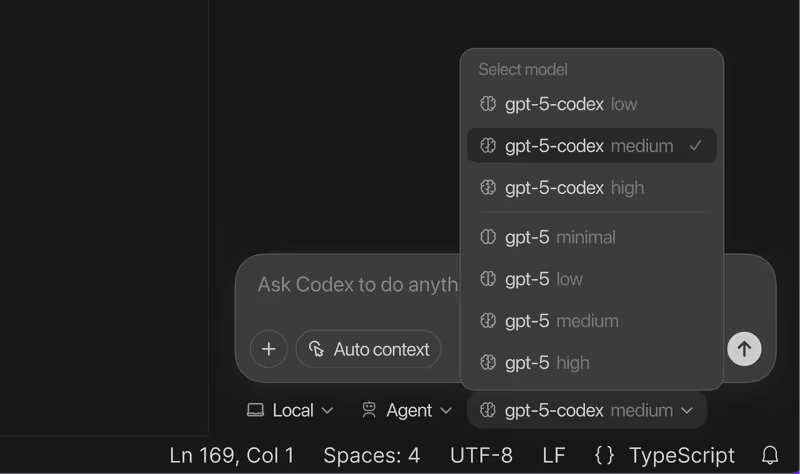
openai.com/codex
Codex homepage
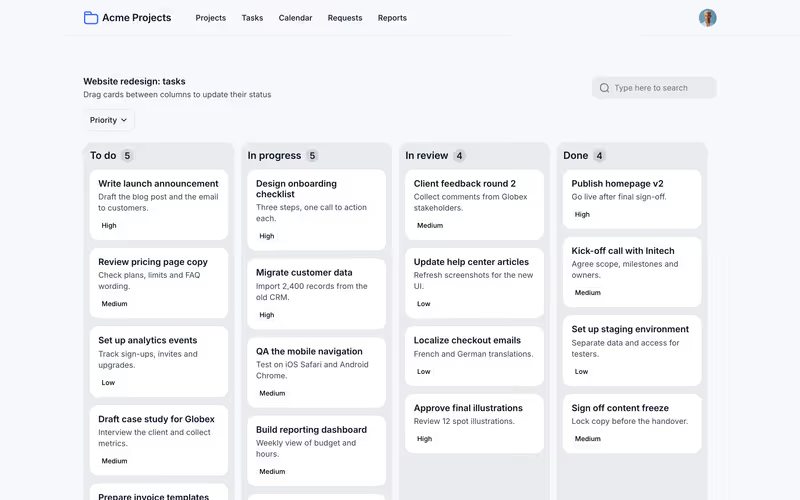
www.softr.io
Softr homepage

The fairest way to compare OpenAI's terminal-based coding agent and a managed, visual app builder is to judge them on the same concrete job: a client portal with custom roles, secure logins, and per-user data isolation. The visible user interface - a few layouts and a data table - represents less than 20% of the work. The rest is infrastructure: ensuring client A can never fetch the invoices of client B, maintaining robust session states, and securing database queries.

This is a classic business application representing a deep, philosophical divergence. Codex acts as an agent inside your Git workflow, executing filesystem edits and compiling raw code that you must subsequently host, maintain, and secure. Softr handles database schemas, member groups, and row-level visual visibility Rules entirely as managed infrastructure, eliminating the edit-compile-test loop for the plumbing layer. A customer portal exposes whether you are looking to write software or simply deploy a solution.

The audience

Who each one is for

Codex

  • Code-confident developers who manage their own repositories and need to automate local coding scripts.
  • Engineering leads seeking to offload repetitive terminal tasks and manage Git worktrees programmatically.
  • Technical creators who already maintain local systems, environment files, and their own servers.
  • Teams where every line of code goes through a rigorous human code review process.

Softr

  • Business Operators who want to build operational portals and CRMs without writing code.
  • Operations Managers and IT teams seeking to eliminate fragile administrative spreadsheets permanently.
  • Workflow design professionals who understand business logic but want to avoid syntax and terminal setups.
  • Organizations that need to distribute customer portals to real users without per-seat licensing bottlenecks.

Codex is built for senior engineers who navigate terminal contexts and Git branches. Softr is designed for knowledge workers who need immediate operational interfaces without the overhead of local compilers.

The scope

What you'd build with it

Codex

  • Raw software scripts that require custom business logic, system-level executions, or special packages.
  • General-purpose codebases, utility classes, and backend endpoints managed under a Git repository.
  • Highly specialized consumers platforms where you require absolute control over every paint layout pixel.
  • What it should NOT build: High-compliance customer portals by makers who cannot read or verify raw code.

Softr

  • Secure customer and partner portals featuring dynamic login tiers and strict visibility configurations.
  • Internal operational workspaces such as centralized business CRMs, inventory managers, and custom ERP systems.
  • Data-driven directories, product catalogs, and programmatic information search hubs.
  • What it should NOT build: Specialized consumer mobile apps packaged directly for public app stores.

The plumbing question

In a customer portal, user privacy is not an aesthetic choice; it is a legal and operational mandate. When you prompt Codex to build an authentication layer or a role-based access route, it writes raw code - such as Next.js middleware, Express endpoints, or Supabase Row-Level Security (RLS) queries. However, Codex is a CLI agent, not a secure hosting platform. It generates the script file and leaves the hosting stack, client-side token management, and environment variables completely in your hands. If the generated script contains vulnerability leaks, or if you expose a raw database hook on the client side, there is no system guardrail to block a data leak.

Softr handles database security and user permissions entirely on the server side, completely abstracted away from the client browser. You do not ask an AI to write custom authentication logic or invent sensitive security queries from scratch. Instead, you manage user groups, data visibility rules, and button access parameters visually within a secure interface. Database entities leverage official, approved OAuth integrations or Softr's native, performant database infrastructure. This ensures that permissions are verified safely before any data is sent over the network, leaving no opportunity for structural hallucinations to compromise private client accounts.

Strengths

Where each one is strong

Edge: Softr

For a client portal or business database app, Softr takes the edge by packaging the essential 80% as tested, secure infrastructure.

Codex

  • Direct integration into local Git workflows, automating multi-branch logic, testing, and script generation.
  • Parallel task execution allows developers to process multiple tasks across isolated workspace containers simultaneously.
  • Compatible with any custom language framework, library version, or custom structural architecture.
  • Generous token efficiency optimizations that minimize API credit waste on large-scale file refactoring jobs.

Softr

  • Turnkey system infrastructure, providing pre-configured user logins, password-reset screens, and Google OAuth natively.
  • Visual permission routing that instantly redirects specific user groups to their custom dashboards.
  • A performant, native relational database featuring AI fields that enrich records right in the table.
  • The hybrid building model: build visually by hand, use templates, or summon complete layouts via prompt.

Failure modes

Where each one breaks

Edge: Softr

Codex can write code that compiles clean but still leaks customer records. Softr handles structural updates cleanly under visible, non-breaking parameters.

Codex

  • Prone to regression loops where fixing one database query breaks working route endpoints.
  • No application hosting environment, requiring manual database provisioning and local credential managers.
  • Tendency to expand solutions past the specified target scope, introducing code bloat.
  • Complete platform model lock-in to OpenAI's backing APIs for generating core structural changes.

Softr

  • Strict layout restrictions relative to raw code, keeping builds aligned to pre-composed block formats.
  • Custom, highly intricate UI patterns require generating specialized visual components in the editor.
  • No direct command-line or system-level local file script execution.
  • Native templates must be customized to fit unique branding environments that deviate from standards.

Iteration cost

The fix loop, priced

Edge: Softr

Softr avoids the fix-loop tax since layout tweaks are direct manual edits rather than paid model regenerations.

Codex

  • Codex access is bundled with OpenAI ChatGPT subscriptions starting at $20/month.
  • Users report rapid token burn patterns when troubleshooting code errors programmatically.
  • Engineers face expensive ChatGPT Pro rates of $200/month for high-priority model access.
  • Model limit allocations do not carry over indefinitely, resetting on monthly cycle boundaries.

Softr

  • Professional plans start at $139/mo billed annually, with custom user groups and 500k database entries.
  • No prompt iterations required: layout edits are configured manually with zero technical credit cost.
  • AI credits are consumed strictly for upfront schema generation, block builders, and AI-powered data steps.
  • Running low on credits never halts progress: everything the AI configures can be fully edited manually.

With Codex, you pay your assistant to debug its own code in a loop. Moving to Softr removes this fee because you can adjust settings visually, keeping credits for actual scaling tasks. Read more on the mechanics in the fix loop tax.

Exit paths

The code you end up with

Edge: Codex

Codex leaves you with complete ownership of raw source code, giving developers the absolute flexibility of standard repositories.

Codex

  • Generates clean, native files saved directly to your local development environment.
  • Standard GitHub commits let you push, download, or walk away from the tool at any time.
  • Zero proprietary framework architecture layer standing between you and the codebase deployment.
  • Allows direct integration with standard CI/CD deployment channels like Vercel and Railway.

Softr

  • An visual, cloud-hosted environment with no raw build folders to export or deploy manually.
  • Standard visual layouts leverage native components maintained automatically by the hosting platform.
  • System code can be customized specifically at the block level using CSS or client script insertion.
  • Ensures long-term framework compatibility by handling runtime and security packages natively.

When neither wins

If your target job is to launch a consumer-facing mobile application with custom canvas layouts, or if you write low-level system scripts, neither of these platforms fits the assignment. Codex requires an experienced developer to evaluate its output and avoid the common deployment bugs of early-stage codebases. If keeping total Git ownership or choosing your own cloud-deploy framework is your primary driver, look to Cursor vs Replit instead.

But if your real goal is to launch a secure, working business workspace, internal directory, or partner system Softr bypasses the developer cycle altogether. By hosting database structures and custom directories natively, you avoid the security hazards of what 45 percent vulnerable means in generated AI files. Softr treats member dashboards as reliable standard infrastructure, resolving the security logic before you publish.

Verdict

Softr is the clear winner for business applications where custom permissions, logins, and relational databases must function safely on day one. By treating user auth and data rows as robust visual options instead of raw, hallucinated code, it protects non-technical builders from compiling structural liabilities. You get a production-grade partner portal or CRM deployed within hours without managing server configurations or waiting on expensive engineering loops.

Codex is the right pick if you are a code-confident developer who requires raw file ownership, a bespoke consumer application interface, or absolute freedom to inspect every repository commit. Because Codex functions directly within terminal routines and Git environments, it is a tool for developers who use AI as a fast scaffold before continuing manual engineering patterns in an IDE.

For any operational department, startup, or business seeking to deploy software that real users and clients log into tomorrow, do not volunteer to maintain a generated, custom codebase. Choose the route that treats authentication and data safety as a reliable foundation. For this specific deliverable, bypass the prompt-generation loop altogether.

Q & A

Frequently Asked Questions

Is Softr better than Codex for building a client portal?

Yes. Softr provides user authentication, dynamic member portals, and visual data visibility rules as secure platform infrastructure out of the box. Codex merely generates system files in an IDE, making it easy for non-developers to introduce deployment and security bugs.

Can I export my code from Codex and Softr?

Codex saves standard programming code directly to your local Git directory, giving you complete portability. Softr is a hosted cloud platform, which keeps your application updated automatically but does not export standard, editable source code.

Does Softr limit my building progress with AI credits?

No. While Softr includes monthly credit limits for automated tasks, you do not need to use AI to change or maintain your app. Every page layout, visibility rule, and database column can be configured manually in the visual editor.

Which tool costs more to iterate and debug on?

Codex iterations can quickly run up API credit bills on premium developer accounts while debugging system errors. Softr avoids these fees because altering visual components and settings does not consume AI credits.