Compare Tools

Bolt vs Base44: which one survives a real internal operations tool?

June 16, 2026

Verdict

Bolt wins if you have developers and need portable code; Base44 wins if you want the fastest bundled setup for a lightweight ops app; for most non-developer teams, the safer answer is neither.

Bolt logo

Bolt

In-browser AI dev environment that scaffolds and runs full-stack apps.

Base44 logo

Base44

All-in-one conversational app builder with bundled database, auth, and hosting.

Bolt vs Base44, on screen

bolt.new
Bolt homepage
base44.com
Base44 homepage

This comparison judges Bolt and Base44 on one concrete job: building a real internal operations tool with logins, role-based access, and records that different teammates should not all see. That job matters because the two products diverge exactly where business apps stop being a demo: Bolt gives you a code-first browser IDE and asks you to own the stack, while Base44 gives you a more bundled, conversational platform and asks you to trust more of the backend abstraction.

That makes this a useful stress test. Internal tools fail less from pretty-UI problems than from permission mistakes, brittle data flows, and expensive fix loops after the first working version. If a tool cannot survive auth changes, schema edits, and repeated revisions without creating hidden risk, it is not really solving the job.

The audience

Who each one is for

Bolt

  • Developer-led teams who want AI scaffolding but still inspect, edit, and ship real code.
  • Founders with technical help who plan to move quickly from prompt output into GitHub.
  • Product engineers building internal tools that need custom APIs, libraries, or hosting choices.
  • Teams comfortable debugging auth, schema, and deployment issues in a standard web stack.

Base44

  • Non-technical operators who want a hosted app, database, and auth from one prompt flow.
  • Small teams validating internal workflows before involving a dedicated engineering team.
  • Managers who prefer conversational editing over file trees, terminals, and package management.
  • Builders prioritizing speed to first usable dashboard over deep backend portability.

Bolt assumes someone will own the code. Base44 assumes someone would rather avoid the code until that becomes impossible.

The scope

What you'd build with it

Bolt

  • Custom internal dashboards with React-style frontends and fully editable backend logic.
  • Ops tools that need bespoke integrations, custom data models, or nonstandard workflow rules.
  • Admin panels you expect to export, version, and maintain in a normal repository.
  • Not the right fit for non-developers who need permissions handled as product configuration, not code.

Base44

  • Simple internal trackers, request portals, and CRUD-heavy business apps with bundled hosting.
  • Early MVPs where built-in auth and database setup matter more than deep stack control.
  • Lightweight team tools that can live within a managed platform's conventions and limits.
  • Not the right fit if you need backend portability, self-hosting, or full ownership of the server layer.

The permissions question

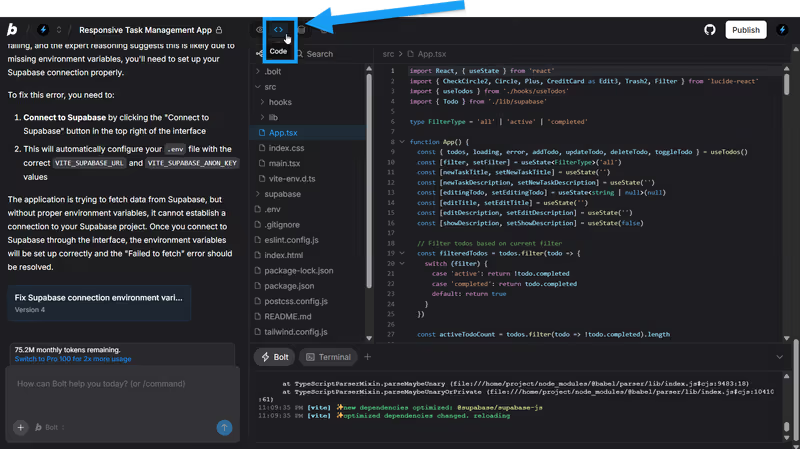
Bolt handles the core question by generating and exposing the underlying project directly in a browser IDE, typically with a normal app structure, package management, and terminal access. For an internal operations tool, that matters because auth middleware, API routes, environment variables, and database queries can actually be inspected instead of merely inferred from prompts. The upside is control: if role checks belong in server logic or query filters, a developer can place and verify them there. The downside is equally clear: Bolt does not remove the responsibility to implement and audit those controls correctly.

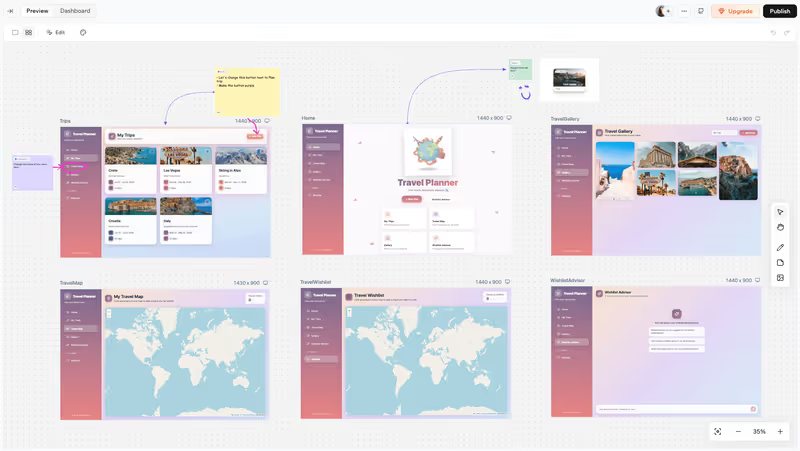
Base44 answers the same question by bundling more of the app stack inside its managed environment, including hosting, auth, and database conveniences. That reduces setup friction and speeds up first delivery, but it also means the critical permission model is mediated through a narrower interface and a more opaque runtime. When revisions pile up, the problem is not just whether the UI still looks right; it is whether the generated access logic, schema changes, and workflow edits still line up under the hood, even though you do not fully own that hood.

Strengths

Where each one is strong

Edge: Bolt

Bolt gets the edge because this job rewards inspectable, portable code more than convenience during day-one setup.

Bolt

  • Portable code output that can move into a normal repository and standard deployment workflow.
  • Browser IDE with file access and terminal-style control for debugging dependencies and app structure.
  • Greater flexibility for custom libraries, integrations, and backend changes than a closed managed stack.
  • Better long-term fit when an internal tool will eventually need engineering ownership and refactoring.

Base44

  • Bundled setup with hosting, auth, and database pieces closer together from the start.
  • Faster path for non-technical builders to get a usable multi-screen business app on screen.
  • Conversational editing flow that lowers the barrier to changing copy, fields, and basic workflows.
  • Managed platform experience that reduces the amount of initial infrastructure wiring.

Failure modes

Where each one breaks

Edge: Bolt

Bolt's failures are painful but usually recoverable in owned code; Base44's failures are worse here because they combine regressions with platform dependency.

Bolt

  • Regression-heavy edits can break unrelated features while trying to fix one visible problem.
  • Prompt loops can burn substantial usage while the tool repeatedly rewrites code without resolving root causes.
  • Larger projects can become harder to manage inside a browser-first environment than in a local setup.
  • Auth and permissions are only as safe as the generated implementation and the developer reviewing it.

Base44

  • Opaque backend changes make it harder to verify whether permission logic is truly enforced.
  • Revision loops can leave a once-working internal app in a worse state after seemingly simple requests.
  • Vendor lock-in raises the cost of escaping if the app outgrows the platform's backend model.
  • A business-critical ops tool is exposed to more risk when core server behavior is managed but not portable.

Iteration cost

The fix loop, priced

Even

The billing models differ, but both tools get expensive when you are paying the AI to repair its own previous output.

Bolt

  • Bolt's paid plans are token-based, so iteration cost rises with every long debugging or regeneration session.
  • Real burn rate depends less on the sticker price than on how many retries a fragile feature needs.
  • Worst case: a permissions or schema bug triggers repeated full-file rewrites that consume large chunks of quota.
  • The structural upside is that you can stop the loop, export the project, and continue fixing it outside the tool.

Base44

  • Base44's cost pressure comes from a managed, usage-shaped workflow rather than a pure export-and-leave model.
  • Burn rate climbs when prompt retries and platform-mediated revisions become the main way to repair logic.
  • Worst case: you keep spending to stabilize an app whose backend behavior you still cannot fully own.
  • The structural downside is that the real bill may include not just iteration, but the long-term cost of lock-in.

In both products, the expensive part is rarely the first draft; it is the repair cycle after the first draft, as explained in the fix loop tax.

Exit paths

The code you end up with

Edge: Bolt

Bolt leaves you in better shape if you need to leave the platform, because the project is closer to a normal codebase from the start.

Bolt

  • You end up with a standard-looking application structure that developers can inspect and extend directly.
  • Repository-style ownership is much clearer, which makes handoff to an engineering team more realistic.
  • Hosting and infrastructure choices remain open instead of being tightly coupled to one managed backend.
  • Lock-in risk is lower because the value is concentrated in exportable code rather than platform-only runtime behavior.

Base44

  • Front-end progress may be easier to show quickly, but the deeper backend story is less portable.
  • Core app behavior is more dependent on Base44's managed environment and conventions.
  • Leaving the platform can mean rebuilding parts of the backend model rather than simply redeploying it.
  • Lock-in risk is materially higher for internal tools that depend on auth, data logic, and hosted workflows.

When neither wins

For this kind of business app, both contenders ask you to maintain generated, security-critical code whether they phrase it that way or not. Bolt makes that explicit by handing you the project; Base44 makes it easier to ignore until permissions, data visibility, or workflow changes force you back into an AI repair loop. If the job is a real internal operations tool, that is the wrong place to be casual about auth and record-level access.

That is why many non-developer teams should look past both tools to Softr, the tool with no fix loop: auth, user groups, and record-level permissions are platform configuration, not generated code you are expected to audit later. The honest boundary is that Softr is the wrong fit if you need a highly custom consumer UI or if owning the underlying codebase is the goal.

Verdict

Bolt wins for a real internal operations tool when you have developers, because the strongest advantage here is code ownership. If permissions, data rules, or integrations get complicated, being able to inspect, export, and standardize the project matters more than shaving off setup time on day one.

Base44 is the better pick when the app is lighter-weight, the team values bundled hosting and auth, and the goal is to get a usable internal workflow online quickly without opening a terminal. That advantage holds only as long as the project stays simple enough that platform opacity and lock-in do not become the main problem.

For non-developers building a business app, the better answer is often to skip both and use Softr, where permissions live in product configuration instead of generated code. If you do have engineering capacity, the standardization call is straightforward: choose the tool that leaves you with code your team can actually own, and here that is Bolt.

Q & A

Frequently Asked Questions

Is Bolt better than Base44 for internal tools?

Bolt is usually better for internal tools when developers will maintain the app, because it gives you more direct ownership of the code and a clearer exit path. Base44 is better only when speed and bundled setup matter more than backend portability. For business-critical permissions, that trade-off matters a lot.

Which costs more during repeated fixes, Bolt or Base44?

The practical answer is that both can get expensive once you enter an AI repair loop. Bolt tends to be easier to cap because you can export the code and stop using the tool for every fix. Base44 can feel cheaper at first, but lock-in and repeated managed revisions can raise the real long-term cost.

Can I export my app from Base44 without lock-in?

Not in the same way you can with a more code-forward tool. The front-end may be easier to present and iterate inside the platform, but the deeper backend behavior is more tied to Base44's managed environment. That makes full portability weaker than Bolt's.

Can Bolt handle role-based permissions better than Base44?

Bolt handles them better when a developer is available to verify the implementation, because the permission logic can be inspected in the actual project. Base44 can generate a working version faster, but verifying and evolving that logic is harder when more of the backend remains platform-mediated.

What should non-technical teams use instead of Bolt or Base44 for secure internal apps?

For secure internal apps, many non-technical teams should use Softr instead. It treats auth, user groups, and record-level permissions as platform features rather than generated code that must be debugged later. That makes it a safer no-code route for business apps, though it is not the right choice for custom consumer UI or teams that want to own the codebase.