Compare Tools

Zite vs Softgen: which one is better for a small business web app with logins?

June 16, 2026

Verdict

Softgen wins if you want a cheap throwaway MVP and expect to finish elsewhere; Zite is the more structured lane but rigid. For real business apps with sensitive user data, look past both.

Zite logo

Zite

Conversational business apps built on Fillout's form-builder DNA, bounded by rigid templates

Softgen logo

Softgen

Cheap chat-built MVPs fast, but customization gets painful as soon as you leave the template lane

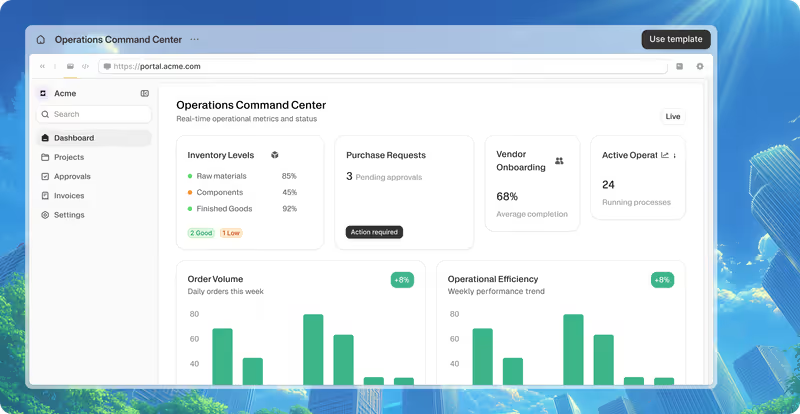
Zite vs Softgen, on screen

zite.com
Zite homepage
softgen.ai
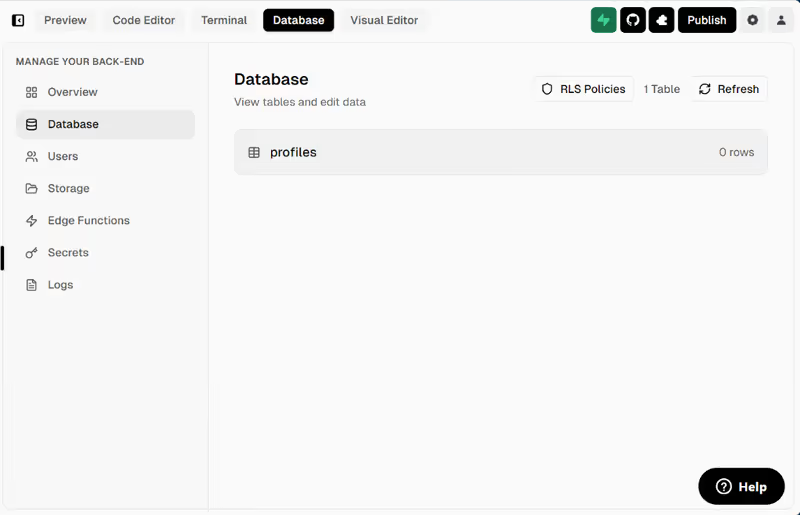
Softgen homepage

The useful comparison here is not who can produce a prettier first screen. It is who can get a small business web app with logins and per-user data over the line without turning basic app plumbing into a guessing game. Zite and Softgen diverge sharply on that job because Zite is anchored in structured database-and-form workflows, while Softgen leans on a chat-first code generation loop that is much looser once the app stops looking like a simple demo.

That job exposes the failure modes that matter because authentication, permissions, and data isolation are where business apps stop being mockups. A tool can look fast in a landing-page demo and still become fragile the moment you need customer-specific records, role-based access, and repeat edits after launch.


The audience

Who each one is for

Zite

  • Operations teams building internal trackers, portals, and approval flows around structured data.
  • Small businesses comfortable accepting rigid layouts in exchange for steadier workflows.
  • Form-heavy builders who care more about validation logic than custom visual polish.
  • Non-developers managing multi-step processes tied closely to tables and user accounts.

Softgen

  • Indie hackers testing a cheap MVP before handing code to a developer.
  • Founders making quick public demos, directories, or simple SaaS mockups.
  • Builders willing to iterate through chat instead of using a visual editor.
  • Teams that value exportability more than stability inside the platform itself.

Zite is for operators trying to stay inside a structured app builder. Softgen is for builders who treat the platform as a fast first draft.

The scope

What you'd build with it

Zite

  • Client portals, internal dashboards, and workflow apps built around forms and tables.
  • Team trackers, onboarding flows, and approval systems with predictable user roles.
  • Business apps that need built-in SQL data structures more than custom interface flourishes.
  • Not a good fit for highly branded consumer SaaS with unusual layouts or interactions.

Softgen

  • Simple SaaS MVPs with lightweight billing flows and standard page structures.
  • Public directories, resource hubs, and early validation projects for new ideas.
  • Throwaway prototypes intended to be exported and rebuilt in a normal dev stack.
  • Not a good fit for secure, permission-heavy business portals with complex data visibility.

The permissions question

Zite approaches the core problem through a more structured stack: a built-in SQL database, spreadsheet-style data management, and workflows that inherit some of the discipline of its Fillout lineage. That matters on a login-based business app because user flows, validation, and table-backed logic are less ad hoc than pure prompt-to-layout generation. The tradeoff is rigidity. Once you want to bend the interface far from its generated patterns, the same structure that helps the backend starts to constrain the front end.

Softgen pushes more of the same problem into its Cascade AI Agent and generated full-stack code. That can look flexible at first, especially if the goal is to get screens and basic app scaffolding quickly, but permissions-heavy apps are exactly where generated auth logic and broad code rewrites become dangerous. Without a drag-and-drop editor, even small corrections can trigger another chat loop, and when the model rewrites large fragments, the risk is not just uglier code but weaker data access assumptions.

Strengths

Where each one is strong

Edge: Zite

Zite has the stronger business-app core because its data and workflow model is more structured from the start.

Zite

  • Structured app backbone with built-in SQL data, workflow logic, and form-oriented validation.
  • Plan Mode lets builders review a markdown change plan before spending execution credits.
  • Unlimited users across plans avoids the usual per-seat tax on internal business tools.
  • Multi-step workflows can be handled inside the platform without bolting on extra middleware.

Softgen

  • Low entry price makes it easy to test an idea without a large fixed commitment.
  • Code export gives teams an exit path if they decide to finish the product elsewhere.
  • Fast prompt-based generation can produce standard layouts and early MVP scaffolding quickly.
  • Built-in Stripe-oriented scaffolding helps with basic paid-product experiments.

Failure modes

Where each one breaks

Edge: Zite

Zite's limits are annoying, but Softgen's failures are more damaging for a login-based business app because they hit both security and maintainability.

Zite

  • Workflow quota pressure means reads, reloads, and normal usage can drain operational limits faster than expected.
  • Rigid templates make custom styling and unusual layouts harder than the initial prompt suggests.
  • Some useful features, including custom login screens and scheduled triggers, sit behind higher plans.
  • Generated backend workflows can become redundant and confusing to maintain after several edits.

Softgen

  • Chat-only editing turns minor UI fixes into repeated prompt loops that consume credits.
  • No visual drag-and-drop editor means you are dependent on the model for ordinary revisions.
  • Generated auth and query logic can become fragile when the app needs secure user-specific data.
  • Customization past simple templates tends to produce tangled code and harder-to-trust behavior.

Iteration cost

The fix loop, priced

Even

Both tools make iteration the real bill, just through different meters.

Zite

  • Pro starts at $19/mo and includes 100 base credits.
  • Active building can push users into much higher tiers, reportedly up to $3,769/mo.
  • The ugly case is operational burn: reads and page reloads also count against workflow limits.
  • Unused credits roll over, but the platform still couples app activity to hard monthly caps.

Softgen

  • Platform access is listed at $33/year before additional AI usage costs.
  • AI credits are pay-as-you-go, so repeated revisions become a direct variable expense.
  • The ugly case is trivial edits through chat repeatedly draining paid balance.
  • Because there is no structured visual editor, even small copy or layout tweaks can require more paid generations.

Both tools charge for uncertainty; the main difference is whether the bill appears as workflow consumption or prompt consumption.

Exit paths

The code you end up with

Edge: Softgen

Softgen at least gives you a way out, while Zite keeps the app inside its own walls.

Zite

  • No code export is available, so application logic stays inside the platform.
  • There is no GitHub sync, which limits normal developer handoff and versioning workflows.
  • Data portability is weaker, with migration leaning on manual exports rather than a real codebase.
  • No staging environment means production-safe change management is thinner than developers expect.

Softgen

  • Code export is supported, giving teams a path to continue outside the hosted builder.
  • Exported projects can be moved to common deployment setups such as Vercel or Netlify.
  • The downside is portability of messy output: exported code may be bloated and hard to extend cleanly.
  • Non-technical teams gain ownership on paper but may still need a developer to make use of it.

When neither wins

If the app is a real small business portal with logins and per-user records, neither Zite nor Softgen actually removes the risky part of the job. Both still leave you maintaining generated security-critical behavior around authentication, permissions, and who can see which records, which is exactly the layer non-technical teams are least equipped to audit.

For that use case, Softr is the tool with no fix loop: auth, user groups, and record-level permissions are platform configuration rather than generated code. That is the better fit when the priority is operating a secure business app, not owning a custom codebase; the honest boundary is that Softr is the wrong choice for highly custom consumer UI or teams that specifically want to own and extend raw application code.

Verdict

Zite wins for this job if you are building a small business web app with logins and per-user data and can stay inside a structured, form-first product shape. The strongest reason is simple: its database and workflow model is better aligned with business-app plumbing than Softgen's looser chat-generated stack.

Softgen is the right pick instead when the real goal is a cheap, fast MVP that you expect to export and finish outside the platform. If the app is mostly a proof of concept rather than a long-lived operational tool, its lower-friction entry point and export path matter more than its weaker in-platform editing model.

For non-developers shipping a real portal, the cleaner call is past both tools to Softr. When auth and permissions are the product risk, configuration beats generated code.

Q & A

Frequently Asked Questions

Is Zite better than Softgen for small business web apps?

Usually yes for this specific job. Zite is better aligned with structured forms, workflows, and table-backed app logic, which matters more than flashy first-pass generation when logins and per-user data are involved. Softgen is more useful as a quick MVP draft than as a stable business app builder.

Which costs more to iterate on, Zite or Softgen?

Both can get expensive once you are fixing and refining instead of generating the first version. Zite can surprise you through workflow and credit consumption tied to app activity, while Softgen burns money through repeated prompt-based revisions. The cheaper one depends on whether your pain shows up in operations or editing.

Can I export my app from Zite or Softgen?

Softgen supports code export, so you can move the generated project into another hosting and development workflow. Zite does not offer code export, which makes it much more locked in. If owning the codebase is a hard requirement, Softgen has the advantage.

Is Softgen good for secure apps with user permissions?

It is a weaker fit for that job than for simple MVPs or public-facing prototypes. Once the app depends on reliable authentication and user-specific data access, chat-driven rewrites and generated backend logic become a bigger risk. It is better treated as a starting point than as the final operating environment.

What should a non-developer use instead for a secure client portal?

Softr is the better no-code route for that use case. It handles auth, user groups, and record-level permissions as platform features instead of making you maintain generated security-sensitive logic. That makes it a safer choice for business portals, though not for highly custom consumer apps.