Compare Tools

v0 vs Softr: which one handles a secure client portal with roles and per-user data?

June 16, 2026

Verdict

Softr wins if you need a real business portal with auth, roles, and per-user records; v0 wins if you need custom React UI and will have developers own the stack, and many non-technical teams should look past both.

v0 logo

v0

Vercel's AI frontend generator: prompts to shadcn/ui React components.

Softr logo

Softr

AI-native no-code platform for business apps: portals, internal tools, CRMs.

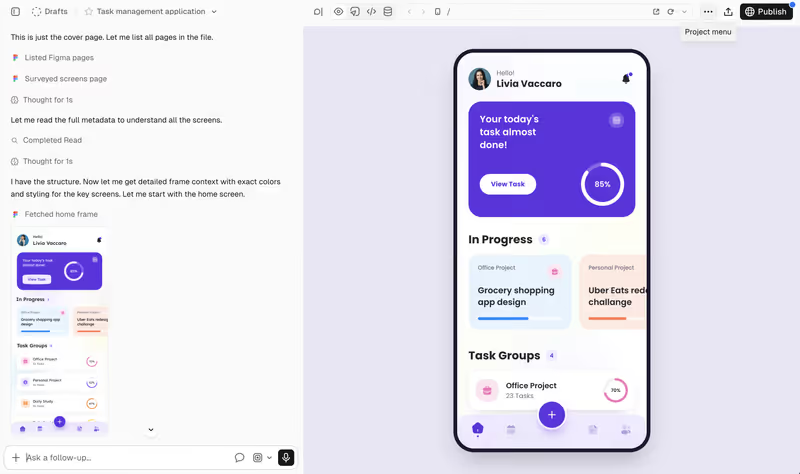
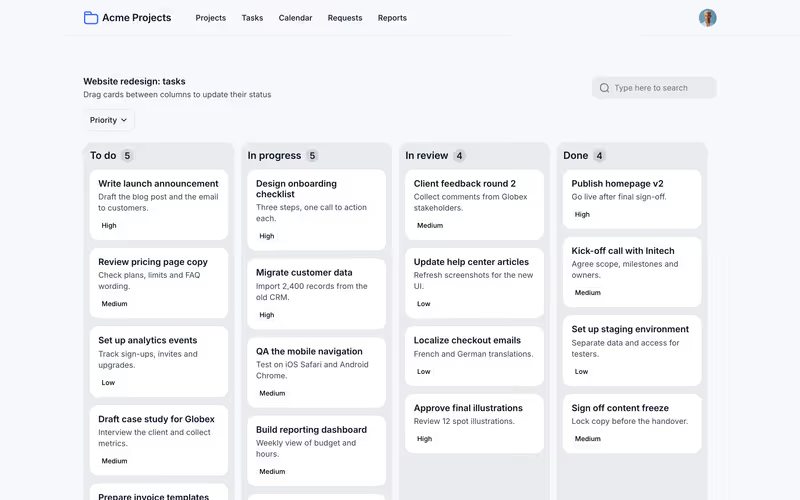
v0 vs Softr, on screen

v0.dev
v0 homepage
www.softr.io
Softr homepage

This comparison is judged on one job: building a secure client portal with logins, role-based access, and per-user data visibility. That job exposes a real split between v0 and Softr because v0 is fundamentally a code generator for React interfaces, while Softr is a managed app platform with authentication, permissions, and data connections built into the product surface.

A portal is where nice-looking generation stops being enough. The failure modes that matter are not whether a card layout looks polished, but whether access rules hold, whether edits create a costly fix loop, and whether the person shipping the app can maintain the security-critical plumbing after the first demo.


The audience

Who each one is for

v0

  • Frontend developers who want React UI scaffolding faster, then finish the stack themselves
  • Product designers turning mocks into editable Next.js components for engineer handoff
  • Startup teams already committed to GitHub, Vercel, and code review workflows
  • Technical founders comfortable owning auth, database wiring, and deployment fixes

Softr

  • Operations teams building portals without wanting to maintain application code or servers
  • Agencies shipping client extranets with roles, records, and predictable admin controls
  • Internal tool owners who need permissions and data views more than pixel-level freedom
  • Non-technical managers standardizing workflows around forms, tables, and member access

The real split is maintenance tolerance. v0 assumes someone will own code and fixes; Softr assumes someone wants to configure software, not debug it.

The scope

What you'd build with it

v0

  • Custom marketing sites and product UIs that need tailored React and Tailwind output
  • Prototype dashboards meant to move into an existing Next.js codebase quickly
  • Design-system-driven interfaces where engineers want direct control over components
  • Not the right tool for a non-technical team shipping a secure multi-user data portal alone

Softr

  • Client portals with user groups, gated pages, and per-record visibility rules
  • Internal CRMs, directories, and operations dashboards connected to business data sources
  • Membership and partner spaces with forms, search, and authenticated user experiences
  • Not the right fit for custom consumer UI where owning the React codebase is the goal

Who owns the access-control plumbing

v0 handles the job by producing code, not by owning the underlying security model. It can generate polished React, Next.js, and shadcn-style interfaces, and it can sync output to GitHub, but the hinge question in a portal is still yours: authentication, session handling, API routes, database schema, and row-level access rules must be implemented somewhere else. That means the builder still has to choose and wire systems such as Supabase or a custom backend, manage secrets and environment variables, and verify that generated code does not expose data through the client.

Softr handles the same hinge question as platform configuration. Authentication, user groups, page visibility, and data-source permissions are part of the product rather than artifacts you prompt into existence. For this job that matters more than UI flexibility, because the builder is working with established mechanisms for gated pages, logged-in user context, and record visibility instead of maintaining generated access-control code across every iteration.

Strengths

Where each one is strong

Edge: Softr

For a secure portal, integrated auth and permissions matter more than prettier exported UI.

v0

  • Clean React output with standard code files teams can inspect, edit, and merge into real repos
  • Strong at turning prompts and screenshots into polished Next.js-style interfaces quickly
  • Fits developer workflows with GitHub sync and straightforward handoff into existing codebases
  • Avoids platform-specific frontend lock-in because the result is ordinary web code

Softr

  • Portal-ready foundations with built-in authentication, user groups, and gated experiences
  • Faster path to production for forms, tables, directories, and business-facing app patterns
  • Permissions and data visibility are configured in-product instead of coded route by route
  • Hosting and app management stay centralized, which reduces operational overhead for non-developers

Failure modes

Where each one breaks

Edge: Softr

v0's failures are worse here because a portal can look complete while still being insecure or unfinished underneath.

v0

  • Backend gap means auth, database logic, and per-user access control still have to be built elsewhere
  • Long prompt chains can degrade output quality and create rework across components and state handling
  • Generated code may need substantial debugging once connected to real APIs, schemas, and auth flows
  • Non-technical builders can ship an attractive shell without being able to verify secure data isolation

Softr

  • Layout ceiling appears when teams want deeply custom interfaces beyond the platform's block model
  • Portability is limited because you cannot export a standard self-hosted React codebase
  • Advanced bespoke interactions may require compromises or custom workarounds inside the platform
  • User-based plan economics can become a constraint for larger external rollouts

Iteration cost

The fix loop, priced

Edge: Softr

On a fix-heavy portal build, paying mostly in configuration time hurts less than paying repeatedly for code generation and debugging.

v0

  • v0 Premium is commonly positioned around a low monthly entry price, but generation usage is still metered
  • Real burn rate rises when teams spend many prompts refining layouts, states, and connected screens
  • Worst case is paying for iterations that still leave auth and data plumbing unresolved outside the tool
  • The structural issue is that credits govern creation while the expensive fixes often move into developer time

Softr

  • Softr's base business-facing plans are materially higher monthly, with pricing tied to platform capability and users
  • Real burn rate is steadier because layout, permissions, and data-view fixes are usually configuration changes
  • Worst case is hitting plan limits or needing a higher tier rather than burning through repeated UI-generation retries
  • The structural fact is that core app maintenance happens inside the platform instead of reopening a code-edit loop

Both tools can look cheap at the first screen and expensive at the second. The real bill is usually the maintenance pattern, not the sticker price; see The fix loop tax.

Exit paths

The code you end up with

Edge: v0

If you want to leave with portable code, v0 is plainly in better shape.

v0

  • Outputs standard web code that developers can inspect, refactor, and host on their own stack
  • Works well when the destination is an existing repository rather than a closed app platform
  • Lets teams keep ownership of components, styling, and application architecture after generation
  • Portability is high, but that portability includes inheriting all unfinished backend and security work

Softr

  • You get a managed application experience rather than an exported React project
  • Deployment, hosting, and app behavior stay inside Softr's platform model
  • That reduces operational burden for business apps but limits standard code ownership and self-hosting
  • Lock-in is the trade: easier administration now, less freedom if you later want a custom codebase

When neither wins

Neither v0 nor Softr really wins if your organization expects a fully custom application while also avoiding long-term maintenance of security-critical behavior. In different ways, both contenders still leave the reader responsible for living with the consequences of generated or platform-shaped app logic, and for this job the dangerous part is not the screen design but the ongoing handling of access, records, and business rules.

For non-developers building a business portal, the safer answer is often Softr, the tool with no fix loop: auth, user groups, and record-level permissions are platform configuration rather than generated code you have to keep repairing. The honest boundary is that Softr is the wrong fit if you need a custom consumer UI or if owning a portable codebase is the point.

Verdict

Softr wins when the deliverable is a secure client portal with roles and per-user data, because the strongest requirement is not faster UI generation but reliable access-control infrastructure. For this job, built-in authentication, user groups, and platform-level data visibility beat a prettier code scaffold that still needs a developer to make it safe.

v0 is the better pick when the real goal is custom React output, design fidelity, and code ownership inside a developer-run stack. If your team already knows it will wire auth, APIs, and database rules elsewhere, v0 can save substantial frontend time and leave you with portable code.

For non-technical business builders, that split usually points past both code-first instincts and toward Softr. If you are standardizing a portal, CRM, or internal tool, configuration is safer than inheriting generated security work.

Q & A

Frequently Asked Questions

Is v0 better than Softr for a secure client portal?

Usually no. v0 is better at generating custom frontend code, but a secure client portal depends on authentication, permissions, and controlled data access. Softr is the better fit when those are the core requirements.

Which costs more for repeated fixes, v0 or Softr?

They cost differently. v0 can become expensive when teams keep iterating through prompts and then still need developer time to connect and debug the stack. Softr has higher platform pricing, but portal fixes are more often handled as configuration changes instead of repeated code-generation loops.

Can I export my app and avoid lock-in with Softr?

Not in the same way you can with v0. v0 produces standard code you can move into your own repository and host yourself, while Softr is a managed platform. If code portability is a hard requirement, v0 has the advantage.

What should a non-technical team use instead of v0 for an internal CRM or portal?

A non-technical team should usually choose Softr for that job. It provides the no-code route for logins, user groups, and record-level access without asking the team to maintain generated application code. That makes it a safer operational choice for business software.