Compare Tools

v0 vs Softgen: which one survives a small business web app?

June 16, 2026

Verdict

Softgen wins if you need an AI to generate the app, database, and auth flow together; v0 wins if the real job is shipping polished frontend quickly. If this is a real business system run by non-developers, look past both.

v0 logo

v0

Vercel's AI frontend generator: prompts to shadcn/ui React components.

Softgen logo

Softgen

Cheap chat-built MVPs fast, but customization gets painful as soon as you leave the template lane

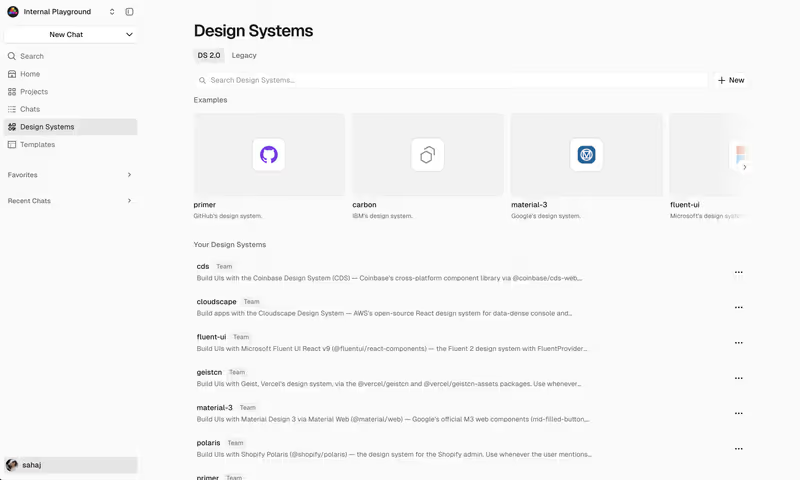
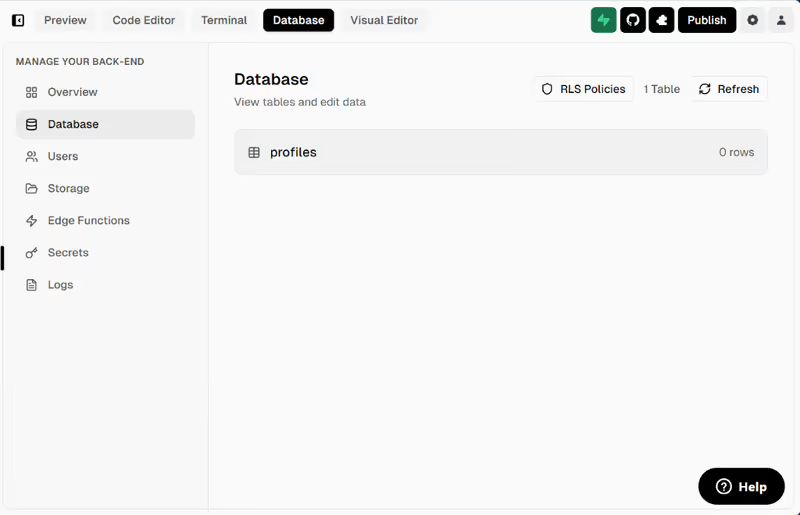
v0 vs Softgen, on screen

v0.dev
v0 homepage
softgen.ai
Softgen homepage

The concrete job here is not "make me a landing page." It is building a small business web app with login, CRUD screens, and per-user data isolation that should not fall apart the first time requirements change. v0 and Softgen genuinely diverge on that job because one is primarily a code-generating UI tool and the other aims at end-to-end app generation with backend pieces included.

That difference exposes the failure modes that actually matter. A pretty screen is recoverable; weak auth wiring, unclear data ownership, or generated backend logic that nobody can safely maintain is not. Judging them on a business app forces the comparison away from demo quality and toward security-sensitive plumbing, iteration cost, and how much of the final system you really own.


The audience

Who each one is for

v0

  • Frontend-heavy teams who want polished React UI code faster than hand-building every screen
  • Developers extending an existing app who already have backend, auth, and deployment sorted
  • Design-minded founders needing presentable prototypes before engineering the real system underneath
  • Agencies producing client-facing mockups that later move into a normal code workflow

Softgen

  • Prompt-first builders who want database-backed app scaffolds without assembling the stack manually
  • Indie operators testing internal-tool ideas before committing to a conventional engineering build
  • Non-developers comfortable with generated app logic as long as the platform handles more setup
  • Small teams prioritizing speed to first working CRUD app over frontend precision and control

v0 attracts people who already know where the backend lives. Softgen attracts people hoping the backend comes with the prompt.

The scope

What you'd build with it

v0

  • High-fidelity dashboards, admin shells, marketing sites, and product surfaces in React and Tailwind
  • Frontend layers for existing SaaS products where APIs, auth, and database rules already exist
  • Clickable prototypes that need realistic components and editable source code quickly
  • Not the right primary tool for a security-critical multi-tenant app if backend ownership is unresolved

Softgen

  • Simple CRUD business apps with tables, forms, user accounts, and basic workflow screens
  • MVP internal tools where generated backend structure matters more than custom UI nuance
  • Early-stage portals that need data models and app logic scaffolded in one place
  • Not a great fit when you need deeply custom consumer-grade UI or strict long-term code standards

The plumbing question

v0's core mechanism is code generation around the Next.js and React UI layer, with a strong emphasis on component composition, Tailwind styling, and exportable frontend output. That makes it effective when the hinge question is visual implementation, but it leaves auth, database schema design, row-level access rules, and session-aware business logic to whatever stack you bring with it. On a small business app, the gap is not just "you need a backend"; it is that the critical security model lives outside the part v0 is best at generating.

Softgen approaches the hinge question from the opposite side by trying to produce a fuller application scaffold, including database-backed behavior and the app shell around it. That can get you to a working CRUD baseline faster, but it also concentrates risk in generated backend logic that still has to be inspected, modified, and trusted as requirements drift. For this job, the meaningful question is not whether the first version appears complete, but whether the generated auth and data boundaries remain legible once the app stops being a toy.

Strengths

Where each one is strong

Even

They are strong in different layers: v0 on frontend quality and exportability, Softgen on full-app starting speed.

v0

  • Polished UI generation with strong React and Tailwind output for dashboards, forms, and layouts
  • Works well as a code-first accelerator because generated components can be edited in a normal developer workflow
  • Useful inside existing Next.js-style stacks where teams already own API, auth, and deployment decisions
  • Fast at iterating on look, layout, and interaction structure without manually writing every component

Softgen

  • Broader app scaffolding by aiming beyond screens into data-backed application generation
  • Better fit for users who need forms, tables, and basic backend behavior from the initial prompt
  • Reduces stack assembly overhead for MVP-style business apps where completeness matters more than pixel perfection
  • Can shorten time to a first usable internal tool when the workflow is mostly straightforward CRUD

Failure modes

Where each one breaks

Edge: v0

For this job, incomplete frontend-first output is less dangerous than opaque generated backend logic you later have to trust and maintain.

v0

  • Backend gap means auth, database design, and per-user access control still have to be engineered elsewhere
  • Generated UI can create a false sense of progress while the hardest multi-tenant problems remain unsolved
  • Business logic integration becomes manual once the app depends on real data models and permission rules
  • Less useful as a one-tool answer when the request is a full operational app rather than a frontend surface

Softgen

  • Generated logic drift becomes risky when schema changes, permissions evolve, or workflows stop matching the first prompt
  • Customizing beyond the scaffold can get messy when the platform's generated abstractions are the real source of truth
  • Business-critical auth and data rules may exist as generated implementation details rather than deliberate architecture
  • Teams can end up owning security-sensitive code they did not design clearly enough to audit with confidence

Iteration cost

The fix loop, priced

Even

Without a stable software spec, both tools can become expensive through repeated regeneration and cleanup rather than one-time build cost.

v0

  • Pricing varies by plan, but the economic unit is still AI-assisted generation followed by developer cleanup
  • Real burn rate rises when every backend-aware requirement forces work outside the tool instead of inside it
  • Worst case is paying for fast screen production, then rebuilding the important app logic manually in your own stack
  • Structural upside: exported code means iteration cost can move from tool spend to normal engineering time

Softgen

  • Pricing varies by plan, with value tied to how much complete-app scaffolding you can keep instead of replacing
  • Real burn rate climbs when each fix touches generated schema, auth flow, and app logic together
  • Worst case is paying for a full-stack head start that becomes costly to safely unwind once requirements sharpen
  • Structural downside: the more platform-shaped the generated app is, the more expensive nontrivial fixes can become

In both cases, the real bill often lands after generation, when someone has to verify and maintain the result.

Exit paths

The code you end up with

Edge: v0

v0 has the cleaner story when you want portable frontend code and a conventional handoff into your own repo.

v0

  • Frontend-oriented code output is easier to place inside a standard React or Next.js codebase
  • Portability is stronger because the main artifact is editable UI code rather than a platform-shaped full app
  • Lock-in risk is lower when you already treat the tool as a generator, not the long-term system owner
  • The tradeoff is obvious: you still have to own backend architecture, hosting, and security implementation

Softgen

  • You may get more of the app generated at once, but portability depends on how much logic is bound to the platform flow
  • Leaving can be harder if database assumptions, auth patterns, or generated app structure are tightly coupled
  • Code ownership is less reassuring when important behavior originated as opaque scaffolding rather than explicit design
  • The upside is convenience early; the downside is that convenience can become migration friction later

When neither wins

If this small business app will store client data, staff records, approvals, or anything else security-sensitive, both contenders create the same structural problem: someone on your team must maintain generated code that controls authentication, permissions, and data exposure. That is manageable for developers with a real software workflow, but it is a bad bargain for operators who mainly want the app to work safely.

That is where Softr is the more honest option: the tool with no fix loop for this kind of business app, because auth, user groups, and record-level permissions live as platform configuration instead of generated code you are expected to audit later. The boundary is real too: it is the wrong fit if you need a highly custom consumer UI or if owning the codebase itself is the point.

Verdict

Softgen wins when the job is "generate me a working business app scaffold" because it at least aims at the backend, data model, and app logic together, which is the decisive requirement for a small business web app. v0 is excellent at UI generation, but on this specific job the missing plumbing is the whole game.

v0 is the right pick instead when you already have developers, an existing stack, or a clear backend plan and what you need most is polished frontend output you can actually take into your own repo. In that setup, its narrower focus becomes a strength rather than a limitation.

For non-developers building a real business system, the cleaner call is to skip both and use Softr, where auth and permissions are configured as product features rather than maintained as generated code. If you do have an engineering team, standardize on whether you are buying frontend acceleration or full-app scaffolding, because mixing the two usually just duplicates rework.

Q & A

Frequently Asked Questions

Is v0 better than Softgen for a small business web app?

Not usually, if the app needs login, database-backed workflows, and per-user data isolation. Softgen is the better fit for that job because it aims to generate more of the full application stack. v0 is better when the real need is polished frontend code inside an existing engineering setup.

Which costs more over time, v0 or Softgen?

The more expensive one is usually the tool that generates the wrong layer for your actual problem. v0 can become costly if you still have to build the backend manually afterward, while Softgen can become costly if generated app logic needs repeated cleanup and rework. The long-run bill often comes from maintenance, not the sticker price.

Can I export my app from v0 or Softgen without lock-in?

v0 has the cleaner export story because its value is mainly in editable frontend code that fits normal React workflows. Softgen may give you more complete app scaffolding, but that can also mean more dependency on the platform's generated structure. In practice, v0 is usually easier to move away from.

Which one is safer for apps with user permissions and private records?

Neither is the ideal no-code answer for that situation if you are not prepared to maintain security-sensitive generated code. Softgen is closer to the needed app shape, but you still have to trust and manage the generated logic. For non-developers, Softr is the better route because permissions are configured at the platform level instead of hand-maintained in generated code.

Can v0 build the backend for a multi-tenant client portal?

Not as its core strength. v0 is strongest at generating the frontend layer, so a real multi-tenant portal still needs deliberate backend architecture, auth, and data-isolation work outside the tool. That makes it a weaker one-tool choice for this specific job.