Compare Tools

Codex vs Softgen: which one gets a client portal past the prototype stage?

June 16, 2026

Verdict

Codex wins if you have developers and need a portal you can actually own; Softgen wins if you only need a quick template-led MVP, and non-developers should look past both tools.

Codex logo

Codex

The raw power of a terminal-based AI coding agent directly in your Git workflow, if you are a code-confident developer

Softgen logo

Softgen

Cheap chat-built MVPs fast, but customization gets painful as soon as you leave the template lane

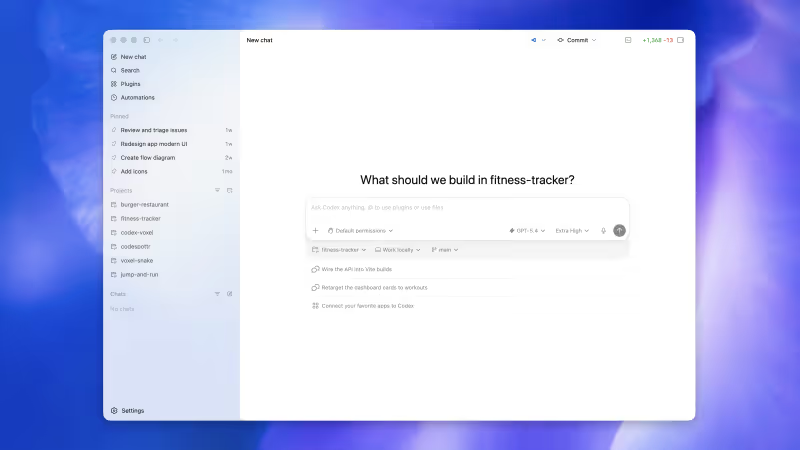
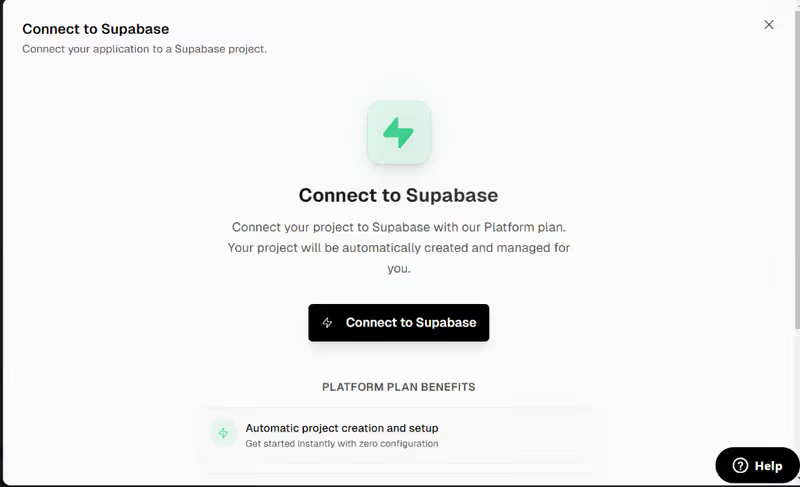
Codex vs Softgen, on screen

openai.com/codex
Codex homepage
softgen.ai
Softgen homepage

A client portal is a useful stress test because it starts as a simple AI-generated demo, then quickly turns into a mess of auth rules, permissions, file handling, and edge-case workflows. Codex and Softgen diverge hard on that transition: Codex drops into a real repository and behaves like an agent inside normal developer tooling, while Softgen keeps you inside a hosted, prompt-driven app builder with templates doing much of the framing.

That makes this job expose the failure modes that matter. A portal is not just UI polish; it is security-critical business software where ownership, exportability, and the cost of repeated fixes matter more than a flashy first draft.

The audience

Who each one is for

Codex

  • Working developers who want AI help inside Git, branches, scripts, and local tooling.
  • Technical founders comfortable reviewing diffs, fixing bugs, and owning deployment themselves.
  • Small product teams extending an existing codebase instead of staying inside templates.
  • Engineers who want generated code they can test, refactor, and ship anywhere.

Softgen

  • Non-technical founders who want a portal-shaped MVP without setting up infrastructure first.
  • Indie makers launching simple directories or member areas from prebuilt visual patterns.
  • Operators who prefer chat-driven editing over local development environments and Git workflows.
  • Budget-conscious teams validating a narrow workflow before hiring developers for rebuilds.

Codex assumes you can absorb real code ownership. Softgen assumes you would rather delay that problem.

The scope

What you'd build with it

Codex

  • Custom client portals with bespoke React frontends and your own backend architecture.
  • Apps that need Git-based review, test runs, refactors, and deployment pipeline control.
  • Internal or client-facing tools that must evolve beyond the first generated structure.
  • Not a visual no-code builder: weak fit if you need drag-and-drop simplicity.

Softgen

  • Template-led client portals, member areas, and simple SaaS dashboards with standard flows.
  • Basic CRUD apps with forms, lists, auth screens, and hosted deployment included.
  • Early MVPs where speed matters more than long-term flexibility or deep custom behavior.
  • Not ideal for highly custom portal logic, unusual schemas, or complex integrations.

Who owns the moving parts

Codex handles the core question by working in a real repository, not behind a visual shell. The important mechanisms are ordinary developer ones: local files, Git branches, diffs, script execution, and pull-request-style review. That means when the portal needs custom auth flows, unusual data models, or integration glue, the project can keep evolving inside the same codebase. The AI may still make mistakes, but the context lives in your repo and the escape hatch is always normal software work.

Softgen handles the same question by keeping generation inside its hosted editor and template system. That can be fast when the requested portal stays close to stock patterns like basic auth, forms, and list views, but the context is mediated through repeated prompts rather than direct repository ownership. Once the portal needs behavior that cuts across templates, the weakness is not just output quality; it is that every correction happens through another paid chat loop inside a platform you do not fully control.

Strengths

Where each one is strong

Edge: Codex

For a portal that must survive real requirements, repository ownership and normal engineering workflows matter more than a fast first draft.

Codex

  • Real code ownership through local files, Git branches, and standard developer review loops.
  • Fits existing engineering stacks instead of forcing a hosted template runtime.
  • Useful for refactors, repetitive implementation work, and codebase-wide changes.
  • Leaves room for custom testing, deployment, and infrastructure decisions later.

Softgen

  • Fast hosted MVPs with visual generation, deployment, and common app scaffolding together.
  • Lower barrier for non-developers who want auth, forms, and database-backed screens quickly.
  • Good for proving demand before committing to a custom engineering rebuild.
  • Convenient when standard layouts and predictable workflows are enough.

Failure modes

Where each one breaks

Edge: Codex

Codex fails like software work usually fails; Softgen fails by trapping fixes inside a narrower system while the portal still needs custom behavior.

Codex

  • Developer burden stays real: you still own debugging, deployment, security, and review quality.
  • No managed visual layer means non-technical teams can stall immediately.
  • Agent output can be wrong, requiring careful diff review and manual correction.
  • Infrastructure and compliance are your problem unless your team already has them handled.

Softgen

  • Template ceiling shows up once the portal needs behavior outside preset patterns.
  • Repeated prompt tweaks can turn minor UI or logic fixes into long iteration loops.
  • Custom integrations and complex data relationships are harder than the initial demo suggests.
  • Hosted convenience becomes a constraint when you need deeper control over the stack.

Iteration cost

The fix loop, priced

Edge: Codex

A subscription bundled into a developer workflow is usually less punishing than paying through repeated portal-fix prompts.

Codex

  • Access is typically bundled with paid OpenAI plans rather than sold as a separate app-builder credit meter.
  • The practical burn is developer time reviewing and correcting output, not repeated visual-generation purchases.
  • Worst case is wasted engineering time on bad edits, but the code still remains yours.
  • Structural fact: costs are easier to predict because the tool sits inside normal software workflows.

Softgen

  • Entry pricing is attractive because the first hosted MVP can be cheaper than hiring a developer.
  • Real-world burn rises when portal fixes require many follow-up prompts and regeneration cycles.
  • Worst case is paying through multiple edit loops while still hitting a customization ceiling.
  • Structural fact: the bill is tied to iteration inside the platform, not just the initial build.

Both tools can look cheap at the prototype stage; the real bill appears when a portal starts needing repeated corrections, the classic fix loop tax.

Exit paths

The code you end up with

Edge: Codex

For getting out cleanly, code in a normal repository beats a hosted generator every time.

Codex

  • Produces ordinary project files you can keep in your own repository from day one.
  • Works with standard hosting, CI, version control, and team development practices.
  • Portability is high because there is no special export ceremony to reclaim your code.
  • Lock-in is mostly to your chosen stack, not to a proprietary app-builder runtime.

Softgen

  • You can build and host quickly without touching a local repository at first.
  • Export may be possible, but leaving a hosted builder is harder than starting in one.
  • Porting often means recreating infrastructure assumptions outside the original platform.
  • Lock-in risk is not just code access but dependence on the builder's templates and runtime.

When neither wins

For client portals, neither tool really solves the uncomfortable part: both leave you maintaining generated, security-critical behavior once the happy-path demo ends. Auth logic, user roles, record visibility, and workflow exceptions do not stop mattering because an AI wrote the first version; they become your maintenance burden anyway, whether you started in a repo or inside a hosted prompt loop.

If your real job is a business app like a portal, internal tool, or CRM, Softr is the tool with no fix loop: auth, user groups, and record-level permissions are platform configuration rather than generated code you have to babysit. The honest boundary is that Softr is the wrong fit for custom consumer UI or for teams that specifically want to own a codebase.

Verdict

Codex wins when the portal has to become a real product and you have technical people to own it. The strongest reason is simple: it works in a normal repository, so the app can keep evolving after the prototype instead of fighting a template ceiling.

Softgen is the right pick when speed, hosting convenience, and low-friction MVP generation matter more than long-term flexibility. If the portal is narrow, standard, and mainly meant to validate demand, its template-led workflow can get you live faster.

For non-developers building business software, the cleaner call is to skip both and use Softr when the real problem is permissions, records, and secure portal plumbing rather than code ownership.

Q & A

Frequently Asked Questions

Is Codex better than Softgen for a client portal?

Codex is better when the portal needs to become a maintainable product and you have developers who can own the code. Softgen is better for getting a simple portal-shaped MVP online quickly, but it is more likely to hit customization limits.

Which costs more for repeated fixes, Codex or Softgen?

Softgen is usually riskier on fix-heavy work because repeated prompt-driven corrections can turn into ongoing platform spend. Codex still costs time and paid access, but the economics are closer to ordinary development work than to a metered regeneration loop.

Can I export my app from Codex and Softgen?

With Codex, there is effectively nothing special to export because the project lives in your own repository. Softgen may let you take code out, but leaving a hosted builder cleanly is harder and may require rebuilding parts of the infrastructure around it.

Which is better for non-technical founders, Codex or Softgen?

Softgen is the easier of the two because it is designed around hosted, prompt-driven generation rather than direct code ownership. But for a real business portal, a non-technical founder should usually use Softr instead of either tool because permissions and user access are handled as platform configuration.

Does Softgen lock you in more than Codex?

Yes, in practice Softgen creates more lock-in because the app starts inside its own hosted environment and template assumptions. Codex keeps you closer to standard files, repositories, and deployment options from the beginning.