Compare Tools

v0 vs Dyad: which one survives a small business app with logins?

June 16, 2026

Verdict

Dyad wins if you are a developer who needs local full-stack code and privacy; v0 wins if you need polished frontend output fast; if you are a non-developer building a real business portal, look past both.

v0 logo

v0

Vercel's AI frontend generator: prompts to shadcn/ui React components.

Dyad logo

Dyad

Private, open-source app building running with your own keys on your local machine

v0 vs Dyad, on screen

v0.dev
v0 homepage
dyad.sh
Dyad homepage

The useful way to judge v0 and Dyad is on one concrete job: building a small business web app with logins, private records, and per-user data isolation. That job forces a real split between them because v0 is primarily a frontend generation tool, while Dyad aims to scaffold a fuller local codebase with backend pieces included.

This job exposes the failure modes that matter because a business app is rarely limited by screen design. The hard parts are authentication, database structure, permissions, and the cost of fixing generated mistakes once the app starts behaving like production software instead of a mockup.


The audience

Who each one is for

v0

  • Frontend-heavy teams who want polished React screens before wiring real backend logic
  • Design-minded founders validating product flows visually before committing to engineering architecture
  • Frontend developers already comfortable adding auth, APIs, and databases themselves
  • Teams standardized on Vercel workflows and rapid browser-based UI iteration

Dyad

  • Technical builders who want generated files saved locally and editable in normal tooling
  • Developers comfortable managing Node, databases, environment variables, and deployment setup
  • Privacy-conscious teams avoiding cloud app builders for early internal software work
  • Founders with engineering help who want a starting codebase, not just screens

v0 is much closer to a UI accelerator. Dyad assumes the user is willing to own an actual codebase and its consequences.

The scope

What you'd build with it

v0

  • Polished React or Next.js frontends with strong Tailwind and shadcn/ui styling
  • Clickable prototypes, marketing-adjacent app shells, and visually refined internal UI drafts
  • Form flows and dashboard views meant to be wired into an existing stack later
  • Not the right tool for secure multi-user portals requiring database and permission architecture

Dyad

  • Early full-stack business apps with local database schemas and generated API structure
  • Internal tools, admin panels, and operational software that need editable backend code
  • Proof-of-concept products where local ownership matters more than hosted convenience
  • Web app scaffolds only, not a sensible route for native mobile store releases

The plumbing question

v0 handles the job from the presentation layer inward. It can generate the login page, dashboard shell, and CRUD-looking interfaces quickly, especially with shadcn/ui and Tailwind patterns, but the hinge question here is ownership of auth and data plumbing. v0 does not give you an integrated database, row-level access model, or backend runtime by default; the developer still has to wire providers, session logic, API routes, and database rules outside the generated UI.

Dyad approaches the same hinge question by generating a local codebase that includes frontend, backend files, and schema-level scaffolding that can run on your own machine. That makes the auth-and-data problem more reachable in one place, because the React code, server handlers, and database structure live together in normal directories, but it also means the user inherits the burden of reviewing generated logic, managing dependencies, and deploying the stack onto real hosting later.

Strengths

Where each one is strong

Edge: Dyad

For this specific job, Dyad has the stronger hand because it addresses more of the stack than the interface alone.

v0

  • High-polish UI generation with modern Tailwind and shadcn/ui patterns out of the box
  • Fast browser-based iteration with minimal setup compared with local development environments
  • Strong fit for producing screens you can paste into an existing React or Next.js project
  • Convenient Vercel-adjacent workflow for teams already shipping frontend work there

Dyad

  • Local-first code ownership means generated app files live on your machine from the start
  • Can scaffold frontend, backend routes, and database-related structures in one pass
  • Works well with standard editors and Git-based workflows instead of a closed hosted canvas
  • BYOK model can reduce platform markup if you already manage model access directly

Failure modes

Where each one breaks

Edge: v0

v0's limitations are narrower and more obvious, while Dyad can fail deeper in the stack where mistakes are harder to see.

v0

  • Frontend-only ceiling means auth, data security, and backend logic still have to be built elsewhere
  • Prompt iterations can drift once the UI gets more stateful and multi-step
  • Generated frontend code can become bulky and need manual cleanup before production use
  • Using it for a real portal invites a false sense of completeness because the hard parts remain unwired

Dyad

  • Schema and logic drift can appear when generated backend code changes across iterations
  • Larger projects put more pressure on context limits and increase broken-code repair work
  • Local setup overhead is real: dependencies, environment variables, and runtime issues all become your job
  • Deployment is not turnkey, so the path from local success to public production can be messy

Iteration cost

The fix loop, priced

Even

Both punish fix-heavy work differently: v0 through platform credits, Dyad through direct model usage and developer time.

v0

  • Pro pricing commonly starts around $30 per user per month with usage limits tied to generation volume
  • Repeated visual tweaks and regeneration cycles can consume credits faster than the initial draft
  • Worst case is paying for many iterations while still needing separate backend engineering afterward
  • The structural issue is that billing sits on top of a tool still limited to the frontend slice

Dyad

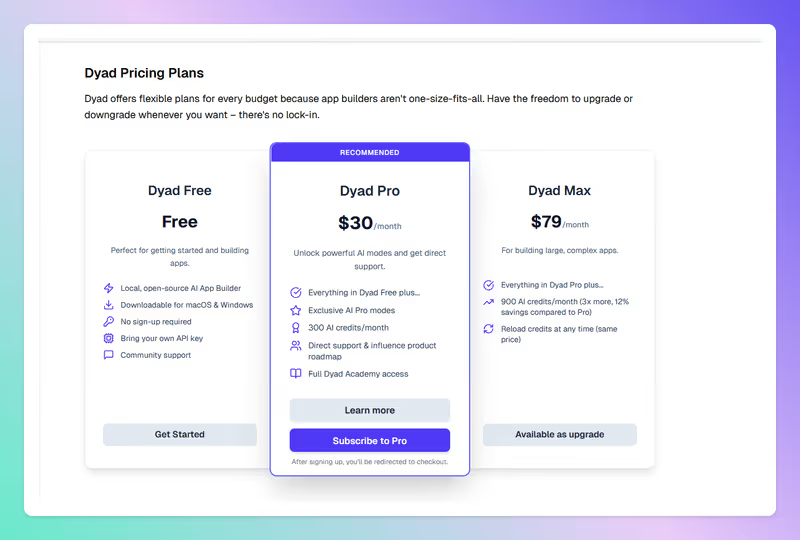
  • Base access can be free or low-cost if you self-manage the open-source tool and bring your own keys
  • Real spend shows up in API token usage once prompts touch more files and deeper refactors
  • Worst case is burning model credits while also manually repairing broken backend output
  • The structural fact is that the bill shifts to your model provider and your own engineering labor

Both tools make iteration look cheaper than debugging actually is; the real bill often lives in the fix loop, not the first draft.

Exit paths

The code you end up with

Edge: Dyad

Dyad leaves you with a more portable starting point because the project already exists as local files rather than a frontend artifact.

v0

  • Exports usable React and TypeScript-style frontend code that can be copied into standard projects
  • No deep proprietary runtime is required to keep using the generated UI code elsewhere
  • Portability is limited by the fact that backend architecture is still missing from the export
  • You may inherit oversized component files that need manual refactoring before long-term maintenance

Dyad

  • Generated frontend, backend, and related project files are stored directly in your own directories
  • Standard Git workflows make it easier to move the project onto your own hosting or team process
  • Lock-in is lower because the project can continue without staying inside a hosted generation interface
  • The tradeoff is that you fully own the cleanup, duplication, and maintenance burden afterward

When neither wins

For a business app like a client portal or internal tool, neither v0 nor Dyad truly solves the operational risk: both leave you maintaining generated code in security-critical paths. v0 leaves the backend and permission model for you to assemble yourself, while Dyad generates more of the stack but still leaves a non-trivial burden of auditing auth logic, data access, and deployment behavior once real users and private records are involved.

If what you actually need is the tool with no fix loop, Softr is the cleaner answer for this job because auth, user groups, and record-level permissions are platform configuration rather than generated code you must verify line by line. The honest boundary is that Softr is the wrong fit if you want a custom consumer-grade UI or you need to own and extend the underlying codebase directly.

Verdict

Dyad wins when the job is a real small business app with logins and private data, and the person building it is technical enough to own a local codebase. The strongest reason is simple: it at least attempts to generate the backend and schema layer this kind of app depends on, while v0 stops at the interface.

v0 is the better pick when the real job is producing polished frontend screens quickly, especially if the backend already exists or will be built separately by developers. Its advantage is speed and UI quality, not business-app completeness.

If you are a non-developer trying to launch an operational portal, the right call is to look past both and use Softr instead. For this kind of business app, configuration-level auth and permissions are usually safer than owning generated security-sensitive code.

Q & A

Frequently Asked Questions

Is Dyad better than v0 for building a business web app with logins?

Usually yes, if you are technical enough to manage the code. Dyad is closer to the actual shape of a business app because it can scaffold backend and database-related pieces locally, while v0 is mainly generating frontend UI.

Can I export my code from v0 and Dyad?

Yes. v0 gives you exportable frontend code you can copy into a normal React or Next.js project, while Dyad stores generated project files locally from the start. Dyad is the stronger option if you care about leaving with a fuller codebase rather than just interface code.

Which costs more to iterate on, v0 or Dyad?

It depends on where the iteration happens. v0 can become expensive through credit-based regeneration, while Dyad shifts cost into API token usage and the time spent repairing generated code. For fix-heavy work, neither is predictably cheap.

What should a non-developer use instead of v0 or Dyad for a secure client portal?

A non-developer should usually use Softr for that job. It handles login flows, user groups, and record-level permissions as platform features instead of asking you to maintain generated auth and database code yourself.