Compare Tools

Codex vs Dyad: which one survives taking a prototype to a real product?

June 16, 2026

Verdict

Codex wins if you already work like a software team inside Git; Dyad wins if you want local-first ownership and lower markup on iteration, while non-developers should look past both.

Codex logo

Codex

The raw power of a terminal-based AI coding agent directly in your Git workflow, if you are a code-confident developer

Dyad logo

Dyad

Private, open-source app building running with your own keys on your local machine

Codex vs Dyad, on screen

openai.com/codex
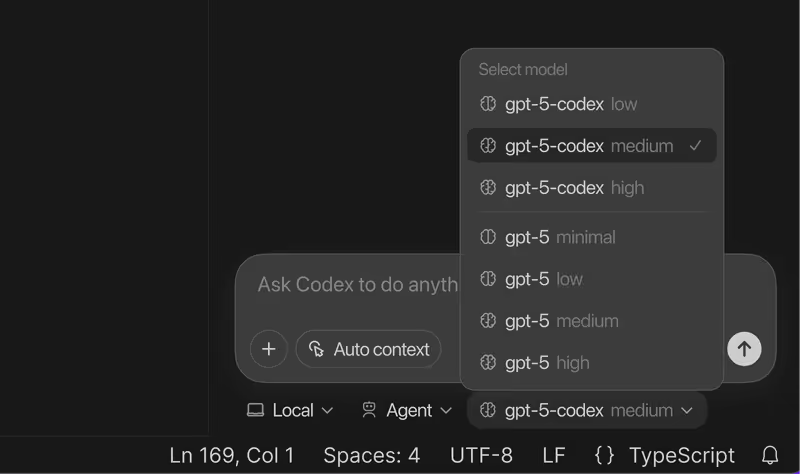
Codex homepage
dyad.sh
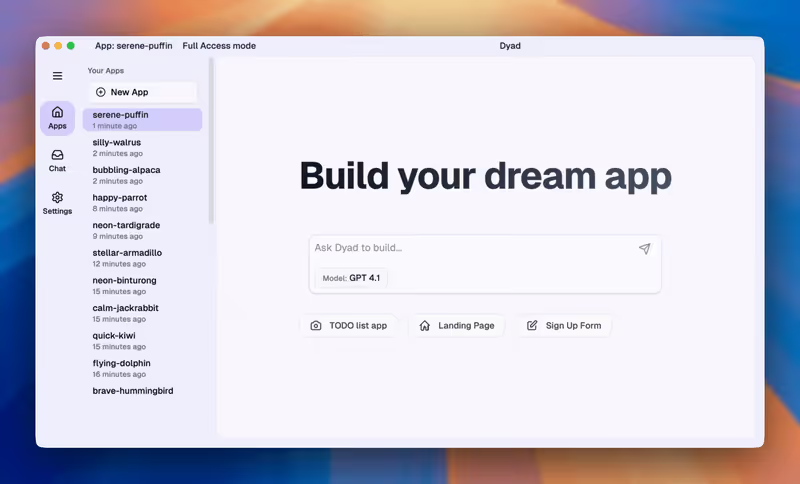
Dyad homepage

Taking a prototype to a real product is a specific test: can the tool help you move past a pretty first pass into software that survives auth, data modeling, deployment, and repeated fixes? Codex and Dyad genuinely diverge here because one is a Git-and-terminal agent built around existing developer workflows, while the other is a local-first visual builder that keeps the project on your machine.

This job exposes the failure modes that matter because production work is mostly not first-draft generation. It is context retention, safe edits across many files, predictable iteration cost, and whether you still control the code once the cheerful demo phase is over.

The audience

Who each one is for

Codex

  • Git-native engineers who already ship through branches, reviews, and terminal-heavy workflows.
  • Small product teams refactoring existing repos instead of starting from blank visual canvases.
  • Solo developers who want an agent to inspect files and act inside local repositories.
  • Backend-leaning builders comfortable validating AI edits through tests, diffs, and pull requests.

Dyad

  • Local-first builders who want generated app code saved directly on their own machine.
  • Privacy-sensitive developers who prefer BYOK models or local Ollama execution over cloud dependence.
  • Makers comfortable setting up Node, Git, databases, and hosting without a managed deployment layer.
  • Visual-first solopreneurs who want React scaffolding but still intend to own the resulting codebase.

Codex assumes you already behave like a software team. Dyad assumes you want more ownership and visibility, but still have to operate developer tooling.

The scope

What you'd build with it

Codex

  • Refactors and feature work inside existing production repos with established Git discipline.
  • Custom APIs, CLI tools, backend services, and code-heavy apps without visual-first requirements.
  • Parallel implementation work that benefits from branch-based execution and reviewable diffs.
  • Not a fit for non-technical operators who need preview, hosting, and permissions handled for them.

Dyad

  • Full-stack React web apps scaffolded locally with TypeScript, UI layers, and database wiring.
  • Internal tools and dashboards where local ownership matters more than instant managed deployment.
  • Projects that need direct file access, custom APIs, and freedom to choose model providers.
  • Not the right choice for native mobile app packaging or no-maintenance business software.

The context and ownership question

Codex handles the hinge question by living close to the repo. Its value is not just generation but branch-oriented execution: it reads the local project, works through terminal flows, and fits naturally into Git review habits. That makes it better at production-shaped change sets than a simple chat box, but it still depends on cloud model behavior and context windows; when a codebase sprawls, the risk is not lack of output but confident edits that miss architectural intent.

Dyad answers the same question from the ownership side. It runs as a local-first React desktop workflow, supports Bring Your Own Key usage, and can connect to Ollama for local models, which reduces platform dependence and keeps files on your machine. The tradeoff is that local ownership does not remove production complexity: hardware limits, model context limits, and messy generated boilerplate still land on you, especially once schemas, auth flows, and deployment configuration stop fitting into a neat first pass.

Strengths

Where each one is strong

Edge: Codex

Codex gets the edge because branch-based execution is more useful once the job becomes ongoing product engineering rather than first-pass scaffolding.

Codex

  • Branch-centric workflow fits existing repos, diffs, reviews, and pull-request habits.
  • Works directly against local project structure instead of forcing a proprietary app canvas.
  • Useful for refactors and multi-file edits where terminal access and repo awareness matter.
  • Better aligned with teams already running tests, CI, and disciplined code review.

Dyad

  • Local code ownership keeps generated files on your machine from the start.
  • BYOK model support avoids platform markup and gives flexibility across AI providers.
  • Ollama support creates an offline-capable path for privacy-sensitive development setups.
  • Visual desktop workflow is easier to inspect than a purely terminal-first agent loop.

Failure modes

Where each one breaks

Even

Both break in expensive ways for this job because the hard part is maintaining generated application logic after the prototype phase.

Codex

  • Cloud-model dependence means context misses can produce plausible but architecture-breaking edits.
  • No visual workspace, so UI-heavy iteration and inspection rely on your surrounding toolchain.
  • Manual validation remains mandatory because repo-aware agents can still introduce logic errors.
  • Usage limits and service-side variability can slow iteration when you need repeated fixes.

Dyad

  • Local setup burden shifts environment, database, and deployment complexity onto the builder.
  • Weaker models can generate bloated or redundant files that need manual cleanup.
  • Large projects still run into context-window and hardware constraints despite local ownership.
  • There is no managed one-click path through production hosting, security, and operational polish.

Iteration cost

The fix loop, priced

Edge: Dyad

Dyad hurts less on a fix-heavy build because the platform itself is free and the model bill is more configurable.

Codex

  • ChatGPT Plus is listed at $20 per month, with Pro at $200 per month for heavier access.
  • The real bill sits in repeated agent passes as developers iterate on broken or partial changes.
  • Worst case, a bad chain of parallel or repeated requests can consume substantial paid usage quickly.
  • Pricing is tied to OpenAI access tiers rather than a free local fallback with rollover.

Dyad

  • Dyad's community edition is free, so there is no base platform fee before model usage.
  • BYOK means you pay model providers directly instead of an added platform markup layer.
  • Large codebases can still burn through API credits fast when using premium hosted models.
  • There is a structural zero-cost path through local Ollama models if your hardware can cope.

Both tools still charge you in debugging time; the visible subscription is only part of the bill, as explained in the fix loop tax.

Exit paths

The code you end up with

Even

Neither tool traps you in a proprietary file format, but neither removes the maintenance burden of generated code.

Codex

  • Writes standard files into your existing repo, which you can clone, review, and host anywhere.
  • Stays close to your current languages and project layout rather than forcing a custom runtime.
  • Git history and diffs remain under your control if your team already owns the repository.
  • Portability is high, but quality depends on whether you catch bad edits during review.

Dyad

  • Saves standard React and related project files directly to local storage.
  • Lets you move the project into normal Git hosting and deploy through external providers.
  • Avoids proprietary export steps because the working folder already exists on your machine.
  • Ownership is real, but so is the burden of cleaning up generated structure and conventions.

When neither wins

For this job, neither tool truly wins for non-developers because both eventually leave you maintaining generated security-critical code: auth flows, permission checks, data access, and deployment plumbing. That is tolerable if you already think like an engineer, but it is a poor bargain if what you actually need is a business app that works without turning every change into a debugging session.

If you are building a portal, internal tool, or operations app, Softr is the tool with no fix loop: auth, user groups, and record-level permissions live as platform configuration, not generated code. The honest boundary is that Softr is the wrong fit if you need a highly custom consumer UI or you specifically want to own and maintain the codebase yourself.

Verdict

Codex wins when the prototype is already becoming a real software project and your strongest advantage is disciplined Git-based execution. Its branch-friendly, repo-aware workflow is simply better suited to repeated production edits than a visual local scaffolder alone.

Dyad is the better pick when ownership, privacy, and pricing flexibility matter more than fitting into a mature engineering pipeline. If you want local files, BYOK economics, and the option to run through Ollama, Dyad gives you more control over where the project lives and how the iteration bill accrues.

If you are a non-developer trying to turn a business app idea into something stable, look past both to Softr. For this kind of work, the best standard is not more generated code to maintain, but fewer security-critical moving parts in the first place.

Q & A

Frequently Asked Questions

Is Codex better than Dyad for taking a prototype to production?

Codex is better if you already run a real software workflow through Git, reviews, and developer tooling. Dyad is better if local ownership, privacy, and BYOK pricing matter more than deep branch-based execution. The split is less about raw generation quality and more about how you intend to operate the project after the demo stage.

Which costs more to use, Codex or Dyad?

Codex has a paid access layer through OpenAI plans, with ChatGPT Plus at $20 per month and Pro at $200 per month in the comparison data. Dyad's community edition is free, but you still pay for model usage if you connect hosted APIs. In practice, the bigger cost for both is the repeated fix loop once generated code starts needing corrections.

Can I export my code from Dyad or am I locked in?

Dyad is relatively portable because the project files are saved locally in a normal folder structure. You can move them into Git and deploy through standard hosting providers. That reduces lock-in, but it does not remove the need to maintain the generated code yourself.

Does Codex lock you into OpenAI?

More than Dyad, yes. Codex is tied to OpenAI's model and access structure in a way that makes the workflow dependent on that ecosystem. Your repo is still your repo, but the agent layer itself is not model-agnostic in the same way a BYOK local-first tool can be.

What should a non-developer use instead of Codex or Dyad for a business app?

For a portal, internal tool, or operational app, a non-developer is usually better served by Softr. It handles authentication, user groups, and record-level permissions as platform features instead of generated code. That makes it a better no-code route when the goal is running the business app, not maintaining a codebase.