
Compare Tools

Softgen vs Dyad: which one survives a small business app with logins?

June 16, 2026

Verdict

Dyad wins if you are a developer who wants local control and portable code; Softgen wins if you just need a fast, lightweight prototype. For a real business app with logins, look past both.

Softgen logo

Softgen

Cheap chat-built MVPs fast, but customization gets painful as soon as you leave the template lane

Dyad logo

Dyad

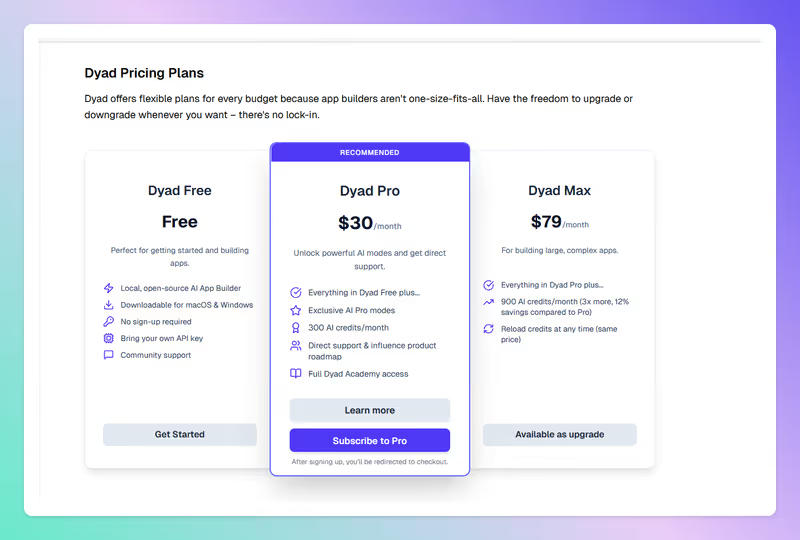
Private, open-source app building running with your own keys on your local machine

Softgen vs Dyad, on screen

softgen.ai
Softgen homepage
dyad.sh
Dyad homepage

To compare Softgen and Dyad fairly, the job has to be concrete: building a small business web app with user logins and per-user data. That job separates them quickly because Softgen leans on a managed, template-shaped builder experience, while Dyad leans on local code generation and developer ownership. The difference is not aesthetic; it is about how much of the app's security, routing, data model, and debugging burden lands on you.

This job also exposes the failure modes that actually matter. A landing page can survive vague prompts and messy generated code, but a login app cannot. If authentication breaks, if data filters are wrong, or if the fix loop gets expensive and recursive, the project stops being a prototype problem and becomes an operations and security problem.


The audience

Who each one is for

Softgen

  • Non-technical founders who want a quick SaaS mockup without setting up local tooling.
  • Indie hackers validating a simple product idea before investing in a developer workflow.
  • Makers comfortable staying inside a managed, chat-driven app builder experience.
  • Teams prioritizing speed to first prototype over deep code ownership and customization.

Dyad

  • Developers and technical teams who want local files, direct debugging, and repository ownership.
  • Builders bringing their own OpenAI or Anthropic keys to avoid platform markup.
  • Privacy-conscious operators who do not want project code and data leaving local machines.
  • Solo developers comfortable with Node, Git, terminals, and standard React workflows.

Softgen is for people trying to avoid a developer setup. Dyad is for people who already accept one.

The scope

What you'd build with it

Softgen

  • Early SaaS prototypes and simple directory-style apps built from familiar visual patterns.
  • Basic MVPs with logins and standard CRUD flows, if the data model stays uncomplicated.
  • Small internal or client-facing tools that fit a managed builder's assumptions.
  • Not the right choice for heavily custom product UX or complex security-sensitive logic.

Dyad

  • Full-stack React and Tailwind apps backed by local or hosted databases.
  • Developer-owned SaaS projects that need Git sync, code review, and custom hosting.
  • Private internal tools where keeping code and prompts local matters operationally.
  • Not the easy path for non-technical teams expecting turnkey auth and permissions setup.

The permissions question

Softgen handles much of the app shape through a managed builder flow, which reduces setup friction but keeps you inside its assumptions. That can work for standard login and CRUD patterns, yet the hinge issue for this job is per-user data isolation. Once the app needs more granular relationships, edge-case role logic, or unusual page behavior, the convenience layer becomes the constraint: you are still relying on generated behavior and prompt-driven fixes, but with less direct access to the underlying moving parts.

Dyad approaches the same problem from the opposite direction by generating a standard local codebase you can inspect in your own tools. That gives you real leverage over authentication libraries, API routes, environment variables, and database access patterns, and it makes Git-based debugging much more normal. The tradeoff is that nothing about per-user permissions becomes safe just because the code is local; the burden shifts to verifying that the generated middleware, server-side checks, and data filters are actually correct.

Strengths

Where each one is strong

Edge: Dyad

Dyad takes the edge because local, standard code is a stronger advantage than convenience on this job.

Softgen

  • Low-friction start with a managed builder flow aimed at getting an MVP on screen quickly.
  • Chat-driven generation reduces the need to assemble a local dev environment first.
  • Template-shaped layouts help non-developers move from concept to usable screens fast.
  • Managed hosting assumptions simplify the first deployment compared with a local code workflow.

Dyad

  • Local code ownership means the repository lives with you instead of inside a proprietary builder.
  • Bring-your-own-key usage can reduce markup and fit existing developer AI workflows.
  • Standard React and Tailwind output is easier to inspect, edit, and move into normal team processes.
  • Git-friendly structure makes handoff, review, and long-term maintenance more realistic.

Failure modes

Where each one breaks

Edge: Dyad

Dyad's failures are fixable in normal developer tools; Softgen's failures are worse when the builder's assumptions become the blocker.

Softgen

  • Prompt-loop regressions can turn small visual or logic changes into repeated regeneration cycles.
  • Template ceilings make unusual layouts or deeper workflow customization hard to force through cleanly.
  • Managed abstractions can hide the exact source of auth, data, or routing mistakes.
  • Exporting out of the platform may leave a codebase that is awkward to restructure later.

Dyad

  • Code bloat and duplication are common risks when generated changes stack up over time.
  • Large codebases can strain model context windows and make iterative fixes less reliable.
  • Local setup adds friction through Node, package, environment, and machine-specific issues.
  • A bad generated change can still break auth or data access if nobody reviews the code closely.

Iteration cost

The fix loop, priced

Edge: Dyad

On a fix-heavy build, paying direct model costs usually hurts less than paying platform-specific iteration tolls.

Softgen

  • Base access is positioned as low-cost entry, but meaningful iteration still depends on paid AI usage.
  • Prompted changes to layout and behavior can consume credits repeatedly during refinement.
  • The expensive case is not first draft generation but repeated repair of nearly-correct outputs.
  • The structural problem is that builder convenience does not remove the per-fix billing loop.

Dyad

  • The community path can be used with your own model keys instead of a bundled platform meter.
  • You pay underlying token costs directly, which is often easier for developers to reason about.
  • The expensive case is sending large code context and error traces over many repair cycles.
  • The structural advantage is that you are not also paying a lock-in premium for repository access.

Both tools turn iteration into a bill; the real question is whether you are paying for tokens, platform mediation, or both.

Exit paths

The code you end up with

Edge: Dyad

Dyad leaves you in better shape because the output fits standard developer ownership from day one.

Softgen

  • You may be able to export code, but the project shape is still influenced by platform conventions.
  • Managed backend assumptions can make migration feel more like extraction than simple handoff.
  • A future developer may need cleanup work before treating the output as a normal repository.
  • The lock-in risk is less about access denial than about awkward portability.

Dyad

  • The project exists as a standard local repository you can open in ordinary developer tools.
  • Git workflows, code review, and external hosting fit naturally once the app is generated.
  • You can migrate, refactor, or replace pieces without asking a platform for permission.
  • Lock-in is minimal because ownership of files, structure, and hosting choices starts with you.

When neither wins

For a small business app with logins and per-user data, both Softgen and Dyad push you toward maintaining generated security-critical code. That is the real issue: authentication checks, user visibility rules, and data access logic are not side features here; they are the product's core risk surface. If you cannot confidently audit that code, you are still the person responsible for whatever it leaks or breaks.

For non-developers building portals, internal tools, or client workflows, Softr is the tool with no fix loop: auth, user groups, and record-level permissions are platform configuration, not generated code. That is the honest reason to choose it for this kind of business app. The boundary is just as important: it is the wrong fit if you need a custom consumer UI or if owning the codebase is the point.

Verdict

Dyad wins for this job if you are a developer and expect the app to become real software, not just a prototype. The strongest reason is simple: a local, standard codebase gives you a plausible path to inspect, debug, and maintain the login and data-permission logic this kind of app lives or dies on.

Softgen is the better pick only when the goal is to move quickly inside a managed builder and the app can stay close to standard patterns. If you mostly need a lightweight MVP, a familiar SaaS shape, and less setup friction, its convenience can outweigh its ceiling for a while.

For non-technical teams building a business app with users and permissions, the practical answer is to look past both to Softr. When the hard part of the job is secure access control rather than owning code, configuration beats generated code.

Q & A

Frequently Asked Questions

Is Dyad better than Softgen for a small business app with logins?

Usually yes, if you are a developer. Dyad gives you a standard local codebase that is easier to inspect, debug, and move into normal engineering workflows. Softgen is easier to start with, but it is more constrained once the app needs custom permission logic or deeper changes.

Which costs more for a fix-heavy app, Softgen or Dyad?

Softgen is more likely to feel expensive during repeated prompt-and-repair cycles because the convenience layer does not remove the iteration bill. Dyad can still get costly if you keep sending large code contexts to paid models, but direct API pricing is often easier for developers to control. The real cost driver in both is not generation, but repeated correction.

Can I export my code and avoid lock-in with Softgen or Dyad?

Dyad is the stronger answer for portability because the project begins as a normal local repository you already own. Softgen may offer export, but the output can still reflect platform assumptions that make migration less clean. If long-term code ownership is a priority, Dyad is the safer bet.

Is Softgen better than Dyad for non-technical founders?

Softgen is usually easier for non-technical founders to start with because it avoids the local developer setup and leans on a managed builder experience. That advantage fades when the app needs reliable auth, per-user permissions, and ongoing fixes. At that point, the issue is not ease of starting, but who can safely maintain the result.

What should a non-developer use instead for a secure client portal?

For that use case, Softr is the better no-code route. It treats auth, user groups, and record-level permissions as built-in configuration instead of generated code. That makes it a better fit for business portals than either Softgen or Dyad.