Compare Tools

Same.new vs Dyad: which one survives a small business web app with logins?

June 16, 2026

Verdict

Dyad wins if you have developer skills and want local, full-stack control; Same.new wins if you only need fast visual scaffolding. If this app runs a real business, look past both.

Same.new logo

Same.new

Clone a live site's UI into editable React fast, if you stick to simple layouts

Dyad logo

Dyad

Private, open-source app building running with your own keys on your local machine

Same.new vs Dyad, on screen

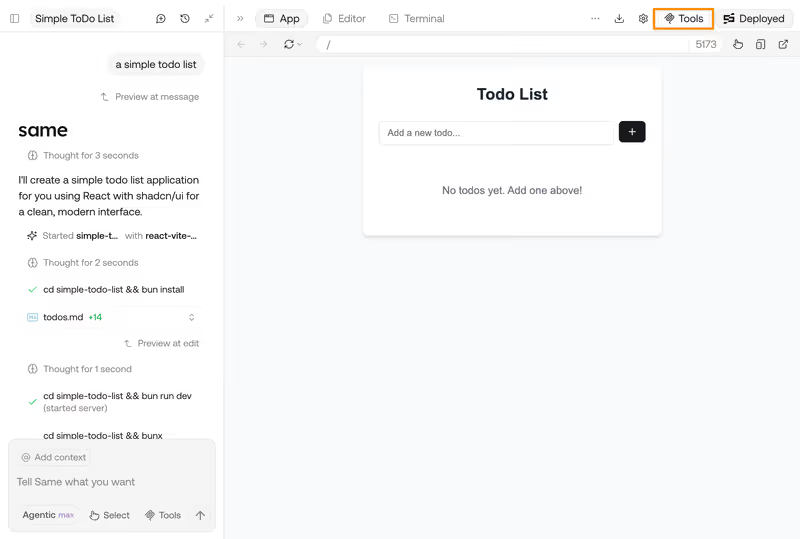
same.new
Same.new homepage
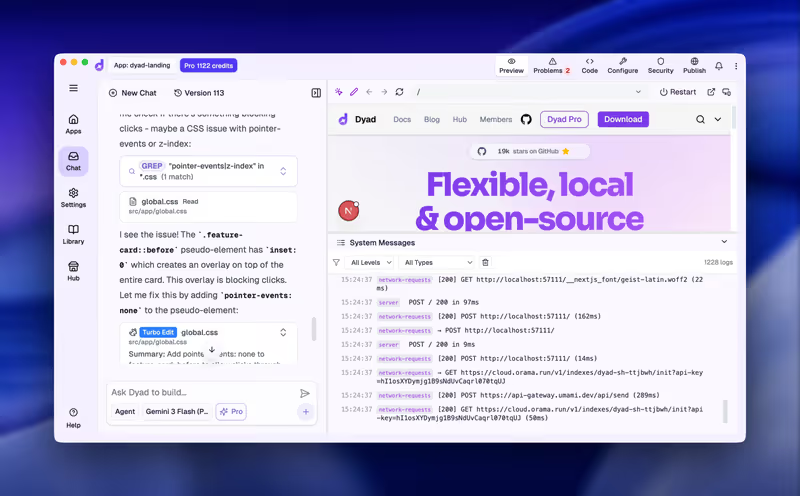
dyad.sh
Dyad homepage

The fairest way to compare Same.new and Dyad is on one concrete job: building a small business web app with user sign-in and per-user data. That job matters because these tools diverge at the exact point where pretty demos stop being enough. Same.new is strongest when the work is visual and frontend-shaped, while Dyad is built around a local codebase that can extend into backend logic.

This job exposes the failure modes that actually matter. A prototype can fake a dashboard with placeholder data, but a real app needs authentication, session handling, database rules, and confidence that one user cannot see another user's records. That is where visual speed, local control, and the cost of fixing generated code stop being abstract feature claims and become operational risk.


The audience

Who each one is for

Same.new

  • Visual-first teams who want to clone layouts and adjust React screens quickly.
  • Product managers mocking up interfaces before a developer touches backend logic.
  • Frontend developers needing a fast Tailwind starting point for brochure-style pages.
  • Agencies presenting UI concepts without committing to production plumbing yet.

Dyad

  • Hands-on developers comfortable with terminals, packages, repos, and local servers.
  • Privacy-sensitive teams wanting code and schemas to stay on local machines.
  • Builders who prefer bring-your-own API keys over bundled platform markups.
  • Engineers creating internal tools with real database logic and authentication flows.

Same.new is for people buying speed on the visible layer. Dyad is for people willing to own the invisible one too.

The scope

What you'd build with it

Same.new

  • Landing page clones and marketing sites where layout fidelity matters most.
  • Interactive React mockups with forms and states that can stay mostly fake.
  • Early UI concepts for portals before backend, auth, and permissions exist.
  • Not a good fit for multi-user apps requiring secure data isolation.

Dyad

  • Full-stack React apps with SQLite or PostgreSQL and local development control.
  • Internal dashboards and admin tools with real CRUD flows and auth.
  • Private business utilities where local-first workflows matter more than polish.
  • Not the best fit for teams expecting one-click deployment and zero setup.

The plumbing question

Same.new approaches this job from the frontend side. Its strength is generating editable React and Tailwind output from visual prompts or cloned pages, but that does not solve the hard part of a login-based app. Authentication, session cookies, protected routes, and per-user filtering still need an external backend or service wired in manually. That means the app can look convincing quickly while the security-critical layer remains absent, implied, or easy to break during later regeneration.

Dyad comes at the same problem through a local repo and standard development workflow. It can generate full-stack files, database-connected code, and integrations that live inside your machine rather than a hosted visual editor. That gives it a real path to implementing auth providers, environment variables, server logic, and database models, but it also means you inherit the usual failure points: package conflicts, broken installs, misconfigured secrets, and the need to debug generated code like any other app. For this job, that is still a more honest foundation than treating the backend as an afterthought.

Strengths

Where each one is strong

Edge: Dyad

Same.new is faster at visible UI work, but Dyad has the stronger shape for a login-based business app.

Same.new

  • Fast visual cloning from an existing URL into editable React-style screens.
  • Browser-based workflow with no local install before you start shaping UI.
  • Quick iteration on spacing, sections, colors, and standard frontend patterns.
  • Useful export path for teams that mainly need a styled frontend scaffold.

Dyad

  • Local-first ownership keeps code, prompts, and schemas under your control.
  • Outputs a standard repo developers can edit in VS Code or Cursor.
  • Bring-your-own-key model avoids paying a platform markup on every request.
  • Better suited to real backend wiring, database logic, and auth extensions.

Failure modes

Where each one breaks

Edge: Dyad

Dyad's failures are annoying but recoverable in a normal repo. Same.new's failures are worse when the app needs stable backend progress.

Same.new

  • Regeneration risk can overwrite or distort working UI during later edits.
  • Complex app behavior can collapse into convincing-looking but shallow frontend code.
  • Backend, auth, and permission layers remain largely your problem to assemble.
  • Fix-heavy prompt loops can waste time while never closing the security gap.

Dyad

  • Setup friction demands local tooling, package management, and debugging patience.
  • Long code-generation loops can consume context and still leave broken builds.
  • Deployment is not handled for you, so hosting becomes another project step.
  • Generated full-stack code still needs review before trusting auth or data access.

Iteration cost

The fix loop, priced

Even

Both tools get expensive when the job turns into repeated auth and data fixes rather than a clean first pass.

Same.new

  • Pro plan is reported at $10 per month with 2 million tokens included.
  • Visual iteration can burn tokens quickly when small changes trigger broad rewrites.
  • Worst case is paying to regenerate screens while backend gaps still remain.
  • Subscription pricing is predictable, but the cap means heavy rework still hurts.

Dyad

  • Community use can be free, with costs shifting to your own model keys.
  • Real spend depends on OpenAI or Anthropic usage during long debugging sessions.
  • Worst case is a long fix loop across backend, auth, and broken dependencies.
  • There is no platform markup cushion; you see provider costs directly.

The shared problem is not the sticker price. It is how fast a shaky app enters the expensive fix loop.

Exit paths

The code you end up with

Edge: Dyad

Dyad leaves you with a more standard, portable repository when you want to continue outside the tool.

Same.new

  • Exports frontend-oriented code that is useful as a styled starting point.
  • You can take the UI out, but the production backend still needs building.
  • Portability is better for screens than for the complete application architecture.
  • The lock-in risk is conceptual: the hard parts may never have existed in code.

Dyad

  • Produces a conventional local repository developers can version with Git.
  • Works better if you want to keep editing outside the original tool.
  • Self-hosting is possible because the output is not tied to a proprietary runtime.
  • The tradeoff is that deployment, ops, and maintenance become fully your burden.

When neither wins

For a small business web app with logins and per-user data, neither Same.new nor Dyad really solves the hardest part for a non-developer. Both leave you maintaining generated, security-critical code: auth flows, protected routes, database access rules, and the small mistakes that turn into data leaks. Same.new tends to hide that problem behind polished frontend output, while Dyad exposes it in a local repo you still have to secure, test, and ship.

If your real job is operating a portal, internal tool, CRM workflow, or client-facing business app, the better route is Softr: the tool with no fix loop. Its auth, user groups, and record-level permissions are platform configuration rather than generated code you now own. The honest boundary is that Softr is the wrong fit if you want a custom consumer UI or you specifically need to own the codebase.

Verdict

Dyad wins when the app is real, the data matters, and someone on the team can actually own a local full-stack codebase. The strongest reason is simple: it gives you a plausible path to implementing the backend, auth, and database logic that a login-based business app cannot fake.

Same.new is the better pick when the assignment is visual rather than operational. If you need to clone a layout, mock a portal, or get a React-style frontend scaffold in front of stakeholders quickly, it gets to the visible result faster and with less setup.

For non-developers building a real business app, that still points past both tools to Softr. When the core problem is permissions and operations rather than code ownership, the safer standard is platform-managed auth and record rules instead of AI-generated security plumbing.

Q & A

Frequently Asked Questions

Is Dyad better than Same.new for a small business web app with logins?

Usually yes. Dyad is the better fit because it can extend into real full-stack code and database logic, while Same.new is much stronger on frontend scaffolding than production backend work. The catch is that Dyad assumes technical skill and local setup.

Can I export code from Same.new and Dyad?

Yes, but the exports are not equal. Same.new is more useful as exported frontend UI code, while Dyad is stronger if you want a standard local repository you can keep developing outside the tool. If you care about portability for the whole app, Dyad has the edge.

Which costs more to iterate on, Same.new or Dyad?

It depends on where the work goes wrong. Same.new can burn through included tokens when visual edits keep regenerating broad chunks, while Dyad pushes cost into your own model keys during long debugging loops. For a fix-heavy app, both can become expensive in different ways.

What should a non-developer use instead for a business portal?

Softr is the safer no-code route for that kind of job. It handles authentication, user groups, and record-level permissions as platform features instead of generated code you must maintain yourself. That makes it a better fit for business portals than either Same.new or Dyad.

Which tool has less lock-in, Same.new or Dyad?

Dyad has less lock-in if your goal is to keep building in a normal development workflow. Its value is the local, standard repo you can edit and host elsewhere. Same.new is more portable at the screen level than at the full application level.