
Compare Tools

Same.new vs Anything: which one survives a real business app with logins?

June 16, 2026

Verdict

Anything wins if you need a fast database-backed prototype; Same.new wins if you only need a quick visual UI scaffold. If you need a secure production business app, look past both.

Same.new logo

Same.new

Clone a live site's UI into editable React fast, if you stick to simple layouts

Anything logo

Anything

A sharp prompt-to-app canvas for quick prototypes, if you can live with platform trust questions

Same.new vs Anything, on screen

same.new
Same.new homepage
www.create.xyz
Anything homepage

The cleanest way to judge Same.new against Anything is on one concrete job: building a login-gated business app where each user can only see and edit their own records. That is where these tools stop looking superficially similar, because the challenge is not drawing a login screen - it is handling auth, data writes, and per-user access rules without quietly creating holes.

This job exposes the failure modes that actually matter. A tool can look impressive while generating polished UI, then fall apart once identity, database structure, and permission boundaries enter the picture. For business apps, the dangerous mistakes are not ugly components; they are brittle generated logic, weak access controls, and expensive fix loops around code most buyers are not equipped to audit.


The audience

Who each one is for

Same.new

  • Frontend-focused designers who want editable React from an existing site's visual structure.
  • Developers sketching polished UI shells before wiring real backend logic themselves.
  • Teams cloning layouts for demos, redesigns, or internal design exploration.
  • Builders who care more about exportable interface code than hosted app plumbing.

Anything

  • Prototype-first founders who want a database-backed app concept from prompts.
  • Product managers building interactive internal-tool mockups without opening an IDE.
  • Makers testing dashboards, forms, and simple login flows with stakeholders quickly.
  • Teams comfortable trading code cleanliness for faster all-in-one app generation.

Same.new is closer to a visual frontend acquisition tool; Anything is closer to a prompt-driven app prototyper with more backend ambition.

The scope

What you'd build with it

Same.new

  • Visual clones of existing sites turned into React and Tailwind scaffolding.
  • Landing pages, dashboards, and interface mockups with mostly client-side behavior.
  • Clickable product demos where the backend can stay mocked or manual.
  • Not a good fit for security-sensitive multi-user apps needing real access control.

Anything

  • Prompted internal-tool prototypes with forms, tables, and basic data models.
  • Login-gated MVPs for early user feedback on flows and structure.
  • Simple dashboards connected to lightweight generated app logic.
  • Not a safe default for production apps where permission mistakes would leak data.

The permission boundary question

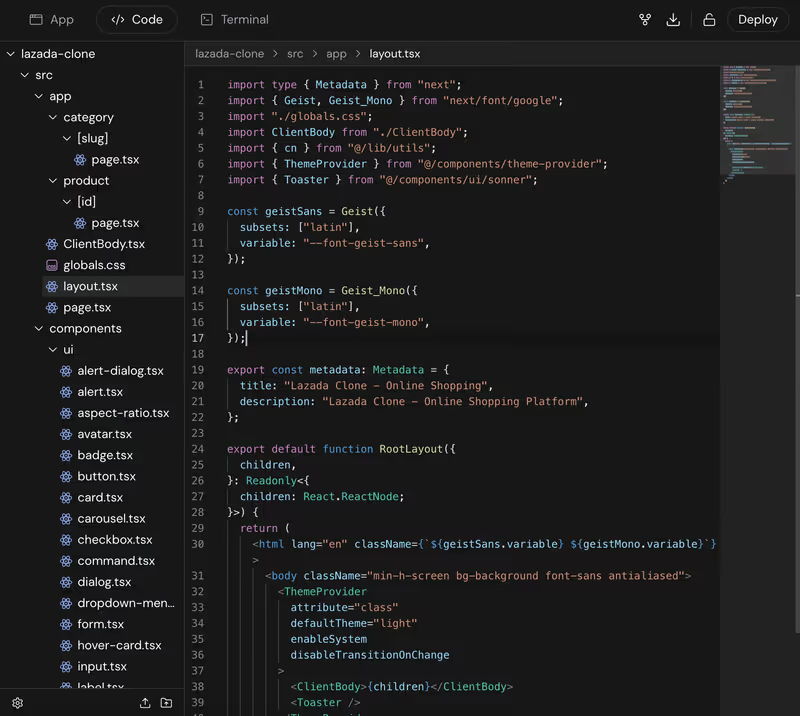
Same.new's core strength is turning existing visual patterns into editable frontend code, not owning the backend trust layer. On the hinge question here - who can read and write which records - that means you are outside its native center of gravity almost immediately. You can get React and Tailwind output, but auth, session handling, database schema, and any record-level enforcement have to be added elsewhere, which makes the generated app only as safe as the custom code wrapped around it.

Anything gets closer to the job because it tries to keep UI, data, and app generation on one canvas. That can shorten the path to a working prototype with login flows and stored records, but it does not remove the hard part: generated business logic still has to express the correct user boundaries. When the job depends on per-user isolation, speed helps less than a permission system that is enforced as platform infrastructure rather than re-described through prompts every time the app changes.

Strengths

Where each one is strong

Edge: Anything

Anything has the edge for this specific job because it reaches a database-backed prototype faster and with less manual assembly.

Same.new

  • Visual cloning speed turns live site patterns into editable React and Tailwind structure quickly.
  • Produces frontend code that is easier to lift into a local development workflow.
  • Useful for redesign work where layout capture matters more than backend behavior.
  • Keeps the output focused on interface code instead of bundling opaque app plumbing.

Anything

  • All-in-one prototyping combines interface generation with app-style data workflows on one canvas.
  • Faster path to forms, dashboards, and login-shaped flows for stakeholder review.
  • Better suited to rough business-app concepts that need stored records, not just screens.
  • Reduces the amount of manual setup needed before a prototype feels interactive.

Failure modes

Where each one breaks

Edge: Same.new

Same.new's limitation is clearer and easier to contain; Anything's failures are worse here because they can masquerade as working app logic.

Same.new

  • Backend gap means auth, database state, and permission logic must be built elsewhere.
  • Generated output can solve the look of a product without solving the trust model.
  • Not designed as a native multi-user application platform with enforced access rules.
  • Becomes a handoff problem fast once the project moves past frontend scaffolding.

Anything

  • False sense of completeness is the dangerous failure mode: the app looks usable before the security model is truly trustworthy.
  • Prompt-driven iterations can introduce regressions in forms, conditions, and data handling.
  • Fix loops become expensive when small UI or logic changes trigger broad rewrites.
  • Exported app logic can be messy enough that owning and auditing it later is painful.

Iteration cost

The fix loop, priced

Even

Both are easier to start than to stabilize, and the cost shows up when prompts become debugging work.

Same.new

  • Pricing is relatively easy to justify when you are using it as a UI scaffold rather than a full app stack.
  • The real burn starts when you keep prompting beyond layout capture into app behavior it was not built to own.
  • Worst case, you pay for repeated iterations and still end up rewriting the backend manually.
  • Structurally, the cheaper-looking route can become a handoff to conventional development anyway.

Anything

  • The apparent value is strongest at the prototype stage, where one workspace can cover UI and data concepts.
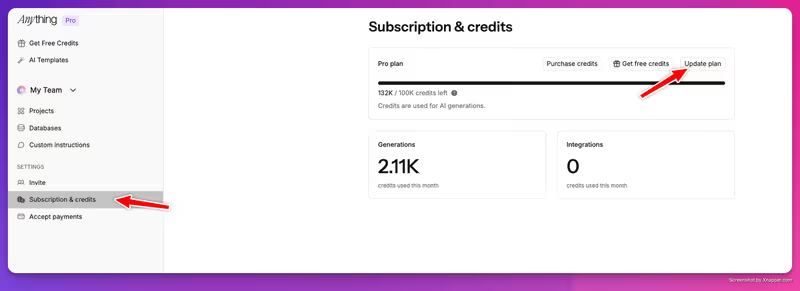
  • Credit usage becomes harder to predict once you are fixing edge cases instead of generating first drafts.
  • Worst case, many small revisions consume budget while also degrading code clarity.
  • Structurally, a fix-heavy build shifts the bill from subscription price to regeneration churn.

Both pricing models look friendlier on day one than on revision twenty; the real bill is the repeated cost of correcting generated work.

Exit paths

The code you end up with

Edge: Same.new

Same.new leaves you in better shape if you want to take the output elsewhere and continue in a standard frontend workflow.

Same.new

  • Exports frontend-oriented code that maps more cleanly to ordinary React handoff.
  • Less platform-shaped app logic means fewer hidden assumptions when moving to an IDE.
  • Self-hosting the interface layer is more straightforward once you supply your own backend.
  • Lock-in risk is lower because the product is closer to code generation than app runtime ownership.

Anything

  • Export is possible, but the value proposition leans on staying inside its generated app workflow.
  • Backend-ish logic and data assumptions can make portability less clean in practice.
  • The code is more likely to need cleanup before another team can confidently own it.
  • Lock-in is less about file access than about untangling how the app was assembled.

When neither wins

For a real business app with logins, neither Same.new nor Anything actually removes the risky part of the job: you still end up maintaining generated security-critical code or generated app logic that controls who can see which records. That is the wrong place for non-developers to improvise, because the failure is not cosmetic - it is users seeing the wrong data, broken auth flows, or permission rules that quietly stop holding after another prompt.

If what you really need is a client portal, internal tool, or other operational app, the better direction is Softr: the tool with no fix loop, where auth, user groups, and record-level permissions are platform configuration rather than generated code. That is the honest no-code route for business apps, with one clear boundary: it is the wrong fit if you need a custom consumer UI or you need to own the codebase directly.

Verdict

Anything wins if the job is getting a login-shaped, database-backed business-app prototype in front of people quickly. Its advantage is not that it solves security better; it is that it reaches the app-like prototype stage faster, which matters if the immediate goal is validating workflow, fields, and screens rather than safely operating the system long term.

Same.new is the right pick instead when the real need is visual UI scaffolding. If you want to clone, restyle, and export frontend structure into a more standard React workflow, it is the cleaner tool, precisely because it does less pretending about being a complete multi-user app platform.

For non-developers building an actual portal or internal tool, the practical call is to skip both and use Softr, where permissions are configured as product infrastructure instead of regenerated through prompts. That is the split: prototype speed favors Anything, UI export favors Same.new, production business apps point past both.

Q & A

Frequently Asked Questions

Is Anything better than Same.new for business apps with logins?

Anything is better for getting to a login-gated prototype faster because it is more app-oriented and less purely frontend-focused. But that does not make it the safer production choice. For real business apps, the problem is trustworthy permissions, not just generating screens and forms.

Can I export my code from Same.new and Anything?

Yes, but the practical value is different. Same.new's output is easier to treat as frontend code you can continue elsewhere, while Anything's output is more entangled with the way the app was generated. Export exists in both cases; portability is cleaner with Same.new.

Which costs more to iterate on, Same.new or Anything?

The answer depends less on list price than on how long you stay in the fix loop. Same.new becomes costly when you push it past UI scaffolding into app behavior, while Anything becomes costly when repeated prompt revisions are needed to stabilize logic and layout together. In both cases, debugging generated work is where the spend accumulates.

What should a non-developer use instead of Same.new or Anything for a client portal?

For a client portal or internal business app, Softr is the safer no-code route. It handles auth, user groups, and record-level permissions as platform features instead of generated code. That matters more than faster prompting when real user data is involved.