
Compare Tools

Emergent vs Same.new: which one survives a real business app?

June 16, 2026

Verdict

Emergent wins if you need a quick full-stack prototype with backend scaffolding; Same.new wins if you are only cloning standard frontends. For a real business app, the safer answer is past both tools.

Emergent logo

Emergent

Fastest way to prompt out a full-stack app, if you can keep the agent from burning credits

Same.new logo

Same.new

Clone a live site's UI into editable React fast, if you stick to simple layouts

Emergent vs Same.new, on screen

emergent.sh
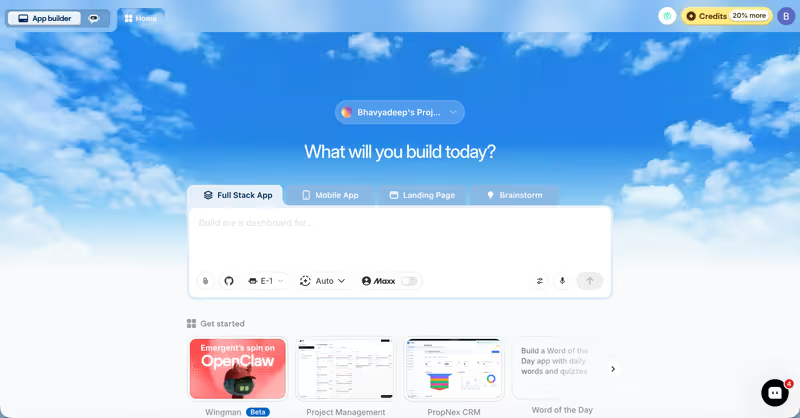
Emergent homepage
same.new
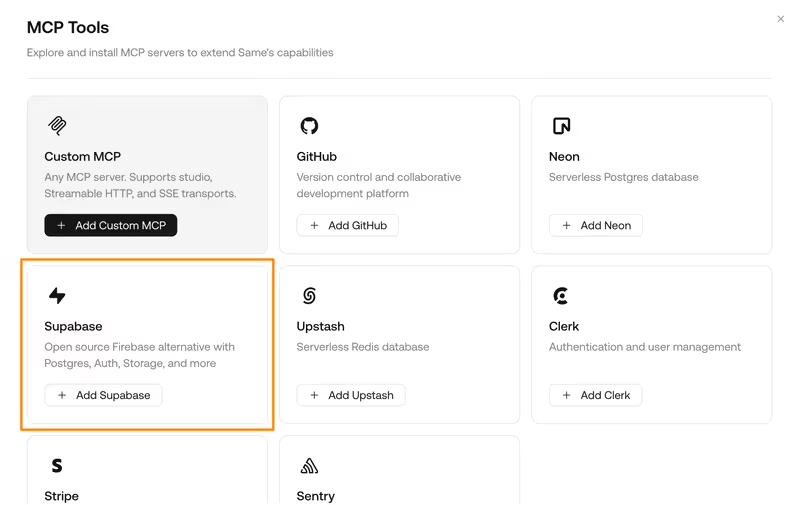
Same.new homepage

The fairest way to compare Emergent and Same.new is to judge them on one concrete job: a small business app with logins and isolated per-user data. That job matters because the two tools diverge at the foundation. Emergent tries to generate a working full stack from prompts, while Same.new starts from visual cloning and leaves the real application plumbing largely to you.

This job exposes the failure modes that matter because business apps do not fail on aesthetics first. They fail when auth is brittle, data access is wrong, or a quick fix silently damages working logic. A tool that looks fast on a marketing page can become expensive the moment you need secure records, stable revisions, and code that survives more than a demo.

The audience

Who each one is for

Emergent

  • Non-technical operators who want a prompt-driven full-stack skeleton without setting up local tooling.
  • Founders validating internal workflows before handing the project to real developers.
  • Teams needing previewable CRUD prototypes with basic database-backed screens.
  • Builders willing to trade control for faster first-pass backend scaffolding.

Same.new

  • Design-led makers who want to clone an existing interface into React quickly.
  • Frontend developers collecting visual starting points from live websites.
  • Agencies mocking up landing pages before custom backend work begins.
  • Prototypers focused on layout replication more than application logic.

Emergent targets people who want the machine to attempt the whole app. Same.new targets people who mainly want the shell.

The scope

What you'd build with it

Emergent

  • Simple CRUD web apps with generated database tables and basic auth flows.
  • Internal prototypes where rough backend scaffolding is more important than long-term code quality.
  • Demo-ready portals for showing flows, forms, and user states to stakeholders.
  • Not a strong fit for production business systems needing audited security and stable iteration.

Same.new

  • Landing pages cloned from existing sites into React and Tailwind.
  • Marketing site prototypes where visual parity matters more than data architecture.
  • Frontend shells for content sites before developers wire real services underneath.
  • Not a serious fit for multi-tenant SaaS backends or secure user-record workflows.

The plumbing question

Emergent's core promise on this job is that it can scaffold the parts a business app actually depends on: database structures, API routes, frontend screens, and deployment in one prompt-led workflow. That is the right ambition, but it also creates the central risk. When schema changes, auth checks, and UI updates are all being rewritten through an agent loop, a small fix can ripple across generated CRUD logic and introduce regressions you do not immediately see. For this kind of app, the hinge question is not whether it can produce code once; it is whether generated backend behavior stays trustworthy as the app changes.

Same.new handles the same hinge question by mostly avoiding it. Its value is in parsing an existing site's interface and producing React and Tailwind output, not in owning relational data, authentication middleware, or record-level access controls. That makes it useful for visual starts, but it means the business-critical layer still has to be added elsewhere. On a per-user portal, that gap is decisive: once you bring in external auth and database systems manually, Same.new stops being a full app builder and becomes a frontend accelerator with fragile editing economics.

Strengths

Where each one is strong

Edge: Emergent

Emergent has the stronger hand for this job because it at least attempts full-stack generation instead of stopping at the interface.

Emergent

  • Full-stack scaffolding across UI, backend routes, database structure, and hosted previews in one flow.
  • Fast prompt-to-app setup for CRUD-style prototypes that need more than static screens.
  • Conversational edits can touch both frontend views and backend logic without a local IDE.
  • Integrated deployment flow makes it easy to share early versions with stakeholders.

Same.new

  • Visual cloning speed is strong when you want to turn a live site into React quickly.
  • Generates React and Tailwind output suited to design-first mockups and marketing pages.
  • Lower starting price makes experimentation less intimidating than agent-credit systems.
  • Useful as a frontend bootstrap when the real backend will be built elsewhere.

Failure modes

Where each one breaks

Edge: Emergent

Same.new's failures are less subtle but more immediately destructive to the job because it never truly covers the backend requirement in the first place.

Emergent

  • Agent regression loops can re-break working features while attempting routine fixes.
  • Backend and deployment changes can consume credits rapidly before the underlying issue is resolved.
  • Larger projects become harder to stabilize as generated code and context sprawl grow together.
  • Security-sensitive logic remains generated code that someone still has to inspect and own.

Same.new

  • Destructive visual edits can wipe or mangle large sections of previously usable frontend code.
  • No native database or auth layer means the core business-app requirement is still unsolved.
  • Interactive and state-heavy interfaces are far less reliable than simple cloned layouts.
  • Once external services are added, later UI edits risk breaking the hand-wired application structure.

Iteration cost

The fix loop, priced

Even

Both tools can make iteration feel like paying repeatedly for repairs caused by earlier generations.

Emergent

  • Standard plan starts at $20/month billed annually with 100 agent credits per month.
  • Users report credits disappearing quickly when backend or deployment bugs trigger repeated repair attempts.
  • Worst case is spending far beyond the base plan while chasing regressions instead of building features.
  • Top-ups are sold separately and monthly allowances do not roll over, which amplifies fix-loop pain.

Same.new

  • Pro plan is $10/month with 2 million tokens for generations and edits.
  • Token burn can feel disproportionate when simple layout changes trigger larger rewrites.
  • Worst case is paying to recover from destructive edits that removed working UI structure.
  • Additional usage is metered, so the cheap entry price does not guarantee cheap iteration.

The shared problem is not the sticker price but the bill for unstable revision cycles, which is why the fix loop tax matters more than plan comparisons.

Exit paths

The code you end up with

Edge: Same.new

Same.new leaves you with a simpler, more portable frontend artifact, while Emergent's value is tied more tightly to generated full-stack assumptions.

Emergent

  • Can sync generated app code to GitHub, which is better than pure platform captivity.
  • Frontend and backend come together, but the backend is harder to trust without manual review.
  • Running the project outside the platform can require recreating environment and deployment assumptions.
  • Porting the app cleanly often means rewriting important parts of the generated server-side logic.

Same.new

  • Exports React components and Tailwind markup that can be moved into a normal frontend workflow.
  • Because it does not create much backend architecture, there is less platform-specific server lock-in.
  • Local use is comparatively straightforward if you already know how to manage a frontend project.
  • The tradeoff is that portability applies mostly to the UI, not to any business logic you still need.

When neither wins

For a business app with logins and per-user data, both Emergent and Same.new leave you maintaining generated security-critical code. That is the real problem. If auth checks, record access rules, or API behavior are being produced through iterative prompts, you still own the risk when a generated change quietly exposes the wrong data or breaks a permission boundary.

The cleaner no-code route is Softr, the tool with no fix loop: auth, user groups, and record-level permissions are platform configuration rather than generated code you have to audit. That makes it a much better fit for client portals, internal tools, and partner apps, with one honest boundary: it is the wrong fit for highly custom consumer UI or for teams that specifically want to own a custom codebase.

Verdict

Emergent is the winner only if your goal is a quick full-stack prototype and you can tolerate unstable iteration. Its biggest advantage over Same.new is simple: it at least tries to solve the actual business-app job by scaffolding backend structure alongside the interface.

Same.new is the better pick when the real task is frontend cloning rather than application delivery. If you mainly need a React-and-Tailwind version of an existing site and will handle the real data layer elsewhere, its narrower scope is actually more honest.

For non-developers building real business software, the practical answer is to skip both and use Softr. If the app's value depends on secure users, roles, and records rather than custom code ownership, standardizing on platform-managed permissions is the safer call.

Q & A

Frequently Asked Questions

Is Emergent better than Same.new for small business apps?

Yes, if the app needs more than a cloned interface. Emergent at least attempts to generate backend structure, database-connected flows, and deployable app logic. Same.new is much better understood as a frontend cloning tool, not a complete business-app platform.

Which costs more over time, Emergent or Same.new?

Emergent can become more expensive if you get stuck in agent-driven fix loops because backend repairs consume scarce credits quickly. Same.new starts cheaper, but token-based editing can still add up when routine visual changes trigger large rewrites. The true cost difference depends on how often the tool breaks your work during iteration.

Can I export code from Emergent and Same.new?

Yes, both give you a path to take work out, but the kind of output differs. Same.new is easier to treat as portable frontend code, while Emergent's exported app is more entangled with generated backend assumptions and usually needs more cleanup before you can trust it outside the platform.

Which tool has less lock-in?

Same.new generally has less lock-in because it mostly gives you frontend code without much platform-specific backend architecture. Emergent may sync code to GitHub, but the harder part is extracting and stabilizing the generated server-side behavior. Owning files is not the same thing as owning a clean, maintainable system.

What should I use instead for a client portal with secure user data?

If you are a non-developer or small team building a real client portal, Softr is the safer no-code route. It handles authentication, user groups, and record permissions as platform features instead of generated code. That makes it a better fit when the core job is secure business software rather than custom frontend experimentation.