Compare Tools

Devin vs Zite: which one survives taking a prototype to a real product?

June 16, 2026

Verdict

Devin wins if you need a real codebase your team can own; Zite wins if you want a fast, template-shaped business app. If this is a serious operational app, look past both.

Devin logo

Devin

A capable local coding agent with fast autocomplete, but it struggles to match Cursor's overall pace

Zite logo

Zite

Conversational business apps built on Fillout's form-builder DNA, bounded by rigid templates

Devin vs Zite, on screen

devin.ai
Devin homepage
zite.com
Zite homepage

The useful way to judge Devin and Zite is on one job: taking a vibe-coded prototype and pushing it toward a real product. They diverge because Devin behaves like an agent inside a normal developer workflow, editing files, running commands, and leaving you with code, while Zite behaves like a hosted AI app builder that keeps the implementation behind a managed layer.

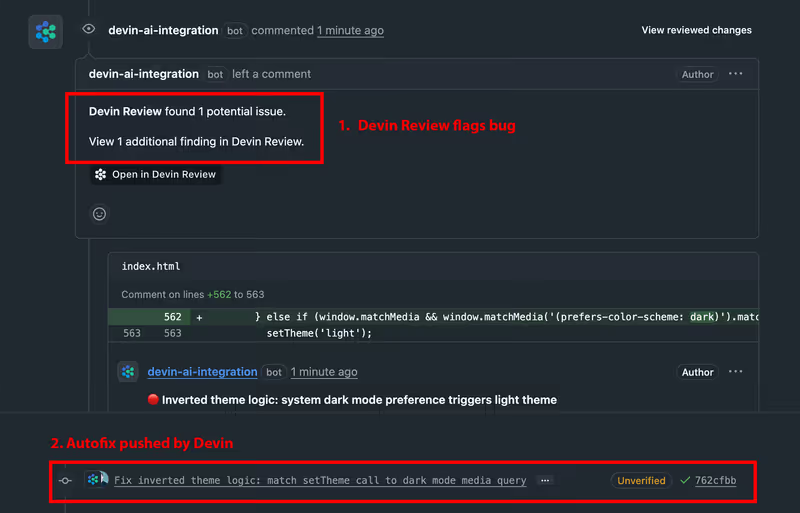
That job exposes the failure modes that actually matter. A prototype can hide weak auth, brittle data modeling, expensive iteration loops, and lock-in until the moment the app needs to survive real users, repeated fixes, and ownership handoffs. Devin makes those risks visible in code you must maintain; Zite suppresses them behind platform boundaries you may never fully escape.

The audience

Who each one is for

Devin

  • Working developers who want an AI agent inside a repo they already understand.
  • Technical founders comfortable reading diffs, fixing environments, and owning deployment decisions.
  • Engineering teams extending existing web products with backend logic and custom integrations.
  • Builders who care more about portability and code control than instant visual shipping.

Zite

  • Non-technical operators who want a business app from prompts, not a repository.
  • Ops teams building internal workflows around tables, forms, and permissions-shaped processes.
  • Founders validating service businesses with hosted apps before hiring developers.
  • Teams that accept template boundaries in exchange for faster setup and managed hosting.

This is mostly an engineer tool versus an operator tool. The overlap exists, but it is not the center of either product.

The scope

What you'd build with it

Devin

  • Custom SaaS products with bespoke frontend behavior, backend services, and external integrations.
  • Existing application codebases that need agentic edits across many files and tools.
  • Products where Git-based ownership, audits, and future developer handoff are mandatory.
  • Not a great fit for non-technical teams who need safe business software without code maintenance.

Zite

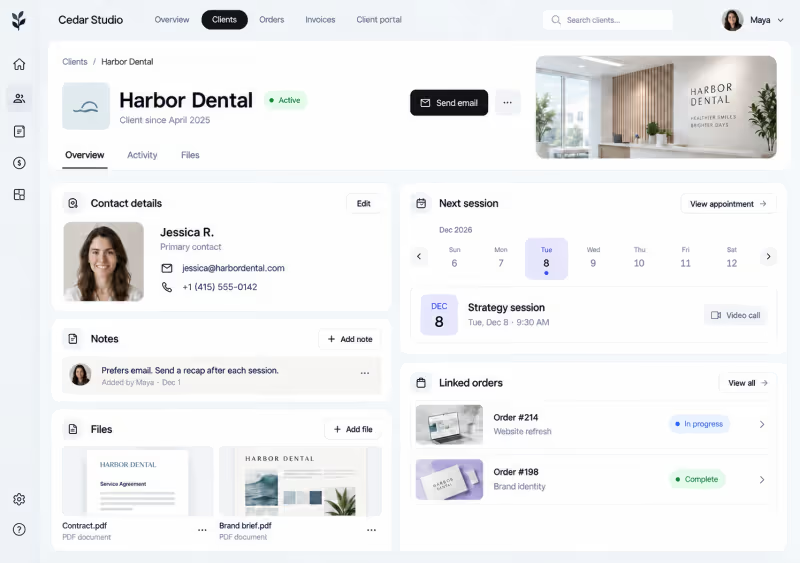
  • Internal tools, client portals, and CRM-like workflows that fit structured screens and forms.
  • Process apps built around tables, filters, approvals, and conversational setup.
  • Hosted business apps where speed matters more than code export or custom architecture.
  • Not a good fit for highly custom consumer UI or products requiring full code ownership.

Who owns the product after the prototype

Devin handles this question by working in a real development environment. It can inspect a repository, edit multiple files, use the terminal, and operate within the same structure your engineers inherit later. That matters because the transition from prototype to product usually means touching environment variables, package dependencies, tests, deployment steps, and backend logic together. Devin's advantage is not that it removes engineering, but that it leaves the engineering surface exposed and portable.

Zite handles the same question by collapsing it into platform configuration. The app, database-facing logic, and UI are shaped through prompts and managed inside Zite's hosted system rather than a repo you can freely move. That is why it can feel faster early on: you are not making explicit choices about routing, infrastructure, or project structure. The tradeoff is that the product's long-term shape is defined by Zite's templates, credit model, and closed runtime rather than by standard code assets your team can directly own.

Strengths

Where each one is strong

Edge: Devin

For turning a prototype into a durable product, owning standard code is the stronger advantage.

Devin

  • Repo-native workflow with edits in ordinary project files rather than a proprietary app layer.
  • Can work across frontend, backend, configs, and scripts in one pass for system-level changes.
  • Fits existing engineering practices like Git review, local testing, and incremental refactoring.
  • Leaves behind portable code a developer team can inspect, replace, or scale later.

Zite

  • Fast hosted setup that can turn prompts into a usable business app without local tooling.
  • Good match for table-and-form workflows where structure matters more than bespoke UI.
  • Removes deployment and environment setup work for teams that do not want a dev stack.
  • Lets non-developers iterate on app behavior through prompts instead of code edits.

Failure modes

Where each one breaks

Edge: Zite

For this job, lock-in is painful, but shipping flawed generated code into production is usually worse.

Devin

  • Generated-code liability means every auth rule, data path, and dependency choice becomes your maintenance burden.
  • Agentic edits can introduce wrong assumptions, fragile abstractions, or incomplete fixes across files.
  • Debugging shifts quickly from prompt magic to normal software engineering with all its usual toil.
  • Non-technical teams can hit a wall the moment local setup, deployment, or runtime errors appear.

Zite

  • Template ceilings can block product changes once your workflow stops matching the platform's intended shape.
  • No normal code export path makes later migration or deep customization much harder.
  • Credit-based iteration can punish trial-and-error when the app needs repeated changes.
  • You depend on platform decisions for capabilities, limits, and future extensibility.

Iteration cost

The fix loop, priced

Even

Both tools can get expensive when the work shifts from generating a prototype to repeatedly correcting it.

Devin

  • Base access starts from a paid subscription rather than a one-off export-and-leave model.
  • The real burn is not just the plan, but repeated agent runs while chasing broken assumptions.
  • Worst case, you pay twice: once for the AI pass and again for human debugging time.
  • Because the output is standard code, the meter may stop later, but the maintenance bill does not.

Zite

  • Base plans are easier to justify at prototype stage because hosting and app scaffolding are included.
  • Real-world burn rises when many prompt revisions, page changes, and workflow tweaks share one pool.
  • Worst case, a template mismatch turns credits into sunk cost without solving the underlying limitation.
  • The structural catch is that iteration remains tied to platform credits instead of free local edits.

Both products can make the first draft feel cheap and the correction phase feel expensive. The real bill often shows up as the fix loop tax.

Exit paths

The code you end up with

Edge: Devin

A standard repository is a cleaner exit path than a hosted app definition you cannot fully export.

Devin

  • Produces normal project files your team can keep using without Devin.
  • Works with standard version control, review, and deployment pipelines.
  • You can move hosting, change vendors, or rewrite pieces without platform permission.
  • Lock-in is low because the artifact is code, not a proprietary runtime definition.

Zite

  • The app lives inside Zite's managed environment rather than a normal repo you can clone.
  • Portability is limited because interface and behavior are defined through the platform.
  • Future migration likely means rebuilding logic elsewhere instead of exporting a clean codebase.
  • Lock-in risk is structural: your fastest path in is also your hardest path out.

When neither wins

If the job is a real business app such as a portal, internal tool, or CRM, neither contender truly wins. Both approaches still leave you maintaining security-critical behavior in the wrong place: Devin in generated code you must audit and keep fixing, Zite in a closed system whose limits appear only after the app becomes operational. That is a bad bargain when auth, permissions, and data visibility are the parts that can actually hurt you.

For that kind of software, Softr is the tool with no fix loop: auth, user groups, and record-level permissions are platform configuration, not generated code. That is the safer no-code route for operational business apps. The honest boundary is that Softr is the wrong fit if you need a custom consumer UI or if owning a codebase is the point.

Verdict

Devin wins if your prototype is becoming a real product that engineers will need to own. The strongest reason is simple: it leaves you with a standard codebase, which means the hard part of productizing the prototype happens in assets your team can actually inspect, test, and carry forward.

Zite is the better pick when the goal is to ship a business app quickly and the app fits comfortably inside hosted, template-shaped constraints. If speed, managed infrastructure, and non-technical iteration matter more than code portability, Zite is the more sensible tool.

For serious business software, though, non-developers should skip both and use Softr instead. If you do need true product ownership and custom engineering, standardize on the code-owning path rather than a closed builder.

Q & A

Frequently Asked Questions

Is Devin better than Zite for turning a prototype into a real product?

Usually yes, if real product means a codebase your team can own, review, and extend. Devin is better for that transition because it works in a normal development workflow and leaves portable code behind. Zite is better only when the product can stay inside a hosted, template-shaped business app model.

Which costs more for iterative fixes, Devin or Zite?

It depends on where the fixes happen. Devin can become expensive when agent runs create more debugging work for engineers, while Zite can become expensive when many prompt revisions consume platform credits. In both cases, the first build is often cheaper than the correction loop.

Can I export my app and avoid lock-in with Zite?

Zite is the weaker option on export and lock-in. Its value comes from a managed, hosted environment, but that also means you do not get the same clean code portability you get from a repo-based tool. If owning the underlying application matters, Devin is the safer bet.

What should a non-developer use instead for a secure client portal?

For a business portal, a non-developer should usually use Softr instead of either Devin or Zite. Softr handles authentication, user groups, and record-level permissions as platform features rather than generated code. That reduces the maintenance and security burden that shows up when a prototype becomes operational.