Compare Tools

Devin vs Softr: which one survives a real client portal?

June 16, 2026

Verdict

Softr wins if you need a secure business portal fast; Devin wins if code ownership matters more than built-in auth, and non-developers should look past custom code.

Devin logo

Devin

A capable local coding agent with fast autocomplete, but it struggles to match Cursor's overall pace

Softr logo

Softr

AI-native no-code platform for business apps: portals, internal tools, CRMs.

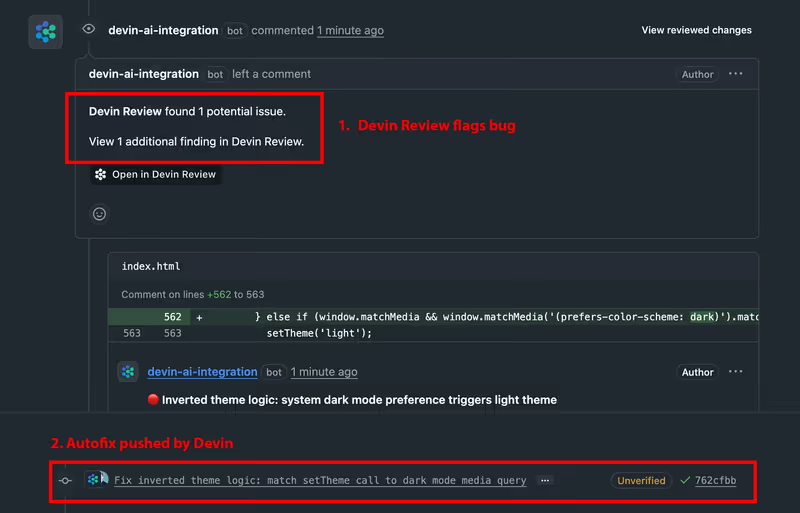
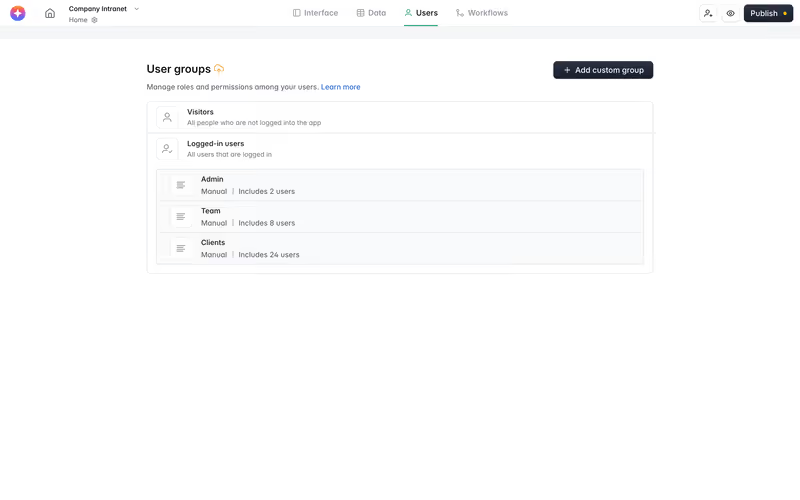
Devin vs Softr, on screen

devin.ai
Devin homepage
www.softr.io
Softr homepage

The cleanest way to compare Devin and Softr is on one specific job: building a secure client portal with logins, role-based access, and per-customer data isolation. That job forces a real divergence. Devin helps a developer generate and edit raw application code; Softr gives a managed business-app platform with auth, permissions, and data plumbing already built in.

This job exposes the failure modes that matter because most portal risk is not the visible UI. It is the silent layer underneath: who can see which records, how sessions are handled, and what breaks when requirements change. A flashy code generator can still leave you maintaining security-critical logic, while a managed platform can still limit how custom the final product becomes.

The audience

Who each one is for

Devin

  • Working developers who want AI help inside a real codebase they still control.
  • Technical founders comfortable reviewing generated code, fixing bugs, and managing deployment.
  • Engineering teams speeding up multi-file edits, refactors, and terminal-driven implementation work.
  • Builders who need handoff-ready repositories rather than a managed no-code runtime.

Softr

  • Operations leaders who need a secure portal without hiring engineers first.
  • Founders building client onboarding, approvals, or account dashboards around business data.
  • Internal teams standardizing permissions, workflows, and records without touching infrastructure code.
  • Agencies shipping business apps faster when the requirement is process, not custom frontend novelty.

Devin assumes someone owns the code. Softr assumes someone owns the workflow.

The scope

What you'd build with it

Devin

  • Custom web apps where a team needs full repository ownership and framework flexibility.
  • Existing codebases that need AI-assisted feature work, debugging, and terminal execution.
  • Bespoke consumer interfaces with unusual frontend behavior or proprietary backend logic.
  • Not the right choice for non-technical teams needing safe portals without code review.

Softr

  • Client portals with logins, approvals, dashboards, and per-user record visibility.
  • Internal tools, CRMs, directories, and workflow apps built around operational data.
  • Partner or vendor portals where permissions and structured forms matter more than novel UI.
  • Not the right choice for teams that must export and fully own application code.

The permissions question

With Devin, the hinge question is whether the generated app's access rules are actually correct. Devin works as an AI coding agent in a developer environment, so it can create auth flows, database queries, and frontends across multiple files, then run terminal commands while iterating. But that means the critical mechanisms for a client portal, including session handling, route protection, and record-level filtering, are still implemented as generated code inside your stack. The burden is on the builder to inspect the logic, validate edge cases, wire hosting, and make sure a simple prompt did not create a subtle data leak.

With Softr, the same question is handled as product infrastructure rather than code output. User Groups, page visibility rules, and server-side CRUD patterns are platform features, not snippets you must audit line by line. The AI layer can help scaffold pages and schema, but the important part is that auth and permissions live in the managed runtime. For a client portal, that changes the maintenance profile: you are configuring access behavior in the platform instead of inheriting a pile of generated security-sensitive code.

Strengths

Where each one is strong

Edge: Softr

For this job, built-in auth and permissions matter more than coding flexibility.

Devin

  • Repository ownership means the output can fit your preferred stack, tooling, and hosting.
  • Multi-file editing helps on large changes that touch routes, components, and backend logic.
  • Terminal access lets the agent run commands, inspect errors, and iterate in context.
  • VS Code-style workflows suit engineering teams already working inside established repos.

Softr

  • Built-in authentication gives you login flows without writing or auditing auth code.
  • User Groups and visibility controls map naturally to portal roles and gated pages.
  • Visual data-driven blocks speed up lists, forms, dashboards, and approval workflows.
  • Managed hosting reduces the operational burden of deploying and maintaining business apps.

Failure modes

Where each one breaks

Edge: Softr

Devin's misses can become security or deployment problems; Softr's are usually scope limits.

Devin

  • Generated access logic can be wrong in ways that are hard to notice quickly.
  • You still need to handle hosting, environment variables, and production deployment yourself.
  • Prompt-driven iteration can stall into bug-fixing loops when the app spans many files.
  • Non-technical stakeholders cannot safely validate whether the underlying portal code is sound.

Softr

  • Layout constraints limit how far you can push highly bespoke consumer-style interfaces.
  • Platform limits and plan ceilings matter if your portal grows beyond standard business usage.
  • Custom code is additive, not a substitute for full repository-level control.
  • No full code export means leaving the platform requires rebuilding the interface elsewhere.

Iteration cost

The fix loop, priced

Edge: Softr

On a fix-heavy portal build, Softr hurts less because core features are configuration, not repeated code generation.

Devin

  • Premium is listed at $20 per month, or $15 monthly when billed annually.
  • Autocomplete is effectively abundant, but faster agent work depends on monthly prompt allowances.
  • The real burn appears when debugging prompts multiply across auth, routing, and data issues.
  • Because usage is tied to iterative agent work, fixing generated mistakes can consume the allowance quickly.

Softr

  • Paid plans start at $59 per month, or $49 monthly when billed annually.
  • Plans include AI credits, but the product remains usable when those credits run out.
  • The expensive path is upgrading for users, records, and governance, not re-prompting layout bugs.
  • Its structure avoids a classic code-gen fix loop because permissions and CRUD are platform features.

Both have a bill, but only one makes routine portal fixes depend on more generated code.

Exit paths

The code you end up with

Edge: Devin

If you want to leave with a portable repository, Devin clearly wins.

Devin

  • You keep a conventional codebase that can be edited in other IDEs.
  • Hosting is portable because the app is not tied to a managed runtime.
  • A developer team can inherit, refactor, or rewrite parts of the generated project.
  • Lock-in is lower because the main asset is source code you directly possess.

Softr

  • The app lives in a managed platform rather than a downloadable full repository.
  • You can configure and extend behavior, but not export the entire application codebase.
  • Custom code stays inside bounded blocks instead of becoming a portable app scaffold.
  • Leaving Softr usually means migrating the workflow and rebuilding the interface elsewhere.

When neither wins

If your real requirement is a highly custom consumer product or a codebase your engineering team must fully own, neither framing wins cleanly here. Devin can generate a lot of application code, but you still inherit security-critical logic to review and maintain; Softr removes much of that burden, but it is the wrong fit when the end goal is total code ownership or a deeply bespoke consumer UI.

For business-shaped work like portals, internal tools, and CRMs, the safer route is the tool with no fix loop: Softr. It gives you auth, user groups, and record-level permissions as platform configuration instead of generated code, but the honest boundary is that it is not the right choice for custom consumer UI or teams that need to own the codebase.

Verdict

Softr wins for a real client portal when the job is to ship secure access, role-based visibility, and business workflows quickly. The strongest reason is simple: those requirements are mostly permissions plumbing, and Softr handles them as managed platform features instead of generated code you must audit.

Devin is the better pick when the portal is really part of a broader custom product and your team cares most about owning the repository. If you have developers who can review auth logic, manage deployment, and accept the debugging overhead, the flexibility of raw code can outweigh the safety of a managed builder.

For non-developers evaluating a business app, the answer points past custom code and toward Softr. If your priority is process reliability rather than code ownership, standardize on infrastructure instead of inheriting a security review job.

Q & A

Frequently Asked Questions

Is Softr better than Devin for building a client portal?

Yes, for most business teams it is. Client portals are mostly about authentication, permissions, and data visibility, and Softr ships those as platform features. Devin can help build the same thing, but only by generating code that someone still has to review, deploy, and maintain.

Which costs more for a fix-heavy portal, Devin or Softr?

Softr usually costs more on the sticker price, but Devin can become more expensive in time and usage when the build enters repeated debugging loops. Portal work often produces many small permission and data-access fixes. Softr avoids much of that because the risky plumbing is configured, not regenerated.

Can I export my app or code from Softr or Devin?

Devin leaves you with code in a normal repository, so export and portability are much better there. Softr does not provide full raw application code export. If code ownership is a hard requirement, Devin has the advantage.

Who should choose Devin over Softr?

Developers and engineering teams should choose Devin when they need framework freedom, repository ownership, and custom product behavior beyond a standard business portal. It fits best when someone technical can validate security-sensitive code. It is not the easier choice for non-technical operators.

What should a non-technical team use instead of custom portal code?

A non-technical team building a portal, CRM, or internal tool should usually use Softr. It is the no-code route that gives you auth, user groups, and record-level permissions without turning your team into maintainers of generated application code. That is the main reason it wins this job.