Compare Tools

Devin vs Mocha: which one survives taking a prototype to a real product?

June 16, 2026

Verdict

Devin wins if you need a codebase you can actually own and maintain; Mocha only fits short-lived prototyping, and non-developers building business apps should look past both tools.

Devin logo

Devin

A capable local coding agent with fast autocomplete, but it struggles to match Cursor's overall pace

Mocha logo

Mocha

Chat-to-app builder, shutting down August 1, 2026 - migrate now

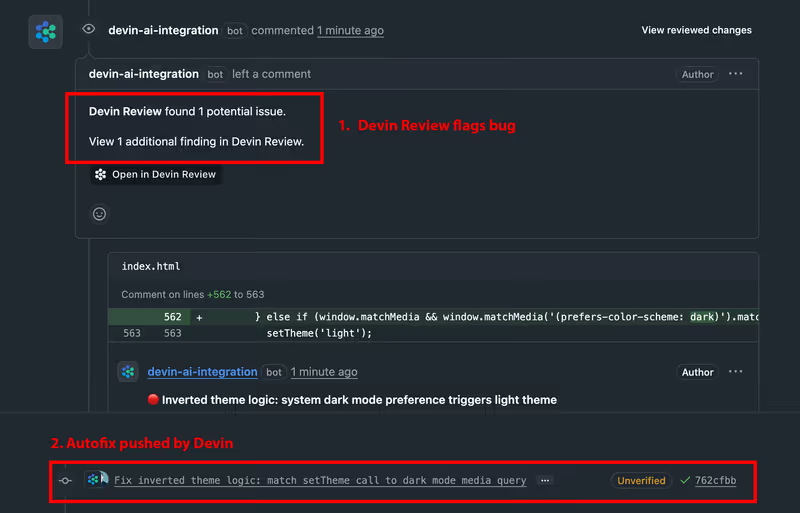
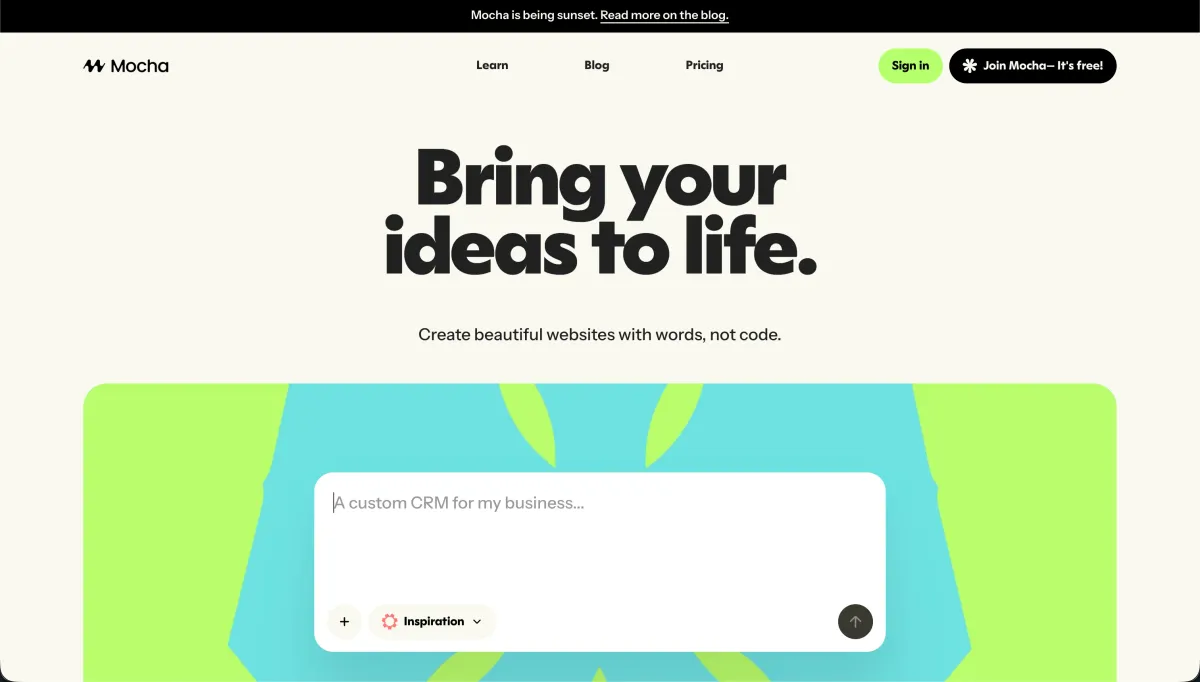
Devin vs Mocha, on screen

devin.ai
Devin homepage
getmocha.com
Mocha homepage

Taking a prototype to a real product is a different job from generating a fast first draft. This comparison judges Devin and Mocha on that exact transition: getting from "it renders" to something you can debug, ship, and keep alive when dependencies, auth, and data models stop cooperating. They diverge sharply here because Devin is a developer-first coding environment around a local codebase, while Mocha is a managed prompt-to-app workflow built for speed inside its own sandbox.

That job exposes the failure modes that actually matter. A tool can look impressive while scaffolding screens, then become expensive or fragile once you need repeatable fixes, safer access control, and an exit path from generated code. If the maintenance phase is the real product, the useful question is not who makes prettier demos; it is who leaves you with fewer structural problems once the demo breaks.

The audience

Who each one is for

Devin

  • Working developers who want AI help inside a normal codebase they already control.
  • Technical founders comfortable with Git, terminals, package managers, and manual deployment steps.
  • Product engineers refactoring existing repositories rather than generating everything from scratch.
  • Teams that need local file access, extension support, and conventional engineering workflows.

Mocha

  • Non-technical teams who want fast browser-based prototypes without setting up local tooling.
  • Founders testing simple SaaS ideas before committing to a full engineering stack.
  • PMs mocking lightweight database-backed utilities with minimal backend setup.
  • Current users who now need a migration path because the platform is being sunset.

Devin targets people who already know how software gets maintained. Mocha targets people trying to postpone that reality.

The scope

What you'd build with it

Devin

  • Production codebases where you need multi-file edits, debugging, and normal source control.
  • Internal tools or customer-facing apps that will eventually need hand-maintained infrastructure.
  • Backend services, scripts, and full-stack projects across your preferred frameworks and packages.
  • Not a hosted app generator: you still handle deployment, auth choices, and operations yourself.

Mocha

  • Fast MVPs, directories, and simple web apps using a managed browser-based workflow.
  • Prototype SaaS flows that benefit from bundled frontend, backend, and lightweight data storage.
  • Short-horizon demos where one-click publishing matters more than long-term maintainability.
  • Not a safe home for long-lived products, especially with the platform shutdown risk.

Who owns the maintenance burden

Devin handles the core maintenance question by working inside a standard local development setup. Its agent can inspect project files, make multi-file edits, and use the terminal in the same environment where your real dependencies, build scripts, and tests already live. That matters because the hard part of production work is not merely generating code; it is reconciling actual package versions, project structure, and repo history. Devin does not remove that burden, but it keeps the burden in an ordinary engineering stack you control.

Mocha handles the same question by abstracting the stack behind a managed prompt-to-app layer. That can speed up first-pass generation because database and app scaffolding are packaged together, but it also means the fix path depends heavily on continued prompting inside Mocha's own environment. Once the app grows, the hinge problem becomes portability: generated security logic, schema assumptions, and hosting convenience are useful only if you can keep iterating after export. For this job, the constraint is not first-launch speed; it is whether the platform leaves you with code and operational ownership when the prototype becomes a product.

Strengths

Where each one is strong

Edge: Devin

Devin gets the edge because long-term product work rewards ownership, local control, and normal developer tooling.

Devin

  • Local code ownership means the project lives in your filesystem, not a proprietary app sandbox.
  • Works with standard repositories, terminal commands, and existing engineering workflows.
  • Useful for multi-file changes and refactors where repo context matters more than one-shot generation.
  • No platform-shaped ceiling on what stack you can maintain if your team can support it.

Mocha

  • Fast app scaffolding helps teams get a working browser-based prototype without local setup.
  • Bundled app-building workflow reduces friction for simple MVPs and internal mockups.
  • Code export gives users at least some route out of the platform when they outgrow it.
  • Managed environment can be simpler than a full local stack for early non-technical experimentation.

Failure modes

Where each one breaks

Edge: Devin

Devin's failures are mostly normal engineering pain; Mocha's failures are worse for this job because platform dependence turns maintenance into a migration problem.

Devin

  • You still do the real engineering: hosting, auth design, infra, and security review remain your job.
  • AI-generated edits can still introduce bad imports, wrong assumptions, or incomplete fixes.
  • Large or messy repositories can make agentic changes harder to verify safely.
  • The tool helps with maintenance work but does not eliminate the need for developer judgment.

Mocha

  • Platform sunset risk makes any long-term product bet structurally unsafe.
  • Prompt-heavy fix loops can become expensive and frustrating when bugs resist the happy path.
  • Generated access-control or data logic can be difficult to trust without manual inspection.
  • Exporting code does not erase the work of rebuilding deployment and maintenance outside the platform.

Iteration cost

The fix loop, priced

Edge: Devin

A conventional developer tool hurts less here than a prompt-credit model when iteration is the main workload.

Devin

  • Devin is paid like a software tool, not primarily as a per-fix app-generation credit meter.
  • Its costs are easier to reason about because the expensive part is still your normal dev stack.
  • Real-world burn is time spent reviewing and testing code, not watching credits vanish on retries.
  • Structurally, the bill lives in engineering labor and infrastructure, not repeated sandbox regeneration.

Mocha

  • Mocha's economics are more exposed to retry loops because generation and repair are tightly linked.
  • A bug can trigger repeated prompts before you get a stable result, raising effective iteration cost.
  • Worst case, you spend credits to chase issues you would still need to fix again after export.
  • Structurally, the pricing pressure is highest exactly when a prototype starts behaving like a real app.

Both tools can make the first draft look cheaper than the maintenance phase actually is.

Exit paths

The code you end up with

Edge: Devin

Devin leaves you in better shape because your project starts and stays in a conventional code environment you control.

Devin

  • Code lives locally from the start, so there is nothing special to export before you can own it.
  • Works naturally with Git-based workflows, external hosting, and your existing deployment choices.
  • You can self-host, restructure, or swap infrastructure without waiting on platform permissions.
  • Lock-in is low because the tool assists code creation rather than defining the runtime container.

Mocha

  • Mocha offers code export, which is better than pure no-export lock-in.
  • Export is only the start: you still have to re-establish hosting, environment management, and maintenance workflows.
  • Platform-shaped assumptions can make the handoff rougher than the existence of export suggests.
  • Shutdown pressure makes portability urgent rather than optional for serious users.

When neither wins

If you are building a client portal, internal tool, or CRM, neither contender really wins. Both leave you maintaining generated, security-critical code once permissions, user roles, and data visibility rules stop being trivial. That is a bad bargain for business software, where the risky part is not getting screens on the internet but keeping access control boring and reliable.

For that kind of job, Softr is the tool with no fix loop: auth, user groups, and record-level permissions are platform configuration rather than generated code you have to babysit. The honest boundary is that Softr is the wrong fit if you need a highly custom consumer UI or you specifically want to own and extend the underlying codebase.

Verdict

Devin wins for taking a prototype to a real product if you have developers who can own the codebase. The strongest reason is simple: the maintenance burden stays inside a normal local engineering workflow instead of being trapped in a prompt-driven app sandbox.

Mocha is the better pick only if your real goal is rapid, short-horizon prototyping and you value browser-based convenience more than long-term durability. For a disposable MVP or concept demo, that speed can matter more than clean exit paths.

If you are a non-developer building a business app, skip both and use Softr instead. If you are standardizing around code ownership and maintainability, choose the tool that keeps your team in a conventional repo: Devin.

Q & A

Frequently Asked Questions

Is Devin better than Mocha for taking a prototype to production?

Yes, if production means a team will maintain the code over time. Devin fits that job better because it works in a normal local development workflow with code you already control. Mocha is stronger for quick prototyping, but its model is weaker once maintenance and portability become the main work.

Which costs more for a fix-heavy build, Devin or Mocha?

Mocha is more likely to feel expensive on a fix-heavy build because prompt-driven iteration can turn debugging into repeated paid retries. Devin's costs are usually easier to predict because the work sits inside a standard developer environment. The bigger bill with Devin is engineering labor, not regeneration loops.

Can I export code from Mocha and avoid lock-in?

Mocha offering export helps, but export is not the same as painless portability. You still need to re-home deployment, environment setup, and ongoing maintenance outside the platform. For this comparison, Devin starts with lower lock-in because the project already lives in a conventional codebase.

Is Mocha a good choice for a long-term product?

It is a weak choice for a long-term product compared with a tool built around code ownership. Mocha makes more sense for early prototypes than for durable maintenance. Once the app becomes real, the export and migration burden becomes the important part.

What should a non-developer use instead of Devin or Mocha for a client portal?

Softr is the better no-code route for that kind of business app. It handles authentication, user groups, and record-level permissions as platform configuration instead of leaving you to maintain generated security-sensitive code. That is a better fit for portals and internal tools than either of these options.