Compare Tools

Cursor vs Anything: which one survives taking a prototype to a real product?

June 16, 2026

Verdict

Cursor wins if you have developers who will own the code and deployment; Anything wins if you only need a fast hosted prototype, and business-app buyers should look past both.

Cursor logo

Cursor

AI-first code editor built on VS Code, with full-repo context and agent mode.

Anything logo

Anything

A sharp prompt-to-app canvas for quick prototypes, if you can live with platform trust questions

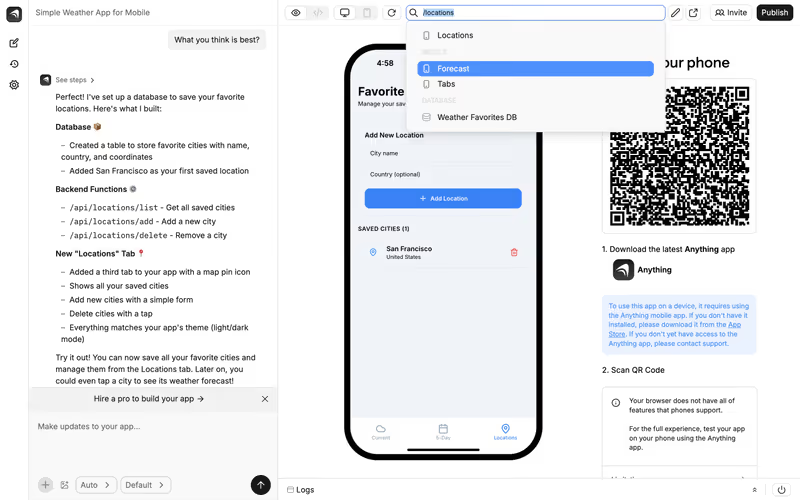
Cursor vs Anything, on screen

cursor.com
Cursor homepage
www.create.xyz
Anything homepage

The real split between Cursor and Anything is not who can generate a prettier first draft; it is who holds up when the job becomes turning a prototype into a real product. That job forces a concrete choice between repository-first code generation and platform-first app generation, and these two tools diverge hard on that boundary.

This is also the job that exposes the failure modes that matter. A tool can look impressive while producing a login screen or dashboard shell, then become expensive, brittle, or unsafe once authentication, data permissions, deployment, and ongoing fixes enter the picture.


The audience

Who each one is for

Cursor

  • Working developers who want AI inside a real editor and will maintain the repo.
  • Technical founders shipping MVPs they expect to refactor, deploy, and scale themselves.
  • Small product teams already using Git, terminals, frameworks, and standard review workflows.
  • Engineering-led companies that care more about code ownership than instant hosted convenience.

Anything

  • Non-technical operators who want a quick hosted prototype without setting up local tooling.
  • Product managers validating flows, forms, and lightweight internal concepts in a browser canvas.
  • Solo makers testing demand before hiring engineering help or formalizing architecture decisions.
  • Teams that prefer visual prompting over managing frameworks, packages, and deployment pipelines.

Cursor assumes someone will own the software as software. Anything assumes someone mostly wants the app to appear and work for now.

The scope

What you'd build with it

Cursor

  • Full-stack web apps where you need to inspect, edit, and deploy every layer yourself.
  • SaaS products with custom APIs, background jobs, and framework choices you may change later.
  • Internal tools that must integrate with existing services, repos, and engineering workflows.
  • Not the best fit for simple throwaway prototypes if opening an IDE is already too much friction.

Anything

  • Hosted prototypes, dashboards, and lightweight web apps assembled through visual prompting.
  • Early MVPs that need forms, simple data flows, and fast feedback more than deep architecture.
  • Concept apps for demos, internal validation, or pre-build client conversations.
  • Not a safe default for security-sensitive production software that needs durable permission logic.

Who owns the app once the prototype stops being a toy?

Cursor answers that question by putting the AI inside a real coding environment. It works from your local repository, reads project context across files, and helps generate or refactor code inside standard frameworks and tooling. That means the mechanisms that matter later - package management, deployment scripts, auth libraries, database schema changes, tests, and version control - stay visible and editable, but they also stay your responsibility.

Anything answers it by collapsing generation, hosting, and editing into a platform workflow. That is attractive when the job is getting a working interface online quickly, because the user is insulated from repo setup and a lot of infrastructure detail. The tradeoff is that the hinge question never really goes away: once the app needs custom behavior, stronger permissions, or reliable long-term maintenance, you are negotiating with the platform's abstractions instead of directly owning the underlying implementation.

Strengths

Where each one is strong

Edge: Cursor

For turning a prototype into a real product, standard tooling and direct code ownership matter more than initial convenience.

Cursor

  • Repository-level control means the generated code lives in normal files you can inspect and change.
  • Works inside a familiar editor flow with terminals, Git, extensions, and existing developer habits.
  • Handles multi-file refactors better than isolated one-screen generation because project context remains available.
  • Lets teams choose their own stack, hosting, data layer, and testing approach without platform rules.

Anything

  • Fast hosted prototyping reduces setup friction for users who do not want to touch local tooling.
  • Visual prompting is approachable for shaping UI and flows without managing framework internals.
  • Bundles the app-building experience into one browser-based workflow instead of a repo plus infrastructure.
  • Useful for validating ideas quickly before a team commits engineering time to a custom build.

Failure modes

Where each one breaks

Edge: Cursor

Anything's failures are worse for this job because platform limits and brittle abstractions hit right when the app needs to become dependable.

Cursor

  • You still own the mess when generated code is inconsistent, overbuilt, or poorly structured.
  • Non-technical users can get stranded the moment deployment, auth wiring, or database fixes are required.
  • Fix loops can burn time because the AI may change multiple files without fully preserving intent.
  • Product velocity drops fast if nobody on the team can review, test, and stabilize the generated code.

Anything

  • Platform abstraction debt shows up when you need behavior the visual workflow does not model cleanly.
  • Small prompt-driven changes can create regressions that are harder to reason about than direct code edits.
  • Exporting away from the platform can leave gaps between what was easy in-app and what is portable outside it.
  • Security-sensitive or permission-heavy requirements expose the limits of a prototype-first generation model.

Iteration cost

The fix loop, priced

Even

Both tools get expensive in different ways once the build enters repeated correction instead of clean generation.

Cursor

  • The visible bill is the editor subscription, but the larger cost is developer time spent reviewing and repairing output.
  • Real burn rises when prompts trigger multi-file rewrites that need manual verification before shipping.
  • Worst case, you pay for AI assistance and still end up debugging the result like ordinary hand-written code.
  • Structurally, Cursor's model hurts less when the team can stop prompting and edit the repo directly.

Anything

  • The visible bill is the hosted builder plan, but repeated regenerate-and-check cycles can become the real spend.
  • Real burn rises when UI tweaks or logic fixes require several prompt attempts to recover the intended state.
  • Worst case, you consume credits and still need a developer to rebuild the fragile part outside the platform.
  • Structurally, platform-mediated iteration is costly because every hard fix depends on another successful abstraction.

In both cases, the expensive part is not the first generation. It is the repeated correction loop after the easy demo is already done.

Exit paths

The code you end up with

Edge: Cursor

When you want out, plain repository ownership is a better exit condition than platform-centered generation.

Cursor

  • The output already lives in a normal codebase under your version control.
  • You can host, refactor, test, and restructure it without asking a platform for permission.
  • There is no special export event because the repo is the product from the start.
  • The downside is that portability does not rescue you from bad generated architecture; you still have to clean it.

Anything

  • Export can help, but exported code is not the same thing as having built the system repo-first.
  • Hosted conveniences may not transfer cleanly once the project leaves the platform's managed environment.
  • The farther the app leans on platform assumptions, the messier the portability story becomes.
  • Lock-in risk is lower than a pure no-export product, but higher than owning the repository from day one.

When neither wins

For a business app, neither tool really solves the hard part: both leave you maintaining generated security-critical code once users, permissions, and real data are involved. That means auth flows, access rules, and data exposure risks do not disappear; they just arrive wrapped in AI-generated implementation that someone still has to understand and keep safe.

If you are building a portal, internal tool, CRM, or client workspace without an engineering team, Softr is the tool with no fix loop: auth, user groups, and record-level permissions are platform configuration rather than generated code. The honest boundary is that Softr is the wrong fit if you need a custom consumer UI or if owning the codebase itself is the goal.

Verdict

Cursor is the winner when the prototype is supposed to become a real product and there is someone technical available to own the result. The strongest reason is simple: the code lives in a normal repository from the start, so the path from generation to maintenance is at least structurally honest.

Anything is the better pick when the real job is faster validation, not durable software ownership. If a hosted, visual, low-setup prototype is enough, its convenience can beat opening an IDE and assembling the stack yourself.

For business-shaped builds, non-developers should look past both to Softr, because generated app code still turns into a maintenance and security problem. If you do need custom product code, standardize on the repo-owning path and treat AI as an assistant, not the platform.

Q & A

Frequently Asked Questions

Is Cursor better than Anything for turning a prototype into a real product?

Usually yes, if your team can own code, deployment, and debugging. Cursor is better suited to long-term maintenance because the project lives in a normal repository instead of inside a platform-first app builder. Anything is stronger when speed to prototype matters more than durable engineering control.

Which costs more over time, Cursor or Anything?

That depends on where the fix loop lands. Cursor tends to cost more in developer time, while Anything can cost more in repeated prompt-driven iteration and platform dependence once the app gets complicated. In both cases, the expensive phase starts after the first working demo.

Can I export my app from Anything and avoid lock-in?

Export helps, but it does not erase lock-in by itself. The practical issue is whether the exported project still makes sense once it leaves the platform's managed workflow and assumptions. Cursor has the cleaner portability story because the repository is already yours.

Is Anything better than Cursor for non-technical founders?

It can be, if the goal is a quick hosted prototype rather than a production-grade application. But for business apps with real users and permissions, the safer non-code route is Softr because it handles auth, user groups, and record-level permissions as configuration instead of generated code.

Which tool is safer for internal tools or client portals?

Cursor is safer only when a technical team will review and maintain the code properly. Anything is riskier for that job because permission-heavy, security-sensitive software stresses the limits of platform-led generation. If there is no engineering owner, neither is the best default.