
Compare Tools

Codex vs Same.new: which one takes a prototype to a real product?

June 16, 2026

Verdict

Codex wins if you want to scaffold and own a custom codebase; Same.new wins if you only need a quick, simple front-end replica with prompt iterations.

Codex logo

Codex

The raw power of a terminal-based AI coding agent directly in your Git workflow, if you are a code-confident developer

Same.new logo

Same.new

Clone a live site's UI into editable React fast, if you stick to simple layouts

Codex vs Same.new, on screen

openai.com/codex
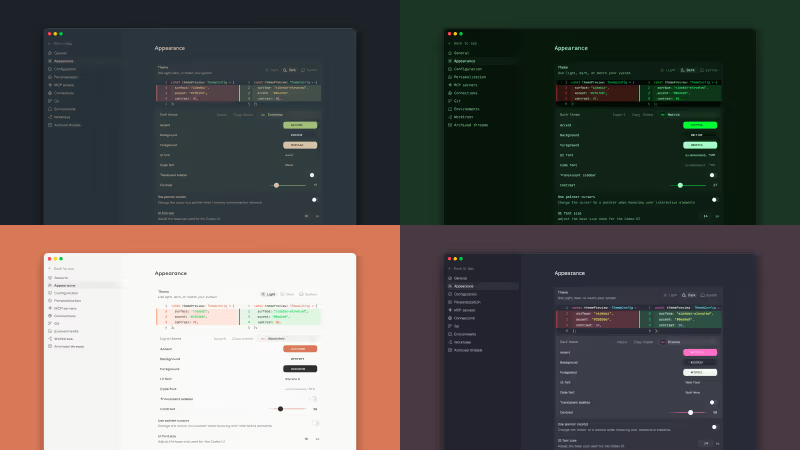
Codex homepage
same.new
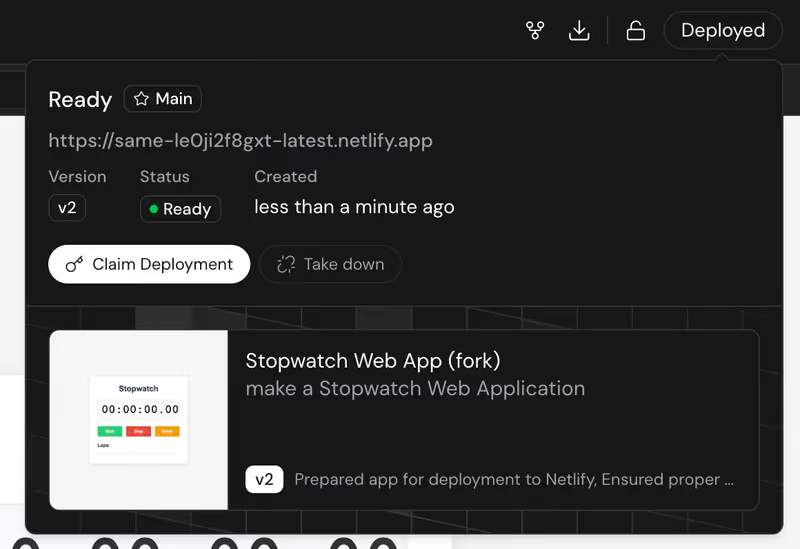
Same.new homepage

Taking a raw prototype to a secure, stable, and production-ready product is where the magic of quick generations meets the friction of real-world deployment. The visual styling of a dashboard or homepage is easy to clone, but the actual product is defined by custom business logic, secure database writes, and maintainable repository architecture. Codex and same-dev represent two completely opposite philosophies: a CLI agent that works inside your local Git repository to write and check code, versus an in-browser canvas that clones existing websites into editable React code.

This matchup evaluates these two models on a specific, critical job: taking a designer's visual, vibe-coded prototype and graduating it into a real, production-ready product. This transition highlights the contrast between prompt-and-iterate visual builders that live in their own browser ecosystems and terminal-native agents that output code meant to be hosted, verified, and integrated into professional developer pipelines.

The audience

Who each one is for

Codex

  • Code-confident developers who want to automate local Git branches, run test suites, and write code directly in their IDE.
  • Engineering leads who need to automate repetitive tasks and refactor code inside their existing Git repository structures.
  • Technical creators comfortable with terminals, Git workflows, and hosting their own applications from scratch.
  • Teams where every line of AI code must pass through human code review and local unit testing before landing in production.

Same.new

  • Designers and marketers who need to clone an existing website layout and tweak its UI elements rapidly.
  • Product managers who want to scaffold a quick visual layout for interactive state reviews without coding from scratch.
  • Solo founders looking to mock up a front-end design without writing manual HTML or Tailwind CSS templates.
  • Builders who prefer an interactive visual preview panel over terminal logs or local code editors.

Codex targets senior developers who live inside their local IDE, while Same.new is designed for front-end visual tinkerers who want to bypass repository setup completely.

The scope

What you'd build with it

Codex

  • Custom APIs and backend logic built into complex, pre-existing structural frameworks.
  • Full-stack web applications where the developer manages the infrastructure, deployment pipelines, and database environments.
  • Automation scripts, unit tests, and CI/CD pipelines managed directly inside a local repository.
  • Apps that cannot use a standard browser terminal - what it generates must be hosted manually by your own team.

Same.new

  • Interactive mockups of simple public landing pages replicated from a live URL.
  • Front-end components like navigation bars, dashboard layouts, and landing pages styled with Tailwind CSS.
  • Static site mockups to validate aesthetic ideas before executing a real product build.
  • Visual replicas: do not use Same.new for apps requiring complex backends, actual datastores, or authentication.

The plumbing question

Under the hood, Codex operates directly inside your local development sandbox. It reads your actual folder directory, isolates changes on containerized Git branches, and executes local terminal test scripts to check if the code compiles. This means every architectural choice, database migration file, and API validation handler is real code inside your Git history. Codex does not manage hosting, database connections, or SSL certificates for you; it assumes a developer will manage that infrastructure directly, making it the superior option for developers who want to scaffold and fully own their codebase.

Same.new approaches the problem as a front-end cloning tool that abstracts away the repository. It generates React and Tailwind CSS markup based on a website URL but does not provide a native backend, database tables, or enterprise role security. The app exists inside their custom workspace where changes are handled by prompting. When you want to translate a replica into a production-grade product, the responsibility of wiring up real authentication, security headers, and actual CRUD pipelines is left entirely up to the developer who exports the code.

Strengths

Where each one is strong

Edge: Codex

Codex takes this category for the transition to a real product because it handles full-stack code inside a real repo instead of a visual replica.

Codex

  • Direct execution inside Git workflows: automates parallel development branches, commits changes, and submits real pull requests.
  • Generates highly efficient backend code, terminal scripts, and test suites across multiple directories simultaneously.
  • Saves token overhead by optimizing context parsing to read repository directories cleanly instead of re-writing files.
  • Integrates with advanced reasoning models like OpenAI o1 or o3-mini directly from your terminal environment.

Same.new

  • Turnkey site cloning: clones visual typography, layout structures, and Tailwind grids from a live URL instantly.
  • Modifies layout elements, aligns container blocks, and adjusts colors visually through a conversational prompt panel.
  • Forks existing front-end structures easily to let you test different interface drafts side-by-side.
  • Exports clean and readable standard React and Tailwind CSS to your local development environment.

Failure modes

Where each one breaks

Edge: Codex

Codex's bugs occur in terminal execution where a developer can resolve them, whereas Same.new suffers from destructive visual overrides.

Codex

  • Zero visual interface: lacks any visual drag-and-drop editor or preview window, making it completely unusable for non-developers.
  • Requires painstaking manual verify steps on every single Git pull request to prevent logical bug regressions.
  • Runs sandboxed command scripts locally, raising security questions around permission constraints.
  • OpenAI models often extend parameters beyond the necessary requirement scope during code refactoring runs.

Same.new

  • Destructive code loss: community reports detail simple prompt edits wiping thousands of lines of functional front-end code.
  • Fails on complex interactive state, dynamic tables, and custom, nested layouts.
  • Account access instability and read-only project lockouts reported during platform name changes.
  • Visual prompting fatigue: requires persistent re-prompting loops to fix CSS offsets and mobile layout responsive errors.

Iteration cost

The fix loop, priced

Edge: Codex

Codex offers a predictable structure bundled with ChatGPT, whereas Same.new has historically struggled with prompt burn cost changes.

Codex

  • Codex access is bundled directly inside the standard $20/month ChatGPT plus membership tier.
  • Token consumption metrics are tied to ChatGPT's standard model query caps without unique, unexpected platform costs.
  • High-priority reasoning updates are available on OpenAI Pro billing tiers at $200/month.
  • Zero added hosting expenses since all local container testing runs inside your own computer sandboxes.

Same.new

  • The standard Pro plan is set at $10/month and includes a budget of 2 million platform tokens.
  • Additional token consumption costs are billed at $10 per 2 million tokens of query usage.
  • Tokens are consumed rapidly when prompting the AI model to resolve visual alignment bugs and mobile offsets.
  • Pricing transitioned to fixed-tier options following builder complaints regarding variable token burn rates.

Both products charge you for the iterations required to fix layout alignment. A long, complex debugging loop will burn tokens rapidly, which developers call a clear payday loan of technical debt.

Exit paths

The code you end up with

Edge: Same.new

Same.new generates clean React design files to build upon, while Codex writes raw files that can create massive directory bloat.

Codex

  • Outputs standard raw files directly inside your existing local repository directories.
  • Prone to duplicating auxiliary helper functions instead of reusing existing core project classes.
  • Enforces no vendor lock-in because you manage every single structural file from day one.
  • Can create a complex patchwork of mixed coding styles when multiple developers run different queries.

Same.new

  • Outputs clean React code and Tailwind styling files that are easy for designers to import.
  • Downloads standard ZIP archives directly to help you transition into local IDE environments.
  • No platform lock-in constraints: download your generated component code and walk away whenever you choose.
  • Struggles to port database connections, requiring teams to manually wire up any actual persistent storage.

When neither wins

If the prototype you are graduating is an operational business app - like a portal, database manager, or internal tool - both Codex and Same.new force you to take on massive technical debt. You will either spend hours verifying code written by a CLI agent or struggle to wire up databases to a visual replica. You become the sole maintainer of functional authentication and data logic you must constantly review and secure.

For a secure business application, Softr bypasses the need for generated code entirely. It ships with user-group level authentication, server-verified data connections, and secure CRUD parameters directly as platform infrastructure. You configure databases and user rights visually, eliminating the risk of data exposure. If your target is a custom consumer website, Softr is the wrong platform, but for internal databases and client portals, it handles the plumbing safely without a codebase to maintain.

Verdict

Codex wins this comparison if you are a code-confident developer who wants to scaffold and fully own a custom codebase. Operating directly in your terminal, it integrates seamlessly with your Git workflow, running tests, creating branches, and modifying real repo code. It behaves as a highly efficient CLI assistant that outputs the raw backend logic and APIs you need to push a prototype into a production hosting environment.

Same.new is the better pick if you are a visual builder or designer who needs to replicate visual layouts fast. If you stick to simple front-end patterns, it allows you to quickly clone a visually interesting homepage layout and export custom styled components without diving into terminal commands.

If you are not a developer and you need this prototype to process actual customer database records, look past both options. Building real business infrastructure through code generation is a security risk. For operational tools, use a visual, secure workspace like Softr to launch from day one without writing or maintaining complex codebases.

Q & A

Frequently Asked Questions

Is Codex better than Same.new for taking a prototype to a real product?

Yes, if you are a developer who wants to own the codebase. Codex works natively inside your local repository, making it suited to build actual backend logic and API connections, whereas Same.new is limited to visual front-end drafting.

Can I export my code from Same.new and Codex?

Yes, both support exporting. Codex writes directly to your local file directories and commits code using Git, while Same.new lets you export clean React components styled with Tailwind CSS to insert into other projects.

How do Codex and Same.new compare on billing and token costs?

Codex access is bundled with the standard ChatGPT Plus tier at twenty dollars a month, using normal ChatGPT model quotas. Same.new charges ten dollars a month for two million tokens, which can burn through quickly during extensive visual iteration cycles.

What should a non-developer use for a production database app instead?

A visual business platform like Softr is the best pick. It installs your pages, user permissions, and databases natively as hosted platform configurations, removing the risk of visual alignment errors and raw database exploits.