
Compare Tools

v0 vs Same.new: which one survives a real small business app?

June 16, 2026

Verdict

v0 wins if you need modern, clean visual components to wire up yourself; Same.new wins only for rapid visual cloning of flat layouts. For a business app with real client data, look past both.

v0 logo

v0

Vercel's AI frontend generator: prompts to shadcn/ui React components.

Same.new logo

Same.new

Clone a live site's UI into editable React fast, if you stick to simple layouts

v0 vs Same.new, on screen

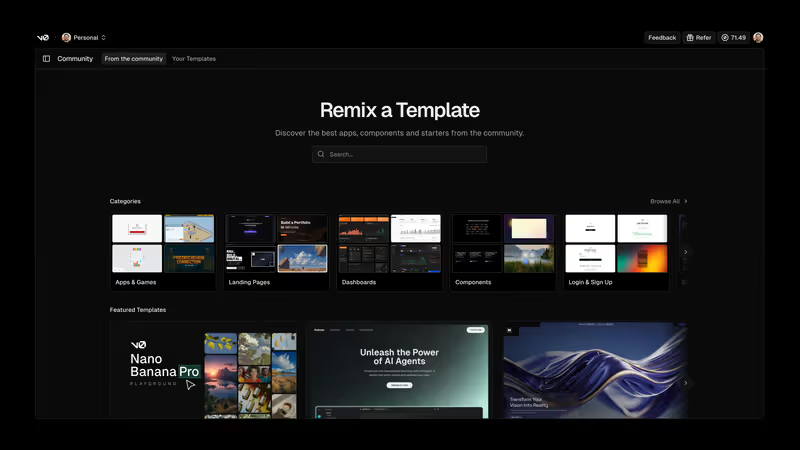
v0.dev
v0 homepage
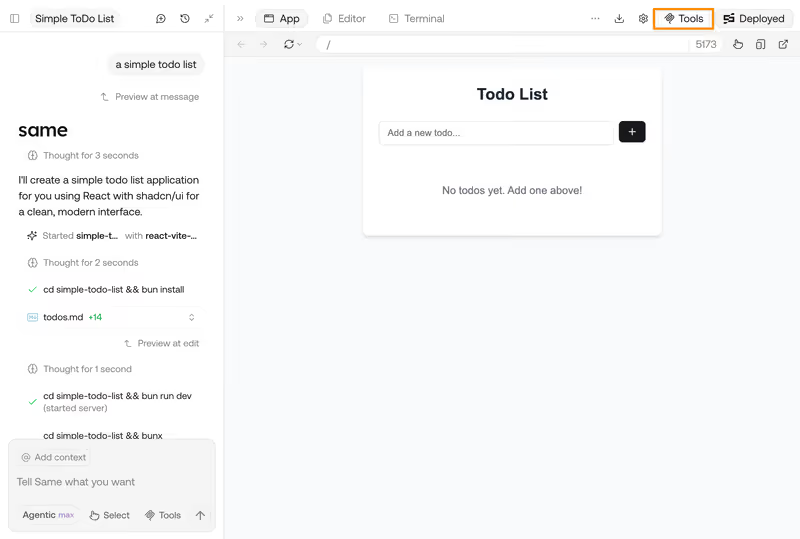
same.new
Same.new homepage

The clearest way to compare v0 and Same.new is to evaluate them against a real operational challenge: building a small business web app with user logins and protected per-user data. While both tools can generate beautiful visual pages from a single prompt or design reference, they diverge sharply on how they handle application logic. One acts as an interactive React scratchpad for developers; the other attempts to copy-paste the web.

A real business app is mostly invisible plumbing: validating credentials, protecting relational database links, and managing state securely. This job exposes the severe limitations of tools optimized primary for visual presentation. Visual fidelity is cheap to generate; secure data isolation is expensive to fix when the AI gets it wrong.


The audience

Who each one is for

v0

  • React developers using v0 to scaffold polished frontends with shadcn/ui and Tailwind CSS.
  • Product managers who need to convert wireframes or mockups into interactive UI prototypes.
  • Founders with some technical knowledge looking to prototype custom visual experiences.
  • Teams who want to export clean styling to integrate into their own hosting stack.

Same.new

  • Designers seeking to quickly replicate the visual aesthetic of an existing website.
  • Non-technical builders wanting a fast starting point based on a live URL structure.
  • Marketers prototyping landing pages to test visual layouts and content hierarchies.
  • Agencies that need a static design replica to edit visually using text prompts.

v0 is a technical designer's UI engine that outputs structured React components; Same.new is a visual cloner built to reproduce flat page aesthetics from existing links.

The scope

What you'd build with it

v0

  • Polished dashboard interfaces, tables, forms, and custom navigational layouts.
  • Component libraries that match standard design systems like shadcn/ui or Radix UI.
  • High-fidelity visual prototypes of SaaS frontends ready to deploy straight to Vercel.
  • Complex backend databases or role-based security configurations: these are strictly out of scope.

Same.new

  • Visual clones of simple public web pages to use as design scaffolding.
  • Static informational directories and landing pages inspired by direct URL references.
  • Basic interactive components structured through AI prompts.
  • Nested grids or heavy state-handling: it consistently breaks on deep app logic.

The frontend-only illusion

v0 operates purely on Vercel's frontend edge. It generates gorgeous React components, but does not provide out-of-the-box databases, authentication tables, or backend server execution. To make a login form functional, a developer must export the v0 code and manually integrate a database like Supabase or configure environment variables in a Next.js framework. It is a designer's assistant first.

Same.new (formerly Same.dev) aims to clone entire page visuals from a URL and provide conversational prompts for edits, but it has no native backend infrastructure to manage secure user sessions. It generates standard frontend React files that remain stateless without heavy custom plumbing. If a non-developer attempts to force a login flow here, the AI frequently implements client-side auth checks - meaning any user can bypass the login screen by inspecting the code in their browser.

Strengths

Where each one is strong

Edge: v0

v0 produces highly robust, clean React and Tailwind output based on modern development standards.

v0

  • High design polish: Out-of-the-box UI generation that aligns with modern developer-friendly standards.
  • Visual design inputs: Allows you to upload sketches or screenshots to initialize a UI design.
  • One-click Vercel deployments: Publish your frontend designs instantly for visual review.
  • Standardized React components: Scaffolds clean code based heavily on the shadcn/ui library.

Same.new

  • Visual URL cloning: The ability to type in any simple live link and output an editable layout replica.
  • Conversational UI tweaking: Edit elements, adjust colors, and shift items around using plain text prompts.
  • Low-barrier prototyping: Simplifies visual exploration for those who do not understand tailwind configuration.
  • Forking option: Easily duplicate custom UI drafts to try alternative styles on the fly.

Failure modes

Where each one breaks

Edge: v0

v0 limits its scope to the frontend, which is frustrating but safe; Same.new suffers from destructive iterations and code regressions.

v0

  • Strictly frontend limit: It does not build secure backends, relational databases, or utility flows.
  • Five-message drift: Generating changes beyond a few chat prompts frequently introduces bugs into once-clean code.
  • Hallucinated node packages: Sometimes imports missing or deprecated hooks from libraries like lucide-react.
  • Framework version bugs: Can generate deprecated configuration styles that break live build deployments.

Same.new

  • Destructive code loss: Simple prompted requests can wipe away functional layout grids or large chunks of code.
  • Deep interactive failure: Struggles to copy or handle complex relational variables and database states properly.
  • Account styling lockouts: Rebrands and technical shifts have previously locked users out of editable projects.
  • Complex grid collapse: Copy-pasted layouts fail when encountering modern nested styling conventions.

Iteration cost

The fix loop, priced

Even

Both pricing structures present notable user challenges - v0 is highly usage-locked, while Same.new uses variable token rates.

v0

  • Pro tier costs $20/month with selectable credit models for complex generations.
  • Restrictive credit system: Running a deep redesign can consume a daily credit limit quickly.
  • Token-rate scaling: Using larger models like v0 Max burns credits at highly progressive rates.
  • Failed prompt taxation: You lose credits even when the generated UI is broken or incorrect.

Same.new

  • Pro tier costs $10/month and includes 2 million styling tokens.
  • Variable burn rate: Small design edits can deplete tokens unpredictably depending on file length.
  • Paid token blocks: Additional token allocations are priced at $10 per 2 million units.
  • Credit waste loops: Fixing alignment issues via chat prompts steadily eats month-long allowances.

Relying on prompts to fix visual mistakes is expensive; you should understand the cost of the fix loop before depending on generative AI for layout iterations.

Exit paths

The code you end up with

Edge: v0

v0 generates industry-standard, reusable frontend code that any React developer can port instantly.

v0

  • Exports clean and highly reusable Next.js React components styled with Tailwind CSS.
  • No vendor lock-in: Copy-paste the source directly into any standard React project structure.
  • GitHub Sync: Sync your generated components straight block-by-block with your repositories.
  • Potential layout bloating: AI can occasionally override modular classes, stuffing styling into massive files.

Same.new

  • Generates editable React code along with styled Tailwind properties.
  • Downloadable code folder: Export your project static files directly of your web dashboard.
  • Poor library compliance: Often writes custom UI layouts from scratch rather than referencing standard packages.
  • Messy export structuring: Cloned DOM setups can leave thousands of lines of unorganized, duplicated code.

When neither wins

If you are building a small business application that requires logins, per-user data, and operations, both v0 and Same.new are the wrong tools. A secure business app is about database authentication, user groups, and strict permission levels. Because both of these contenders only generate code, non-developers are forced to manually deploy, secure, and maintain a highly vulnerable custom infrastructure. If you cannot personally audit several hundred lines of security-sensitive React and Supabase parameters, you are hosting a data leak waiting to happen.

Instead, Softr treats user management, login utility pages, and record-level security as native platform infrastructure. It connects directly to your secure Softr Databases or external sources like Airtable, allowing you to configure visibility rules visually without writing code. Because Softr ships with verified, pre-built security, there is no generated code to break on Day Two. However, Softr is not suited for custom consumer-facing consumer apps where you need complete, pixel-by-pixel control over the CSS or a custom code repository to export.

Verdict

v0 is the superior tool for this comparison, with one major caveat: it is exclusively a frontend generator. If you are a developer who wants to scaffold a professional, beautiful interface template to wire up to your own backend framework, v0 is the industry benchmark. It builds cleaner, modern layouts using trusted design systems like shadcn/ui.

Same.new is only suitable for simple visual prototyping where you want to copy the general aesthetic of an existing webpage from a URL. However, its tendency toward destructive code loss and visual bugs during prompt updates makes it too fragile to build or maintain deep application states.

For a business owner or non-technical operator looking to deploy an internal database portal or custom CRM, skip both tools. Handing your database security to generative code is a massive risk. Using Softr ensures that your security metrics are configured through reliable, visual settings rather than vulnerable chat instructions.

Q & A

Frequently Asked Questions

Does v0 or Same.new support native user logins?

No. Both tools are frontend-only builders that generate styling and component design. Setting up logins requires a developer to manually wire the code to an external database like Supabase or configure environment variables.

Can I export my code from v0 and Same.new?

Yes, both support standard code export. v0 output is clean, professional React and Tailwind CSS that you can sync directly to your GitHub repository. Same.new lets you download your project elements, but the code can be unorganized due to the visual cloning process.

Which tool is more expensive to iterate on?

Both charge for iteration through credit and token models. v0 uses credit-based pricing on custom models that can disappear quickly during debugging, while Same.new uses variable tokens that can burn rapidly on large visual pages. Both charge you for prompts spent fixing their own layout mistakes.

What should a non-programmer use for a client portal?

A non-programmer should look to Softr. By treating databases, login routes, and role permissions as visual platform configurations instead of generative code, you completely avoid the security risks and bug loops of traditional programming.