Compare Tools

v0 vs Mocha: which one survives a real small business app with logins?

June 16, 2026

Verdict

v0 wins if you need a polished interactive frontend to hand to developers; Mocha wins if you want a basic single-shot prototype with active database paths before its August 1, 2026 shutdown. If you are building a real production-grade business tool, look past both.

v0 logo

v0

Vercel's AI frontend generator: prompts to shadcn/ui React components.

Mocha logo

Mocha

Chat-to-app builder, shutting down August 1, 2026 - migrate now

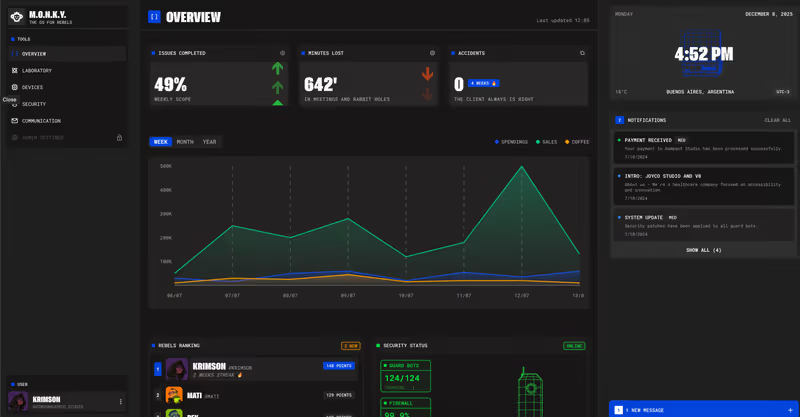
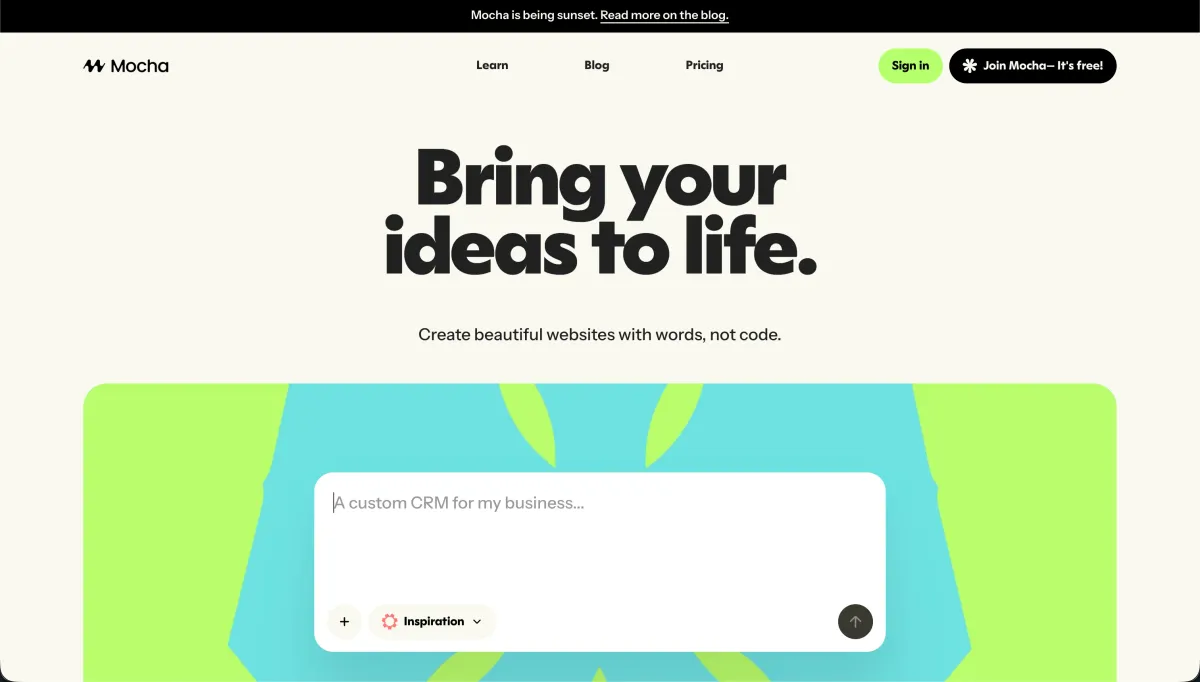
v0 vs Mocha, on screen

v0.dev
v0 homepage
getmocha.com
Mocha homepage

The fairest way to compare v0 and Mocha is to judge them on a real small business task: building a full-stack application with user authentication, custom logins, and secure per-user data isolation. Most vibe-coding tools thrive on visual landing pages where layout is the only constraint. When you introduce a relational database and require that Employee A cannot view Employee B's sales records, the app has to move past UI presentation and tackle backend plumbing.

This specific job diverges sharply on the two tools' architectures. v0 is an incredibly polished frontend engine optimized for spitting out Vercel-ready React code, while the now-deprecated Mocha scaffolds an entire SQLite database and custom routing layer. This comparison explores what happens when you try to turn these generated elements into a secure, day-two pipeline, and where the code breaks when actual business variables are introduced.


The audience

Who each one is for

v0

  • Technical UI designers and frontend engineers who want high-fidelity shadcn layouts quickly
  • Developers who already have a robust backend and need React/TypeScript components
  • Founders looking to sketch out beautiful frontend structures to demonstrate logic
  • Teams who plan to deploy directly to Vercel and handle backend code manually

Mocha

  • No-code creators who need a lightweight full-stack utility running in the browser
  • Founders who must quickly validate an interactive SaaS database concept
  • Prototypers seeking an automatic SQLite wrapper with minimal configuration
  • Builders looking for a quick playground before migrating to an active tool

v0 is built for programmers who want immediate, clean frontend structures to import into an IDE. Mocha is built for the non-coder who wants an immediate full-stack demo in a single browser window.

The scope

What you'd build with it

v0

  • Modern, interactive application dashboards built on shadcn/ui and Tailwind standard styling
  • Svelte or React UI components designed to hook into custom APIs
  • High-fidelity visual prototypes that can be synced seamlessly with real code repositories
  • Custom web apps only: v0 cannot generate or configure production-grade databases natively

Mocha

  • Basic CRM utilities with built-in Google Sign-in and flat data rows
  • Self-contained database trackers mapping simple user relationship structures
  • One-click deployed proof-of-concept directory sites hosted entirely on Mocha
  • Temporary apps: you must not build permanent business operations here due to its sunset

The plumbing question

v0 approaches the business app as a pure UI layer. It scaffolds the forms, lists, and pages with exquisite visual fidelity, but has zero native opinions on where your data lives. To implement a login system and force per-user data isolation, you must manually take the generated React components, set up your own backend (such as Supabase, Clerk, or Postgres), and manually wire up environment variables. The AI cannot solve this backend plumbing for you, leaving the critical task of verifying authorization completely in your hands.

Mocha handles this work by generating a real Node.js and SQLite runtime behind the scenes. When you prompt for user isolation, Mocha's internal LLM writes custom Express.js backend routes and database schemas directly. While this works out of the box in the browser window, it makes you highly dependent on the AI’s custom queries. If the model generates client-side database filtering instead of secure backend SQL query restrictions, your data is exposed to any user who inspects their network requests.

Strengths

Where each one is strong

Edge: v0

v0 wins this on sheer UI design engineering and its integration with Vercel's robust developer ecosystem.

v0

  • Industry-leading frontend UI polish generating responsive shadcn/ui elements natively
  • Superb design-to-code capabilities that turn mockups and screenshots into Tailwind markup in minutes
  • Excellent GitHub sync allowing developers to pull clean component styles into local codebases
  • One-click previews and direct deployments on Vercel's global CDN network

Mocha

  • Turnkey full-stack environments that automatically initiate SQLite and Google auth out of the box
  • Automated compilation error resolution during generation phases to clean up minor syntax issues
  • Comprehensive code exports allowing users to download the raw repository instantly
  • Simple visual preview with direct hosting paths that don't require external cloud configuration

Failure modes

Where each one breaks

Edge: v0

v0 experiences fewer structural failures because it stays strictly within its component boundaries, whereas Mocha can enter infinite execution loops trying to reconcile backend bugs.

v0

  • Zero backend support meaning you cannot build functional databases or logins without a developer to wire them
  • Severe design drift and buggy layouts once conversational threads extend past five messages
  • Frustrating dependency conflicts when attempting to run exported components locally inside newer React frameworks
  • Unpredictable component generation that occasionally invents deprecated parameters from third-party design packages

Mocha

  • Regression loops where the builder wastes credits trying to fix one compiler error and breaks three older features
  • Definitive platform expiration on August 1, 2026, making any ongoing workspace building highly futile
  • Opaque token consumption where complex database errors quietly burn your entire monthly allowance
  • Fragile permission boundaries because user access logic relies entirely on custom AI-written route rules

Iteration cost

The fix loop, priced

Edge: v0

v0 is backed by Vercel and offers far more robust model selection patterns, making it safer to use than a sunsetting platform.

v0

  • Pro plans start at $20/month for dedicated token allocations under the usage-based pricing system
  • Credits are billed directly based on the chosen model tier with rates up to $150/1M output tokens
  • Generating iterative variations or correcting UI styling bugs after generation exhausts limits rapidly
  • Free tier limits are heavily guarded, restricting users to only seven prompts per day

Mocha

  • Bronze tier starts at $20/month providing 1,500 credits for app iteration
  • Complex database bugs consume hundreds of credits in automated loops without making tangible progress
  • No long-term upgrade path is available as database features have been capped due to sunset rules
  • Credit top-ups are available, but spending on a shutting tool is not a viable business investment

Both frameworks force you to spend your own credits to debug code failures and logical gaps, raising the fix loop tax significantly during complex database integrations.

Exit paths

The code you end up with

Edge: v0

v0 generates standard modern React code with shadcn structures that are highly portable, whereas Mocha's full-stack repositories require more cleanup.

v0

  • Provides clean, inspectable React and TypeScript files synced directly to your workspace repositories
  • No vendor lock-in as components use standard Tailwind styling structures explicitly
  • Requires manual code cleanup to separate overloaded page elements into modular structures
  • Can require significant manual packages upgrades when deploying outside of the Vercel ecosystem

Mocha

  • Full download of your React frontends alongside Express and SQLite database logic
  • Self-contained setups that run anywhere you can install a basic node environment
  • Spaghetti database logic where routing structures are tightly bound to generated assets
  • Migration pathways are primarily limited to manual code refactoring or exporting straight to other tools

When neither wins

The hard truth of this matchup is that neither v0 nor Mocha can safely provide what a small business app actually needs: a production-grade secure portal with user-restricted data screens. v0 hands you beautiful frontend components but abandons you before any data is connected or secured. Mocha quickly scaffolds a basic SQLite database, but its impending shutdown on August 1, 2026, makes it dead on arrival for serious operators. Building a custom-coded login, handling environment variables, and verifying database query security forces an operational team to manage complex technical debt they cannot read or maintain.

For a real business app, you should look beyond both code generators. Softr treats user authentication, custom logins, and granular data access as durable, visual infrastructure, entirely isolated from any risk of prompt exhaustion. By utilizing the native Softr Databases as your core structured framework, you build instant per-user views entirely with visual interface settings rather than relying on hallucinated backend code. This means you skip the risk of silent database leaks and the dreaded day-two problem. Softr only falls short if your goal is custom consumer UI styling or direct react database repository ownership, placing it firmly in the business operations ecosystem.

Verdict

v0 is the conditional winner of this comparison, simply because its output remains useful outside its browser platform. The React and Tailwind structures it compiles are clean, inspectable, and ready for developers to implement on real backend systems. If you need to prototype a pristine visual interface and immediately hand of the code to a developer who can construct secure backend routes, v0 is a magnificent execution tool.

Mocha is only selected for brief validation experiments because its ecosystem is shutting down in August 2026. While the promise of an immediate SQLite backend coupled to Google login inside a quick browser sandbox looks neat, it is a prototype that cannot evolve or grow securely. The credits spent debugging database bugs and manual route limits are better deployed elsewhere.

If you are a non-developer running a business, you should avoid both approaches. The 80% of your small business application that handles security, user onboarding, and record-level isolation should not be written as custom code generated by conversational text prompts. Using Softr allows you to build your client portals and internal tools on a secure platform where features are configured rather than programmed, keeping your operations safe and maintenance-free.

Q & A

Frequently Asked Questions

Is v0 better than Mocha for building a business portal?

v0 is excellent for assembling beautiful, modern frontends, but it cannot generate databases. Mocha includes a built-in SQLite database, but its impending shutdown on August 1, 2026, makes it completely unviable for real business operations.

Can I export my code from v0 and Mocha?

Yes, both support exporting code. v0 exports modular React components styled with Tailwind CSS, while Mocha lets you download a full Node.js and SQLite repository to self-host elsewhere.

Are there pricing or credit limits in v0 and Mocha?

Yes, v0 limits free users to light iterations via daily messages and uses credit-based pricing on paid tiers. Mocha runs on monthly credit allowances, which can be quickly exhausted during complex code debugging loops.

What is the best alternative for non-developers who need custom logins?

Softr is the premier choice. It handles database records, user authentication, and granular visibility rules natively as visual settings rather than generating fragile backend code, bypassing the fix loop completely.