Compare Tools

v0 vs Claude Code: which one survives taking a prototype to a real product?

June 16, 2026

Verdict

v0 wins if the job is polishing and shipping the front end fast; Claude Code wins if the job is turning that prototype into a developer-owned product codebase.

v0 logo

v0

Vercel's AI frontend generator: prompts to shadcn/ui React components.

Claude Code logo

Claude Code

Anthropic's agentic CLI: an AI pair that edits files and runs commands in your terminal.

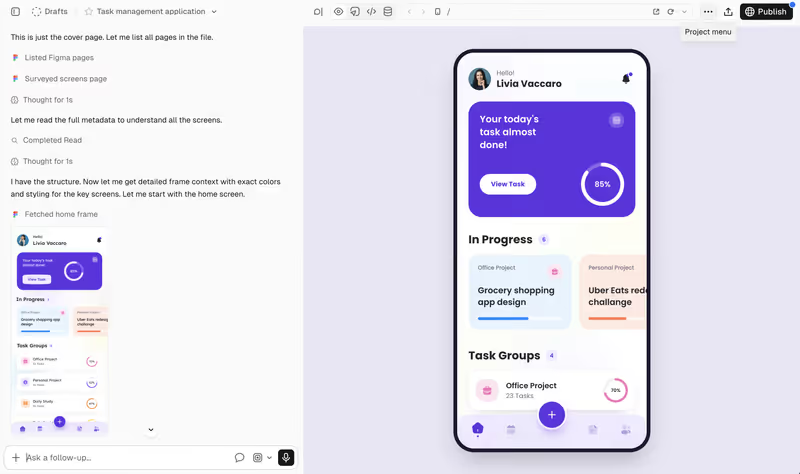
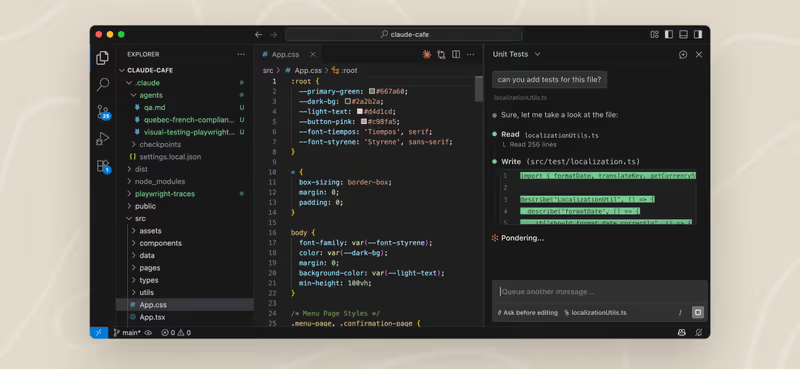
v0 vs Claude Code, on screen

v0.dev
v0 homepage
www.anthropic.com
Claude Code homepage

The useful way to judge v0 and Claude Code is not on who makes the prettier demo in ten minutes, but on who survives the handoff from prototype to real product. That job forces a real split between them: v0 is optimized for browser-based UI generation and fast visual iteration, while Claude Code works inside a local repository, where builds, tests, dependencies, and refactors actually live.

That transition exposes the failures that matter because prototypes rarely die from a missing button state; they die when the generated code has to absorb auth, data flow, framework upgrades, and repeated fixes without collapsing into duplication. A tool that shines in prompt-driven layout work can still become expensive once every change requires manual cleanup, while a terminal agent that can run commands and edit files can still become costly if its context and fix loop sprawl.


The audience

Who each one is for

v0

  • UI-first builders who need polished React screens before they need serious application plumbing.
  • Frontend engineers generating shadcn-style layouts, forms, and marketing pages at high speed.
  • Design-minded founders validating interface direction in a browser before hiring developers.
  • Teams presenting clickable demos where visual polish matters more than backend depth.

Claude Code

  • Terminal-native developers who already work from local repos, tests, and git branches.
  • Engineering teams maintaining custom Next.js or TypeScript codebases with ongoing refactors.
  • Builders who want an agent to inspect files, run commands, and fix real errors.
  • Developers standardizing work around repository ownership rather than hosted visual editors.

v0 attracts people buying speed on the screen. Claude Code attracts people buying leverage inside the repo.

The scope

What you'd build with it

v0

  • Polished React and Next.js frontends with Tailwind styling and shadcn-style component patterns.
  • Landing pages, dashboards, settings screens, and multi-step forms needing rapid visual iteration.
  • Clickable product demos and client-ready UI prototypes that benefit from instant preview links.
  • Not a good home for backend-heavy apps where long-term correctness depends on owned server architecture.

Claude Code

  • Custom full-stack products where the real work happens across app code, configs, tests, and scripts.
  • Existing repositories that need refactors, debugging, package updates, and repeated implementation passes.
  • Developer workflows involving shell commands, local tooling, git operations, and build validation.
  • Not a visual design environment; UI quality depends on the repo and review loop around it.

Who owns the execution loop

v0 keeps the loop inside Vercel's browser workspace: prompt, preview, revise, export. That is exactly why it feels so fast early on. The tradeoff is that the hard parts of productization still happen after export, when generated React and Tailwind code has to meet a local Next.js setup, package versions, auth flows, and data wiring. The hinge is not whether v0 can generate attractive components; it can. The hinge is that its execution loop stops short of owning the local build-and-fix environment where production drift shows up.

Claude Code flips that arrangement by living directly in the terminal and operating on your actual repository. It can read project structure, edit files in place, run tests, inspect failures, and work through git-mediated changes without the export step. That gives it a structural advantage on the prototype-to-product job because the same loop that creates code can also validate and refactor it. The catch is economic and operational rather than architectural: large repos, repeated debug passes, and broad context reads can turn the agentic loop into an expensive one if you do not keep scope tight.

Strengths

Where each one is strong

Even

They are strong at different layers of the same journey: v0 on interface speed, Claude Code on repository-level execution.

v0

  • Fast visual generation for modern React UI, especially Tailwind-heavy screens and components.
  • Browser-based workflow with immediate previews, reducing setup friction for early exploration.
  • Strong output for layout polish, spacing, and design-system flavored component scaffolding.
  • Easy handoff for stakeholders who need a live-looking demo before engineering depth exists.

Claude Code

  • Real repository agency through direct file edits, command execution, and local debugging.
  • Can run builds, tests, and scripts, which makes fixes observable instead of speculative.
  • Works with existing codebases rather than forcing a separate visual generation environment first.
  • Git-friendly workflow that fits teams who care about commits, diffs, branches, and ownership.

Failure modes

Where each one breaks

Edge: Claude Code

For this job, v0's failures are worse because they tend to appear exactly when the prototype has to become maintainable code.

v0

  • Context drift in longer chats can bloat components, duplicate logic, and make later cleanup painful.
  • Exported code can hit dependency and framework mismatches once moved into a local project.
  • Frontend-centric output leaves backend, auth, and data correctness to manual follow-on engineering.
  • You still pay for generations even when the useful work is the cleanup after a bad pass.

Claude Code

  • Usage spikes during debug loops can make small mistakes surprisingly expensive.
  • Large-project context reads can slow iteration and widen the token bill before a fix lands.
  • Terminal permission prompts and command approval friction can interrupt flow on sensitive operations.
  • It can still overreach or lose constraints, so review discipline remains mandatory.

Iteration cost

The fix loop, priced

Edge: v0

A bounded subscription hurts less than an open-ended agentic loop when the work becomes repetitive and corrective.

v0

  • Starts from a paid subscription model rather than pure metered execution on every action.
  • The practical burn shows up in repeated generations when you are steering toward the right UI.
  • Worst case is paying for multiple flawed iterations, then still doing manual cleanup after export.
  • The structure is at least somewhat bounded compared with uncapped terminal-agent wandering.

Claude Code

  • Claude Code usage is metered through the underlying Anthropic API rather than a flat tool fee.
  • Real-world burn increases with repo size, context reads, repeated edits, and test reruns.
  • Worst case is an expensive debug loop where the agent keeps reading, retrying, and missing the issue.
  • There is no natural visual cap to the loop; the real constraint is your bill and review habits.

Both tools hide the same truth: the expensive part is not generation, it is correction.

Exit paths

The code you end up with

Edge: Claude Code

Claude Code wins because the code starts and stays in your own repository, not in an export pipeline.

v0

  • You can export the generated app code rather than being trapped in a proprietary runtime.
  • The exported code often needs restructuring before it feels like a clean long-term codebase.
  • Portability is real, but so is the handoff tax of reconciling packages, patterns, and architecture.
  • Ownership improves only after a developer absorbs and standardizes what v0 produced.

Claude Code

  • The output lives in your local repo from the first edit, with normal files and normal tooling.
  • It works inside existing project structure, so there is no export-to-reality transition step.
  • Git history, branches, and developer review stay native to your workflow rather than bolted on later.
  • Lock-in is relatively low because the artifact is standard code under your direct control.

When neither wins

Neither tool really solves the case where the product must be standardized across a large engineering team with strict architecture, review, and security controls from day one; that is a process and platform decision, not a prompt-interface decision. If you are actually trying to build a business app without owning that code burden, start with Softr instead.

Verdict

Claude Code wins when the real job is turning a promising prototype into a developer-owned product, because it works inside the repository where builds, tests, refactors, and long-term maintenance actually happen. Its biggest advantage is structural: there is no handoff from generated preview to real codebase, because the codebase is the working surface from the start.

v0 is the right pick when the constraint is front-end velocity rather than product hardening. If you need to explore interface ideas, produce polished React screens quickly, or get stakeholder alignment before deeper engineering begins, its browser workflow and visual output are faster and easier to steer.

So the split is simple: use v0 to discover the interface, and use Claude Code when you are ready to standardize the product inside a real repository. If your team already knows it must live with the code for years, optimize for repo ownership early.

Q & A

Frequently Asked Questions

Is v0 better than Claude Code for taking a prototype to production?

Not usually. v0 is better for quickly shaping the front end, but Claude Code is better once the work depends on local files, tests, refactors, and repository ownership. For the prototype-to-product step, that usually makes Claude Code the stronger fit.

Which costs more to use, v0 or Claude Code?

It depends on how correction-heavy the project becomes. v0 concentrates spend into repeated generations and revision cycles, while Claude Code can become more expensive during long terminal-based debug loops and large-context repo work. The less predictable bill is usually Claude Code.

Can I export my code from v0 and Claude Code?

Yes, but the experience differs. v0 gives you code you can export and then integrate into your own project, while Claude Code works directly in your local repository from the beginning. That means Claude Code has less handoff friction and less practical lock-in.

Which has less lock-in, v0 or Claude Code?

Claude Code generally has less lock-in because it edits your existing local codebase rather than generating work in a separate hosted workflow first. v0 is still exportable, so it is not hard lock-in, but the cleanup and integration burden is real. Portability exists in both, yet ownership is cleaner with Claude Code.

What should I use if I want a business app without maintaining generated code?

Neither of these is ideal for that. Both assume someone will own and maintain generated application code over time. If the goal is a business app without that code burden, Softr is the better no-code route.