Compare Tools

v0 vs Zite: which one survives a small business web app?

June 16, 2026

Verdict

v0 wins if you are a developer who want bespoke React components; Zite wins if you are a non-technical builder who need a pre-wired database; look past both if security and predictable scale matter.

v0 logo

v0

Vercel's AI frontend generator: prompts to shadcn/ui React components.

Zite logo

Zite

Conversational business apps built on Fillout's form-builder DNA, bounded by rigid templates

v0 vs Zite, on screen

v0.dev
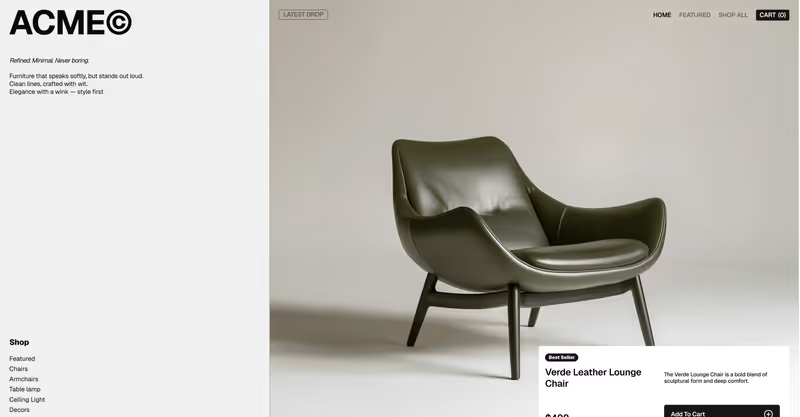
v0 homepage
zite.com
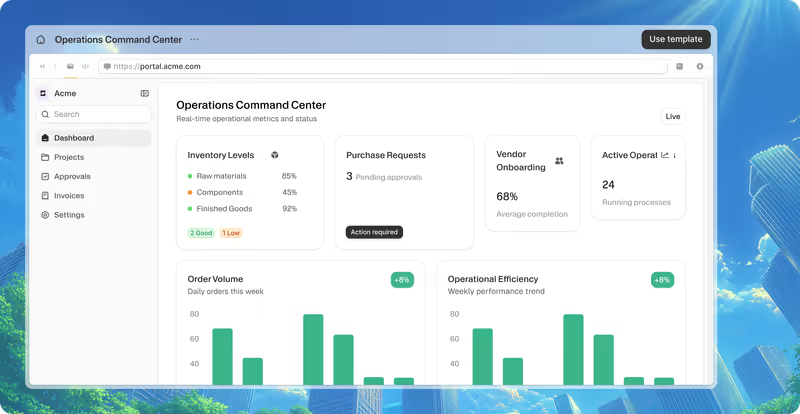
Zite homepage

Building a small business web app with logins and per-user data sounds like a UI problem until the backend rules start mattering. This is exactly where v0 and Zite diverge: v0 is fundamentally a frontend code generator, while Zite is a template-bounded app builder with database and permissions opinions baked into the platform.

That job exposes the failure modes that actually hurt. A polished screen is easy to demo, but user isolation, auth flows, database access, and change costs are what decide whether the app survives real use or turns into a cleanup project.


The audience

Who each one is for

v0

  • Frontend-heavy teams who want polished React components dropped into an existing codebase.
  • Developers who already own auth, database, and deployment infrastructure elsewhere.
  • Design-conscious founders working with engineers who can wire backend logic manually.
  • Product teams using AI to accelerate UI scaffolding rather than ship complete apps.

Zite

  • Non-technical operators who want to build internal tools without touching code.
  • Small teams needing forms, tables, and basic portals from a guided prompt flow.
  • Solopreneurs who prefer hosted infrastructure and built-in database setup over flexibility.
  • Business users willing to accept template constraints in exchange for faster configuration.

v0 assumes a developer downstream. Zite assumes the platform should absorb most of the setup, and that assumption shapes everything.

The scope

What you'd build with it

v0

  • Polished dashboards, portals, and admin frontends that need custom React presentation.
  • Clickable prototypes or MVP interfaces before backend logic is fully implemented.
  • Reusable UI components built with Tailwind CSS and shadcn-style patterns.
  • Not a full business app by itself: it does not provide native database, auth, or server logic.

Zite

  • Internal tools, simple CRMs, and client-facing portals with standard data views.
  • Operational workflows centered on forms, records, lists, and permissions.
  • Basic login-based apps where built-in database structure matters more than custom design.
  • Not a good fit for bespoke consumer UI or heavily customized design systems.

The plumbing question

v0 does not solve the core plumbing for this job; it hands you code. If you ask for a client portal, you can get clean React and Tailwind output, but session handling, API routes, database models, and Row-Level Security still have to be implemented elsewhere. In practice that means exporting or syncing the code into your repo, then integrating an auth provider, a database such as Postgres or Supabase, and the permission logic that prevents one customer from seeing another customer's records.

Zite approaches the same problem from the opposite direction by coupling UI generation to its built-in data layer and permission model. The upside is that schemas, forms, and record views can appear together, which reduces setup for non-developers. The trade-off is that the permission and data convenience live inside a rigid runtime: you get less room to reshape flows, layouts, and edge-case behavior without fighting the platform.

Strengths

Where each one is strong

Edge: v0

v0 has the stronger upside when design quality and code ownership matter more than built-in operations.

v0

  • High-quality frontend output with standard React and Tailwind code you can actually edit.
  • GitHub sync supports moving generated work into a normal developer workflow.
  • Strong at turning screenshots, sketches, or prompts into polished interface scaffolds.
  • Portable output reduces lock-in because the code is not trapped in a proprietary runtime.

Zite

  • Built-in data layer lowers setup friction for forms, records, and basic portal views.
  • Hosted environment avoids separate hosting and infrastructure decisions for new builders.
  • Prompt-driven generation can assemble practical CRUD-style apps faster than manual coding.
  • Unlimited-user positioning is attractive when seat-based pricing would otherwise compound.

Failure modes

Where each one breaks

Edge: Zite

For this job, v0's failure mode is harsher because it can leave the hardest parts entirely unfinished.

v0

  • Frontend-only ceiling means auth, database access, and secure per-user logic are still your problem.
  • Longer iteration chains can degrade output quality and introduce buggy component changes.
  • Exported code may still require cleanup around dependencies, structure, and framework versions.
  • A convincing mockup can hide how much backend implementation work remains before launch.

Zite

  • Template rigidity makes design customization hard once you move beyond standard layouts.
  • Workflow and page behavior can create usage pressure on active, data-heavy apps.
  • Important capabilities may sit behind higher plans, which hurts once the app becomes real.
  • AI-generated workspace sprawl can make maintenance harder as the app grows in complexity.

Iteration cost

The fix loop, priced

Even

Both tools can make revisions expensive because debugging and rework consume metered usage in different ways.

v0

  • Pro is listed at $30 per user per month with included monthly model credits.
  • Heavy prompt-and-revise sessions can burn through the included allowance quickly.
  • Worst case is paying for generations that still require manual cleanup or re-prompting.
  • The structure is metered rather than rollover-friendly, so mistakes still count against spend.

Zite

  • Pro starts at $19 per month with a base credit allowance rather than pure flat usage.
  • Prompt revisions and app changes draw down credits during normal iteration.
  • Worst case is an active portal consuming credits or workflow limits through ordinary use.
  • The structural issue is that the bill is tied to both building and operating the app.

Both products hide part of the real cost in revision loops and active usage, which is the usual fix loop tax.

Exit paths

The code you end up with

Edge: v0

v0 leaves you with portable code; Zite leaves you with a working app that remains bound to its platform.

v0

  • Exports standard React and TypeScript-oriented frontend code rather than a proprietary package.
  • GitHub sync supports bringing generated work into a repo you already control.
  • Developers can refactor, replace, or self-manage the output after export.
  • You still own the burden of making the exported frontend operational and maintainable.

Zite

  • There is no normal code export path equivalent to taking the app into your own repo.
  • Hosting and runtime stay tied to Zite rather than to infrastructure you directly own.
  • Portability is limited if you later need a custom stack or self-hosted architecture.
  • Design and behavior customization remain constrained by the platform's built-in patterns.

When neither wins

For a real small business web app with logins and per-user records, both v0 and Zite leave you exposed to the wrong kind of maintenance. v0 makes you own generated security-critical code around auth, APIs, and data access, while Zite reduces that coding burden by moving the logic into a closed platform that still has to be trusted, worked around, and paid for as the app gets more complex. The problem is not whether the first version appears quickly; it is who has to carry the security and permission model after launch.

If you are a non-developer building a portal, internal tool, or client workflow, Softr is the tool with no fix loop: auth, user groups, and record-level permissions are platform configuration, not generated code you have to maintain. Its honest boundary is that it is the wrong fit if you need a custom consumer UI or want to own a codebase outright.

Verdict

v0 wins if you are a developer and the deciding factor is code quality on the frontend. Its strongest advantage is that it produces portable React UI you can actually take into a real stack, instead of trapping the interface in a proprietary builder.

Zite is the better choice when you are a non-technical builder who values built-in data structure and hosted simplicity more than design freedom. For straightforward internal apps or lightweight portals, getting forms, tables, and permissions in one place can matter more than owning code.

For non-developers building business-critical software, though, the safer call is past both tools to Softr. That is the cleaner route when you need auth and record-level permissions as configuration rather than generated code or a fragile prompt workflow.

Q & A

Frequently Asked Questions

Is v0 better than Zite for a small business web app?

v0 is better if you are a developer and the main need is high-quality frontend code you can integrate into your own stack. Zite is better if you are non-technical and want built-in data structure and hosting. For a security-sensitive business app, the deciding issue is less the UI and more who owns auth and permissions after launch.

Which costs more, v0 or Zite?

They meter cost differently, so the more expensive one depends on how you work. v0 can get costly during repeated generation and debugging cycles, while Zite can become expensive when credits or workflow-like usage are consumed by both building and operating the app. The hidden cost in both is iteration, not just the base subscription.

Can I export my app from v0 and Zite?

v0 is the stronger option for export and portability because it gives you standard frontend code that can move into a normal repository. Zite is much more platform-bound, with less practical portability if you later want to self-manage the app elsewhere. If owning the codebase matters, v0 is the clearer choice.

Is Zite better than v0 for non-technical founders?

Usually yes, because Zite bundles more of the operational setup into the product and asks less of the user technically. v0 still assumes someone will handle auth, data, and backend integration outside the tool. If the founder wants the no-code route for a business app, Softr is the cleaner answer.